

The bee hotel has some new occupants. #Biodiversity #Bees #Pollinators #BeeHotel
@Broadfork can I recommend a different bee hotel for you? I have recently bought a bee hotel that you can disassemble and clean during the winter, so to decrease the parasite and predator load that tend to acumulate on these hotels, and increase the chances of survivability of the new bee generation.
These drilled wood blocks are a bit suboptimal, as there are polen mites that tend to starve the bee larvae and beetles that eat the larvae after a couple of years of use.
@MiguelGuerreiro Can you provide a link to that evidence please? That would be great to look at.

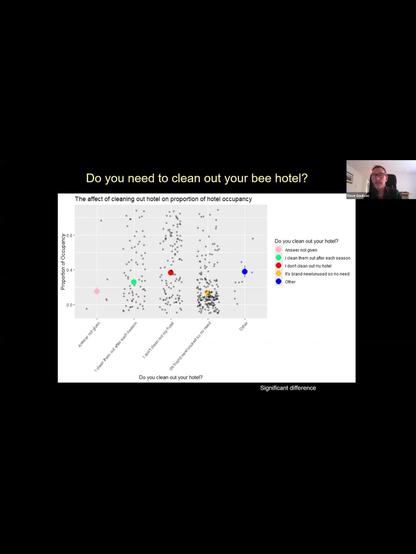
I’ve been following a citizen science project by Prof. Dave Goulson’s Buzz Club here in the UK. It’s collecting useful information on bee hotels.

It is in its infancy. Bee hotels do attract mites but as to should you clean out your bed hotel, the jury is still out on it.

Their data suggests hotels that weren’t cleaned out have more occupied holes.
#Bees #Pollinators

https://youtu.be/6c_YhzKD0mo?si=8AHM_AHH7EnCvPWU

@Broadfork my evidence is only from watching others do and show (on youtube) the results of not cleaning them (a lot of coccons dead and spread of mites to newer generations). Which is worth what it is...
I look forward to check the results from this study.

@MiguelGuerreiro I’ve seen some of those and mites are terrible for bee populations but I’ve not seen any year 2 onwards advice.

I’ll see how the bee hotels are in early spring next year. I can and will certainly clean them if need be. Or provide new ones.

I am conscious the time to clean holes is quite tight between new bees leaving the nests and new ones being filled.

I’m hoping better guidance can be provided based on practical evidence provided by such as the buzz club and Dave Goulson.

@Broadfork the women of rent mason bees (USA?), what she does is as soon as the old bees are done, and the coccons are ready (late summer, autumn?) she cleans the hotel racks and the coccons.

@MiguelGuerreiro I’m not sure how much relevance US or UK mason bee knowledge is to each other. I just use UK sources to be sure it’s relevant for what I do

I’ve seen US YouTubers using paper fillers and removing cocoons for storing. It’s interesting but that’s not something I want to do.

There’s good information in the lifecycle of UK mason bees in this link.

http://lambleys.co.uk/mason-bees-uk/

I’m interested to see if the holes the bees don’t use this year will be used by them next year & vice versa.

Mason Bees UK: A Practical Guide to Backyard Pollinators - Lambleys.co.uk

In British gardens and allotments, the humble mason bee offers a powerful, low-maintenance boost to pollination. Mason bees uk are non-aggressive, solitary bees that eagerly visit blossoms early in.

Lambleys.co.uk
@Broadfork huh! I follow Dave Goulson on youtube! Occupancy is not the same as fitness or survavibility of offspring. When I have time I will check this better, but thank you for the heads up!
@MiguelGuerreiro Yes I agree. I wasn’t trying to conflate the two issues. The biological recording company is a worthwhile resource to dip into.