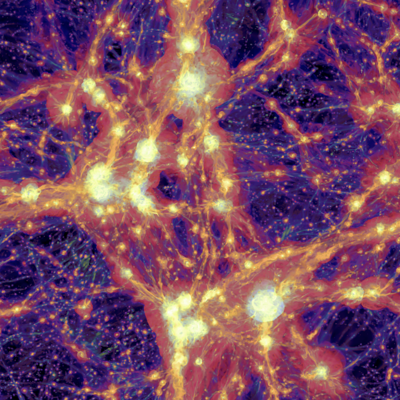
#paperday on #astroph

"The Impact of the Magnetised Cosmic Web on Ultra High Energy Cosmic Ray Propagation" by Allegra Firinu, myself and Carmelo Evoli.

We investigated the role of realistic extragalactic magnetic fields in deflecting E>1e18eV cosmic rays, effectively creating "an horizon" beyond which particles cannot reach us, as they are trapped by magnetic fields.

https://arxiv.org/abs/2605.02324

#cosmoMAG #astrophysics #astronomy #physics

The existence of a "Magnetic Horizon" has been surmised to make a sense of the strange sorting in composition of the highest energy UHECRs measured by the Pierre Auger Observatory, which is not predicted by standard acceleration models. But it could be explained if significant magnetic fields are affecting the propagation of 1e18eV particles more than of 1e20eV particles - which can happen because the deflection by magnetic fields scales as \propto E/B , where E=particle energy
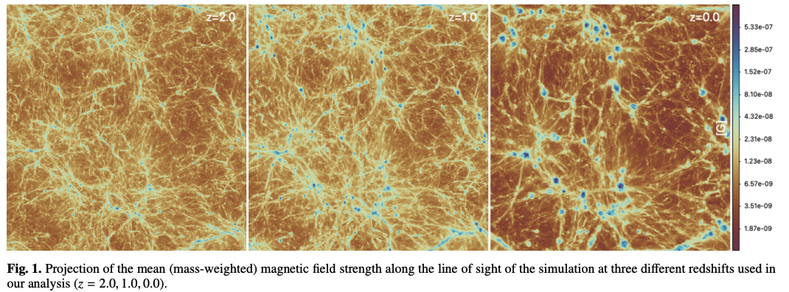
To study this process in detail, we used a set of realistic cosmological MHD simulations produced with the ENZO code, selected based on previous works comparing with radio observations, and featuring both a primordial field (0.3nG) and the seeding by feedback processes.
We analysed in sequence several snapshots from the same run, since UHECRs could have been injected in the ancient past.

To be flexible in our analysis, we designed and deployed a new code, fully written in #Julia , which injects and transports UHECRs across redshift and starting from galaxies in the simulation, and also apply energy losses to them.

It can run in parallel and is publicly available here:

https://github.com/FrancoVazza/UMAREL_PUBLIC/

The name is very important 😅
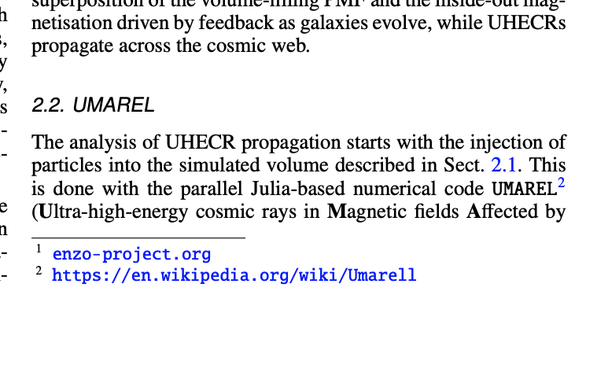
UMAREL=Ultra-high-energy cosmic rays in Magnetic fields Affected by Rigidity Diffusion and Energy Losses

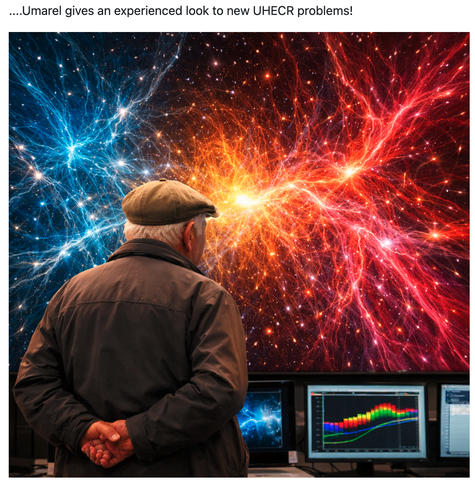
Also, #Umarel is a word that only exists in the area of #Bologna , and it identifies retired males who stars at construction works in the street, typical with their arms behind their back.

https://en.wikipedia.org/wiki/Umarell

So, our most important result is that the energy-dependent maximum propagation of particles since their injection, for what we believe is the most realistic model of cosmic magnetism, well explains the current UHECRs data!

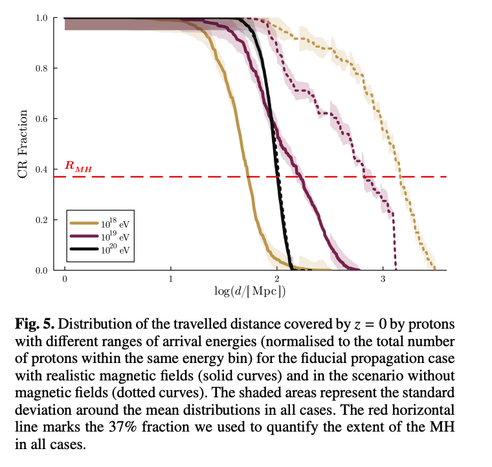
Magnetic fields introduce a modulation in the maximum distance covered by UHECRs. Usually energy losses with photon backgrounds (photo-pion or pair productions with CMB photons) are the limiters of propagation at high energy.
At low energies, it can be magnetic fields!

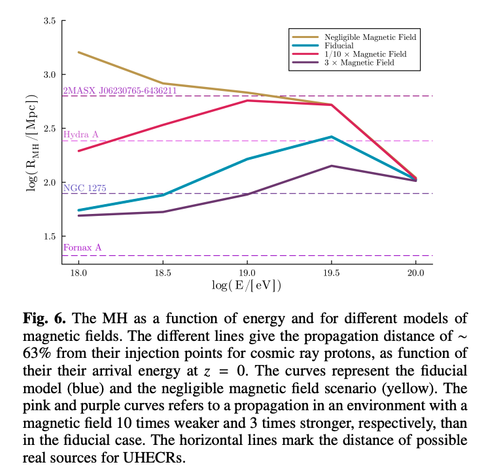
This summarises our results: it shows the effective "horizon" within which we could be reached by cosmic rays as a function of their energy.

At 1e18eV it's ~50Mpc instead of 1500Mpc in the case of no magnetic fields.
At 1e20eV it's instead the same (~100Mpc) regardless of magnetic fields, as loss process are the one making the horizon (in this case, the famous GZK effect - https://en.wikipedia.org/wiki/Greisen%E2%80%93Zatsepin%E2%80%93Kuzmin_limit)

This paper is the result of Allegra's Master Thesis work, and we hope to develop on this further; our UMAREL code allows us a few things which are not easy with other codes, like simulating the propagation of UHECRs as the background cosmic web is evolving for example, which is important because both sources and the magnetic fields evolved in the last 10 billion years.

It also allows us to inject CRs during the run, which is not possible in other codes.

The paper also shows that using a 3D model of magnetic fields dynamically evolved with the cosmic web does not give the same answers one can get using instead a simpler semi-analytical description of random magnetic fields (as usually in the literature).
Also: that the magnetic horizon naturally arise for the same primordial magnetic field model which we independently selected a couple of years ago based on entirely different data

-> https://mastodon.social/@franco_vazza/113519951147357770

@franco_vazza @Wittylama that’s one of the Wikipedia articles you started, right?
@mike_peel @franco_vazza yes! That’s so cool! I’m going to have to add that as a new footnote
@Wittylama @mike_peel 😅 ok a good result of the article already
@franco_vazza @mike_peel Returning to this... I know there is the ArchivX paper, but is there *any* independent publication that *specifically* mentions the reason for the acronym UMAREL? I would need that as a footnote to justify including this in the WP article. Even a blogpost will do.

@Wittylama @mike_peel 😅 not sure I understand...in this publication we introduced for the first time this code we wrote, and in the footnote within the article, we refer to the actual meaning, see figure.

We also created a github page where the connection is prominently explained (see bottom): https://github.com/FrancoVazza/UMAREL_PUBLIC/

@franco_vazza I've added it to the article now. See footnote 34.
What I mean is that: ideally, WP footnotes should always be "independent" descriptions of a thing, not the person saying it about themself (etc.)
So - if there is any independently published report *about* your work, that describes this umarel connection, that would be ideal.

meanwhile - art is imitating life and the WP article now references back to your paper ;-)

@Wittylama This is awesome, thanks!