I am starting a new topic today. As suggested yesterday it deals with commercial lunar missions (a loosely defined term here!), and much of it will be taken up with the Google Lunar X Prize, a textbook example of how not to plan lunar exploration or almost anything else. I start with a few precursors and end with the transition to the current CLPS program.

The first precursor has to be Harvest Moon: https://en.wikipedia.org/wiki/Project_Harvest_Moon

I described this in Moon Chronicle part 6, but ...
#moon #maps

Project Harvest Moon - Wikipedia

... I originally gave it the date 1973, and I have pushed it back to 1972 (revised part 6 will be available shortly). Harvest Moon was a concept involving flying a spare Saturn rocket and Apollo spacecraft to the Moon to return lunar samples for sale to collectors, jewellers and scientists, supposedly covering the cost of the mission. Hardware was 'spare' because 3 of the 10 planned landings were cancelled. The concept collapsed because NASA and the DOD would not support the flight.
#moon

Why not support it? It would go to the Apollo 15 site with that crew (they were already trained for it), but they were under a cloud because of a scandal involving postal covers ( https://en.wikipedia.org/wiki/Apollo_15_postal_covers_incident ). Also DOD would not provide the navy resources for splashdown, or NASA for tracking, mission control etc.

What would the crew do if Harvest Moon happened? According to space enthusiast Doug Van Dorn they would collect Apollo 15 hardware...
#moon

Apollo 15 postal covers incident - Wikipedia

... and go to the North Complex, a possible volcanic hill dropped from EVA 3 of that mission. These would be 2 walking EVAs. They would deploy some experiments including a biology module, an observatory and a science rover. The landing site would be between the Apollo 15 site and North Complex. The map suggests a smooth location in that area. The plan was unrealistic from the start.
#maps #moon
About 20 years after Harvest Moon a new crop of commercial missions appeared. Advances in computing, rocketry etc. suggested to some that a small company could do what only superpowers had done in the 60s - land a robotic spacecraft on the Moon. Our first case is LunaCorp of Arlington, Virginia. They teamed up with the Robotics Institute at Carnegie Mellon University in Pittsburgh who would provide rovers. They are an ancestor of today's Astrobotic, the CLPS company.
#moon
LunaCorp's rovers might have been used for science or more entertainment-related missions. The latter got more publicity. Live video and motion sensor data would control simulators on Earth to duplicate the experience of driving on the Moon. Simulators in theme parks would let the public 'join' the ride, and with safeguards customers might also drive the rover briefly. That revenue source would support the mission. It's a good idea, just not feasible at the time. Where would they go?
#moon
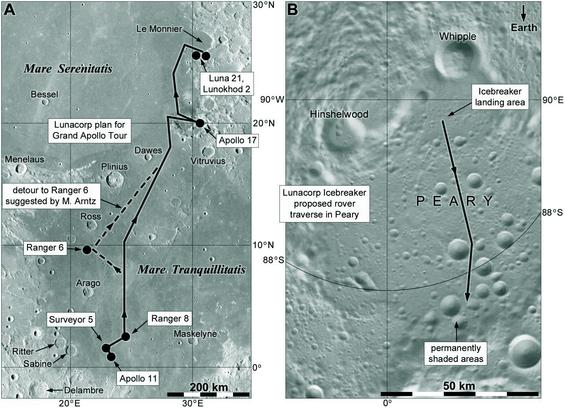
LunaCorp described a 'Grand Apollo Tour' which would land near the Apollo 11 site to view the LM carefully, not disturbing the historic site. They would visit Surveyor 5 and Ranger 8 nearby, then head north to Apollo 17 and finally to Lunokhod-2, 1000 km altogether. The map at left shows a schematic route with a side trip to Ranger 6 (a study by one of my students). A more scientific mission called Icebreaker is shown at right. It assumes space agency funding.
#maps #moon
The rover team at Carnegie-Mellon pushed these ideas hard. After LunaCorp couldn't raise the funds for it they proposed the idea to NASA's Discovery Program under the names Lunar Ice and Victoria. A later version, again private (i.e. not for Discovery), was called LunaQuest. All this came to nothing, except that Astrobotic is a direct descendant of these efforts. They will try again later this year with their big Griffin lander and two rovers.
#moon
Sorry I missed a post yesterday - technical difficulties at this end. To continue our story... I noticed I didn't put a date on the LunaCorp posts - this was all happening in the mid- to late-1990s. It failed because they could not raise the money. The same fate befell today's company, Applied Space Resources (ASR) of Hicksville, New York. They intended to fly a private lunar sample return mission called Lunar Retriever in the late 1990s.
#moon
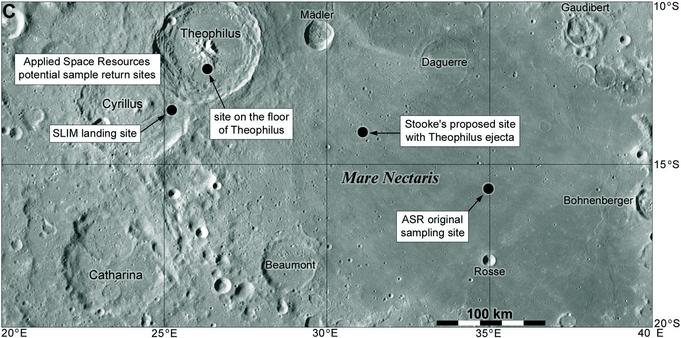
ASR would sell samples for scientific research and to collectors, jewellers or other commercial markets. They had plans for several missions with dog-related names like Lunar Husky. But where to land? The target, Mare Nectaris, offered mare basalts and Theophilus ejecta, which would include Nectaris basin rim material. The site shown on the company website was at 16 S, 35 E, near the middle of the mare. Dating Nectaris would be an important addition to the lunar chronology.
#moon
I knew the ASR people and advised moving closer to Theophilus to increase the amount of ejecta collected (near 14 S, 31 E). Later ASR talked of a scenically dramatic site just south of the central peak of Theophilus. This map shows their sites and the nearby SLIM site, also chosen to analyze Theophilus ejecta. But the money could not be found and the plans came to nothing. Our next mission will try yet another money-making strategy.
#maps #moon
Data sales are another strategy for making money from commercial missions. Transorbital, Inc. of La Jolla, California was set up in 1998 and planned a lunar orbiter and landers. The orbiter, in about 2001, would transmit high resolution images of the Moon and the company would sell or license data to space agencies and others (e.g video for movies, stills for advertising). The landers (called Electra) would also provide images for sale and might carry cargo for a fee.
#moon

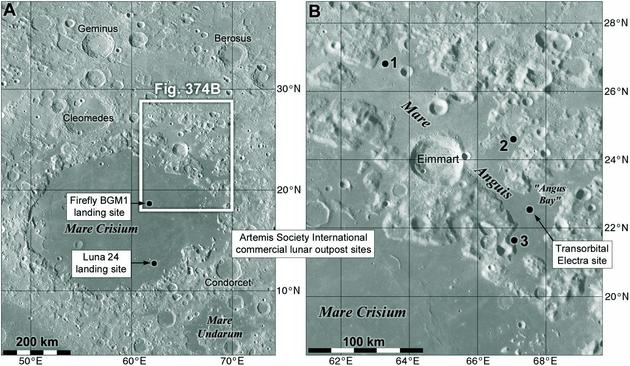
Transorbital was linked to a private lunar base initiative, Artemis Society International. One Electra lander could go to the preferred Artemis site in Mare Anguis just east of Mare Crisium (22.6 N, 67.7 E). The map shows 3 Artemis sites and the Electra site.

Needless to say, Transorbital couldn't raise enough funds to fly. These ideas are only just becoming feasible now - Firefly carried cargo and sold data like eclipse and sunset images to NASA a year ago.
#maps #moon

A few other ideas for private lunar missions were tried in the years around 2000. Perhaps the best-known was Blastoff! - another entertainment scheme involving three rovers:

https://en.wikipedia.org/wiki/BlastOff!_Corporation

All these companies suffered from the same problem: the difficulty of raising money. Investors were not convinced it could be done. How can we get past that? The X Prize Foundation decided to try again a few years later.
#moon

BlastOff! Corporation - Wikipedia

Prizes to spur innovation have a long history - the Longitude Prize, Lindbergh's Orteig Prize and others. The X Prize Foundation thought to follow those with new prizes for contemporary issues, and seemed to have succeeded with the original X Prize (later called the Ansari X Prize) for sub-orbital spaceflight:

https://en.wikipedia.org/wiki/Ansari_X_Prize

I won't get into the real value of what was accomplished by the winning team, but it did lead to a larger space-related prize...
#moon #GLXP

Ansari X Prize - Wikipedia

Google put up a $20 million prize (and more later) but the X Prize Foundation ran the competition, announcing in in September 2007. To win, a non-government team had to land on he Moon, move 500 m and transmit some specified data before the end of 2012. 20 million is not enough to do this so additional funding was always expected - sponsorships, sales of data or cargo delivery etc. Many space enthusiasts thought modern technology would make it possible. It was not to be.
#moon #GLXP

This story is a sort of Odyssey... but the Iliad contains a Catalogue of Ships:

https://en.wikipedia.org/wiki/Catalogue_of_Ships

So that is where we will start, with a Catalogue of GLXP Teams. What a varied lot they were, from serious teams run by aerospace professionals to people tinkering in their garages. I will present them in the order in which they joined the competition.
#moon #GLXP

Catalogue of Ships - Wikipedia

Just before we look at GLXP teams I should add some other details. The prize was $20 million up to the end of 2012 or $15 million up to the end of 2014. This changed frequently. In 2010 the deadline became the end of 2015. The prize would fall by $5 million if a government mission landed first, a condition dropped in late 2013 as China prepared its Chang-E 3. A second prize was added and more prizes for some additional tasks like surviving the lunar night. It got quite complicated.
#moon #GLXP
Now we can start looking at teams, with maps of landing sites where needed. We go in order of joining, and alphabetical order in groups joining at the same time. The first was Odyssey Moon, led by Bob Richards and run from the Isle of Man. It formed before the GLXP and joined as soon as it could. Alan Stern and Paul Spudis joined as advisors. Like all teams their fundraising was hurt by the 2008 economic crisis. In 2010 Richards bailed out (taking many of the team with him)...
#moon #GLXP
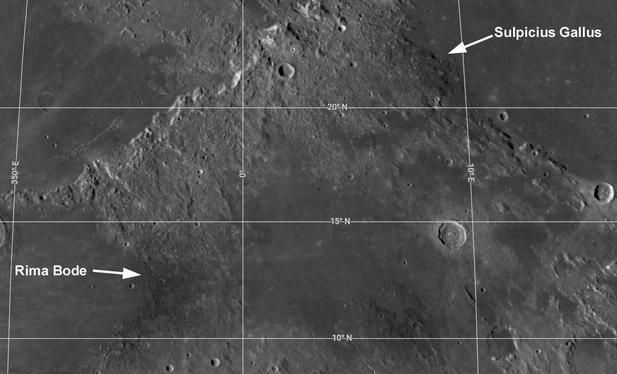
to form a new US-based team with better financial prospects. Odyssey Moon struggled to continue, and late in 2012 it merged with Israeli team SpaceIL and continued under that name. While it was operating the team mentioned landing in a dark pyroclastic deposit such as Rima Bode or Sulpicius Gallus. Apollo sites were considered later. The lander would hop to meet the GLXP movement goal, but later missions might use rovers or do sample return.
#moon #GLXP
21 February 2008: the first ten registered teams (including Odyssey Moon) were introduced at Google's campus in Mountain View, CA. One was ARCA (Romanian acronym for Aeronautics and Cosmonautics Romanian Association). Most teams planned to buy a launch but ARCA decided to build its own rocket, which never seemed very realistic. Their small rocket would launch from a balloon (and later a supersonic jet plane). These plans never came to anything. ARCA had been in the first X Prize...
#moon #GLXP
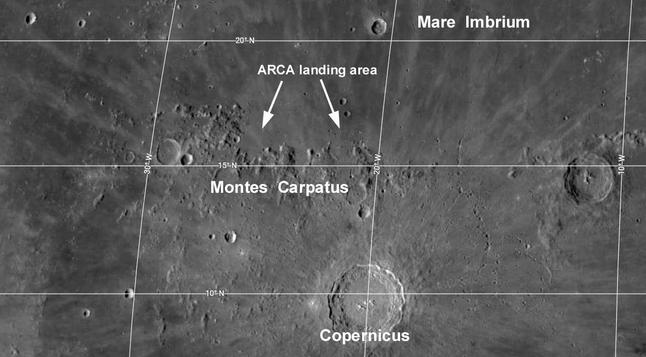
And they continued working on ever more tenuous plans after the X Prize ended, moving from Romania to the US and back. My main interest is always landing sites. Romania is home to the Carpathian Mountains so they decided to land in southern Mare Imbrium within view of the Montes Carpatus (named after the Carpathians, obviously... there's a story in that association, he said cryptically with an eye to a future post).
#moon #GLXP
Robotic vehicle expert William 'Red' Whittaker of Carnegie Mellon University had been involved with Lunacorp and the Icebreaker Discovery mission proposal, and now headed Astrobotic, our next GLXP team. Astrobotic persisted after the GLXP ended and is now part of the CLPS (Commercial Lunar Payload Services) program, one of a small number of teams who made that jump. We will spend more time on this interesting team beginning with their GLXP plans.
#moon #GLXP
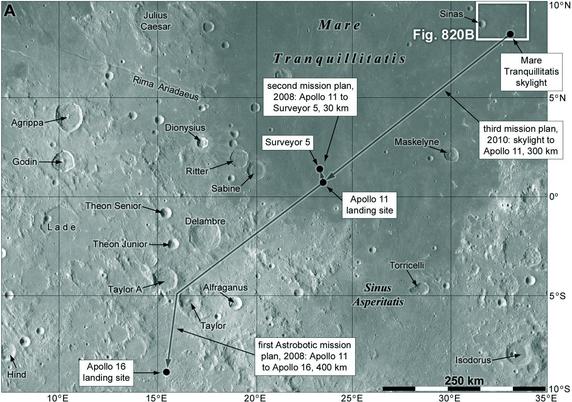
As initially described by Astrobotic, in a mission called ‘Tranquility Trek’ a lander named Artemis would deploy a rover called Red Rover about 500 m from the Apollo 11 LM descent stage near the 40th anniversary of that landing. The rover would in fact touch down just after the first lunar sunrise following the anniversary, on 26 or 27 July 2009. After examining the Apollo 11 site it would set off on a 300 km trek to the Apollo 16 site.
#moon #GLXP
The Astrobotic mission plan evolved rapidly during the first year, soon shifting to a shorter ‘Tranquility Trek’ of about 30 km from the Apollo 11 site to Surveyor 5. An Astrobotic video in 2010 showed the rover landing near the Tranquillitatis skylight, driving to its edge to view the interior, and then driving 300 km to the Apollo 11 site to view sunset near the LM. The map shows these 3 suggested missions. Their plans went far beyond this, as we will see.
#maps #moon #GLXP
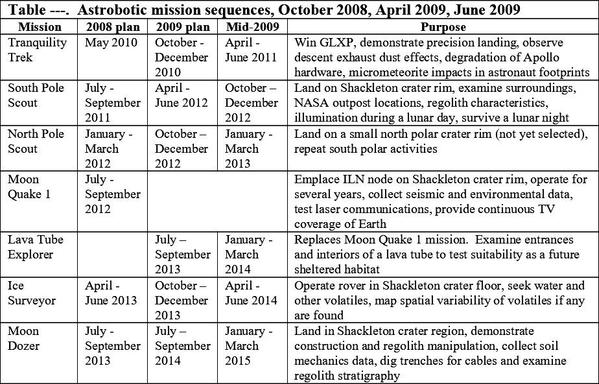
The rover missions we just looked at were for the first Astrobotic mission, to win the Google Lunar X Prize, but the team had ambitions far beyond that. This table lists several versions of their plans. The missions are more overtly for science or engineering development. Some might become Discovery or other NASA missions, others might support Constellation. The dates given are expected launch dates. This is only just becoming feasible today.
#moon #GLXP
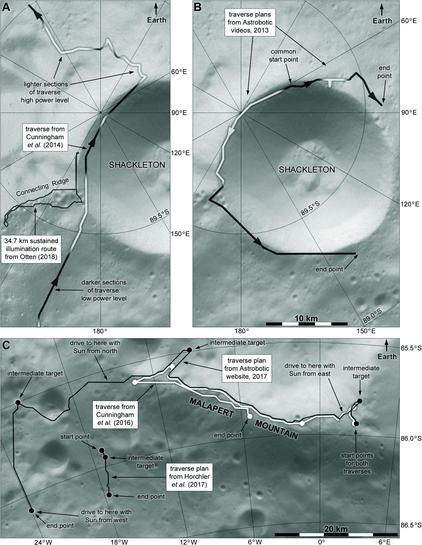
Astrobotic didn't just design rovers, they put an enormous effort into background research (e.g. chilling batteries in liquid nitrogen for lunar night survival). These maps show studies for polar missions, including power generation and traverse planning. This is only a glimpse at what they did, there is lots more. The 'sustained illumination route' is always in sunlight and they had other versions of it, farther from the pole.
#maps #moon #GLXP
The GLXP competition deadline was extended several times as funding difficulties continued. Tech optimism made some think that building a lander would be easy 40 years after Apollo, but it turns out there is a reason why space is expensive. Astrobotic amended its plans several times but they settled on exploring a skylight - a vertical entrance into a cave, especially a lava tube. The first examples were discovered in Japan's Kaguya mission data and LRO found more.
#moon #GLXP