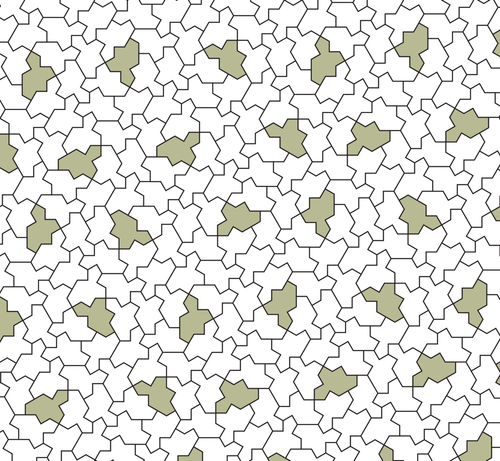
@revk @darkling it is counterintuitive! But you don't work out the location of a Spectre tile based on the location of its parent hexagon. You work it out based on the tile you're putting it next to.
In each run of the recursive transition algorithm, you start with a Spectre that has some list of parent hexagons, and you ask what's on the other side of one of its edges. For example:
"I have a Spectre which is child #0 of a G hexagon, which is child #2 of a Y hexagon, which is child #1 of a P hexagon. What's on the other side of edge #7 of that Spectre?"
The algorithm recurses up and down consulting its lookup tables, and answers:
"The tile on the other side of that edge is a Spectre which is the only child of an X hexagon, which is child #7 of an S, which is child #3 of the same second-level P. Edge #7 of your original Spectre meets edge #12 of the new one."
Now you place the new Spectre in your output diagram by lining up its edge #12 with edge #7 of the one you already had. You don't need to calculate it based on the coordinates of the parent tiles. Every tile you place is the neighbour of one you already had, so you place it next to that neighbour.
 RevK
RevK 

 Hugo Mills
 Simon Tatham