Since releasing my oil video I've had so many people claiming that renewables will never work and we need nuclear power instead.

What's odd is that almost all of the messages mention that nuclear power is the only solution for the "base load".

I have a degree in Electrical Engineering and I took several nuclear science electives. I like nuclear energy. But I received so much "base load" gaslighting that I started to doubt my own understanding of the situation.

@notjustbikes I wonder if those advocating so vociferously for nuclear are happy for the long term storage (by which we mean over timescales no human civilisation could ever hope to last) in their their back yard?

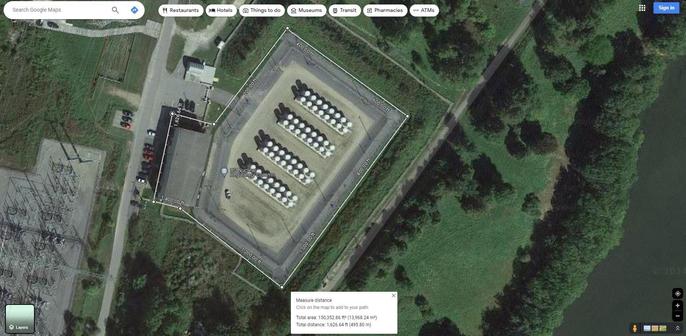
@cabbagebeets @notjustbikes I’d be happy to *eat* all of the nuclear fuel spent to generate the power I personally use in a year. People really have no concept of how energy-dense it is. This is an aerial photo of the storage for Maine Yankee Nuclear Power Plant, a plant which operated from 1972-1997, rated at 860 MW, with a lifetime capacity factor of 68.2% (so it generated ~586 MW on average). 25 years is 219,150 hours, so this plant generated ~128.5 TWh of power over its life. And this isn’t just spent fuel, it’s all the severely contaminated concrete and steel from the reactor, too. All in a grid about 100’ by 120’.

Last I heard, New York City’s power consumption is estimated at 60 TWh per year, so this picture represents all the waste from powering one of the biggest cities in the world for two entire years.

@cabbagebeets @notjustbikes New nuclear plants probably shouldn’t be built in most areas (people living close to or inside the arctic/antarctic circles may not have better options). Renewables are worthwhile, and should absolutely make up most new power generation. That said, all power generation has waste, and renewables have waste problems of their own which should not be ignored.

We don’t have cost-effective recycling for solar panels. When panels break today (hail, high winds, sand etching the surface over time, etc.), it’s much cheaper to dump them in e-waste landfills in Africa or Southeast Asia, where they poison the groundwater. Better recycling is on the horizon (How long have better nuclear reactors been on the horizon?), but it’s not here yet. Legal changes like making recycling mandatory could help, but most areas don’t seem to have the stomach for that.

Wind turbine blades are composite materials which probably can’t ever be recycled. The best disposal method we have for them today is grinding them up (which risks giving workers silicosis; see quartz countertop issues) and burning them for industrial process heat.

@bob_zim @cabbagebeets @notjustbikes

Online discussions tend to be a bit tough, as posters come from different regions and backgrounds.

But recycling of solar panels has been mandatory in the EU since 2012.

https://mm-markets.com/how-smart-regulation-kick-started-solar-panel-recycling-the-eu-model/

How Smart Regulation Kick-Started Solar Panel Recycling – The EU Model – MM Markets

@bob_zim @cabbagebeets @notjustbikes

The electrical power you use in a year would be equicalent to around 40g of enriched uranium. This would very very likely kill you.

"generating a 1,000,000 kilowatt hours (1 GWh), about the same electricity a person uses in their lifetime, requires 6.8 pounds of enriched uranium fuel."
https://www.freeingenergy.com/math/nuclear-fuel-uranium-weight-pound-kwh-mwh-m125/

"Uranium mainly targets the kidneys: [...] intakes of more than 50 milligrams can cause renal failure and death"
https://science.howstuffworks.com/science-vs-myth/what-if/what-if-ate-uranium.htm

#nuclear

How many pounds of uranium are needed to generated a MWh in a nuclear plant?

Burning coal creates a wide range of pollutants. Mercury is one of the more toxic byproducts found in coal ash. How much is produced in the US each year?

Freeing Energy

@billiglarper That’s talking about intake of powder or salts. Those forms can accumulate in the body, particularly in bones, where they can release energy over time. Spent fuel pellets are a refined metal, which the human body can’t really absorb at all, and the digestive tract doesn’t keep anything for long.

40g of uranium metal is a hair over two cubic centimeters. Split it in two, seal it with the ratios of lead and concrete normally used for spent fuel, and it would be two large pills, but not especially dangerous ones in any regard. Negligible risk of heavy metal accumulation. There could be an increased risk of GI cancers, depending on how active the fuel still is.