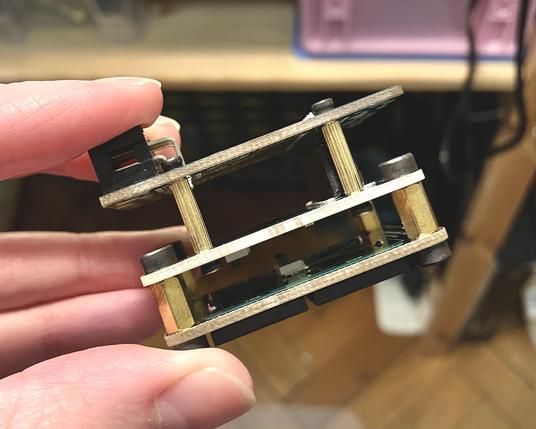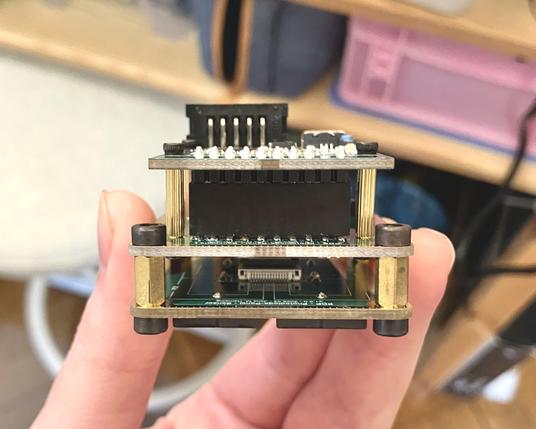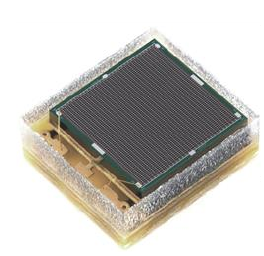
I was even more productive yesterday and assembled this cute stack!
It’s four Hamamatsu S1337-1010BR Si photodiodes with respective amplifiers. I want to add a scintillator, a light-proof metal casing and see whether I can use this as an energy-dispersive x-ray sensor, maybe even do energy-dispersive x-ray spectroscopy
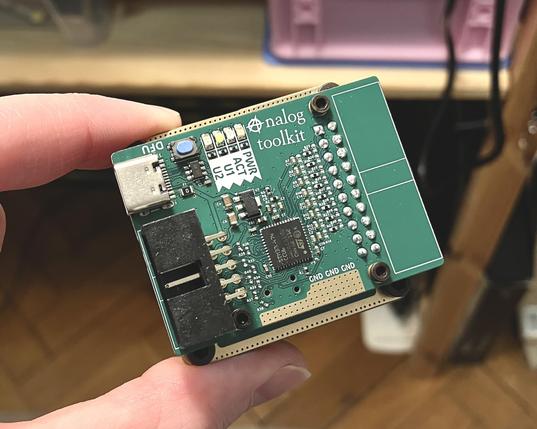
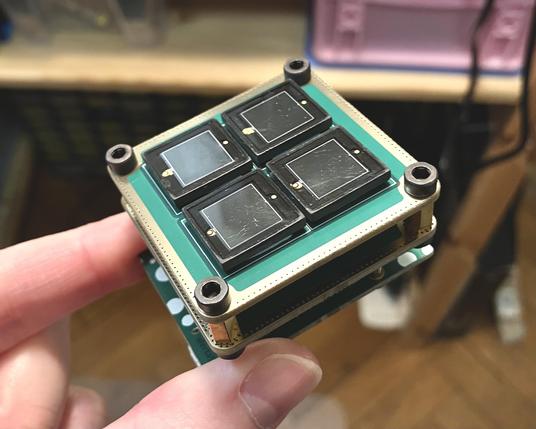
the analog toolkit really lends itself to be plugged onto a different board with 2.54mm headers at the bottom, I think I will do this more often.

I could also add a dedicated B2B connector, but I don’t think this is a big need, maybe I will add a footprint for size constrained applications

Oh, and if anyone here has input on scintillators and building an energy dispersive x-ray sensor in general, feel free to chime in!

@janamarie wie got plenty of plastic scintillator in Aachen.
How many kilogram do you need?
@cccpresser just a handful will suffice :D I would love to take some!
@janamarie @cccpresser But its "only" plastik scintillator, no idea how good it will performed when detecting x-rays.
@cccpresser i am also interested. Would like to build muon detectors :-)
Any possibility to send a few to me? Would cover the costs + Mate fee :p
@janamarie Looks good!
Unfortunately I am very sure this won't work for EDX, or any kind of spectroscopy.
With scintillators you're counting single photons at those energies, and the diodes just leak way too much to get those tiny signals out of your regular shot noise.
Photodiodes can generally be used for x-ray detection, but with the S1337 only being PN as opposed to PIN their active region is tiny, and they have a high capacitance which just introduces noise.
@gigabecquerel thanks! And aww, I almost feared something like that! Can you recommend a different diode? I’m happy to update the sensor board to try a different one

@janamarie As crappy as its reputation may be, I've seen some people pull fantastic x-ray spectra from regular old BPW-34!
But the real magic is in the preamplifier and following signal chain, the detector itself is just one part of the whole system.

check out this paper, as an example:
https://www.researchgate.net/publication/229038928_X-Ray_Spectroscopy_with_PIN_diodes

@gigabecquerel oh very nice, thank you! Yea I will certainly update my board(s) with with the papers findings and different diodes! I think I will see if I can get this board up and running first, get a feeling for the whole measurement process and maybe do the metal-parts first, but I will certainly keep your recommendation there!
@gigabecquerel @janamarie
BPW34's are amazing little devices for many things.
Friend also used one in his free space laser communications receiver.
And I know of at least one funny spectrometer build that had one.
That one also had significant thought spent on the preamp.

@janamarie very nice!

Those are quite large photodiodes, no?, For non-photovoltaic ones at least!

@ari yep! 10mm2 sensing area!
@janamarie Very cool project! What kind of amplifier are you using? We have been thinking about a DIY EDX for our SEM for while now...

@stdlogicvector @janamarie I copied this design from muonpi.
https://gitlab.ccc.ac/cpresser/sipm-preamplifier

(The description is wrong and needs updating, the latest version uses onsemi SiPMs)

It works well, I can see a nice finger spectrum.

cpresser / SiPM Preampliier · GitLab

SiPM preamplifier using a BGA2818 MMIC chip.

GitLab
@stdlogicvector I will publish the schematics sooner or later! Not much thought went into this yet, it’s a simple op-amp based amplifier with diode biasing, but the amplifier board is different to the diode board, so I can update it with a better driver at some point
@stdlogicvector if you have any input, please share, would be happy to read more into such amplifiers!

@janamarie I only have a little bit of experience with logarithmic transimpedance amplifiers for measuring light level. And I did one charge sensitive amp design for a PMT in a gamma spectrometer. One of the many projects of which I should at least publish the schematics and firmware...

That's why I shared your post with gigabecquerel as he is my go-to expert in all things detector related!