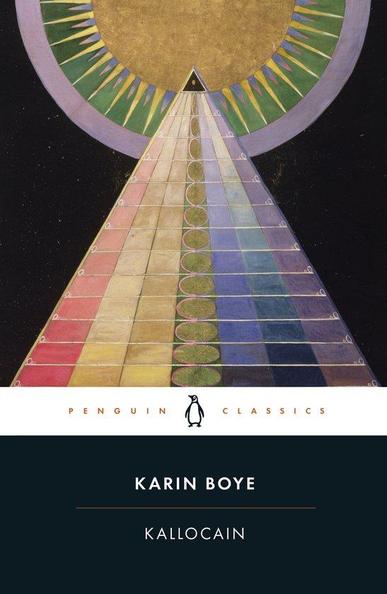
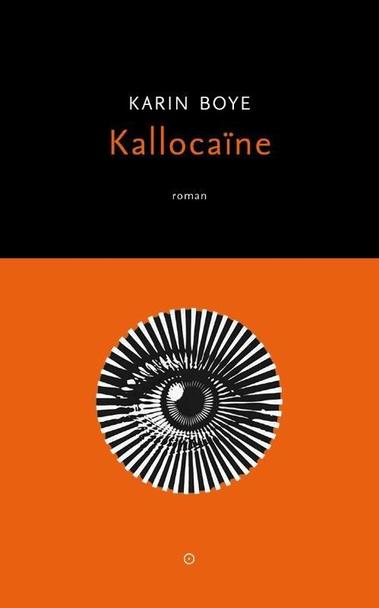
๐Ÿ“˜ "Kallocaรฏne" by Karin Boye, translated from Swedish into Dutch by Bart Kraamer

Available in English as "Kallocain", translated by David McDuff.

Although I wish to spread the love of reading all the time, sometimes it's difficult. Especially now, when books feel simultaneously more important than ever in this fascist landscape, but also frivolous to focus on when war is waging. I've also been distracted by a new health issue that sadly requires some medical attention (I'm fine), filling my head with new questions like "will there still be gas to drive to the hospital?" and "what if the bomb drops when I'm under sedation?". Every day I feel overwhelmed, scared, angry and upset.

Instead of screaming about the US and Israel and their allies and all of the horror that they've been causing, and all the other countries who passively stare at it all (please EU, just follow Spain's lead), let me just scream about this book instead of spiraling even more. This novel that unfortunately fits so well in this terrible year.

I was surprised that I had never encountered this book before, since it's a dystopian classic that could (should!) be as well-known as 1984 and Brave New World, but sadly isn't (yet!). In it we get to read the written report of a chemist, living in a totalitarian state that is supposedly at war with a neighboring state. It's a collectivist society with long work hours and barely any opportunity for free will. The protagonist has just invented a serum that forces people to express their true inner life, effectively making thought crime something that can be acted upon.

This is obviously a sad book, but it has so many strong points. Despite its deeply developed, bleak world, there's no info dumping. As the reader you slowly learn about how the state is run throughout the novel, and every time you realize something new about its inner workings, no matter how much it's in line with everything, it's still shocking. The protagonist is just as interesting as the worldbuilding: utterly convinced of the righteousness of the state, proud to be a cog in the machine, yet ever so self-centered and hypocritical. What an interesting, complex combination of a personality.

There was one scene that I can't get over, it was so artfully done. Being vague to avoid spoilers, it's essentially a scene in which the protagonist thinks he'll gain total power over another person. But it plays out differently, in such a way that the power dynamics completely switch around, and the protagonist is the one figuratively stripped naked and vulnerable. I was just as surprised as the main character was at that point. Loved it. People could be writing 20-page essays about just that one scene.

In an odd way, I think the book is not only depressing, but also hopeful. Not in a pushy way, but... a truth serum could be a double-edged sword. What if everyone's truth in a bad regime is that they're afraid, tired and miserable? What does this knowledge do to another person, especially if you're used to a world that's so dangerous that you've never been able to know anyone's true thoughts besides your own? Food for thought (secretly, in the privacy in your own head -for now).

Kallocain was written and published in 1940, clearly inspired by the war, by Hitler and Stalin, maybe even by their divvying up of parts of Europe. Dark times, not unlike now. The author committed suicide in 1941. Reading that made me sadder than reading the book. Do you feel like this too, like we're always losing the good ones, the ones who understand and can pierce through the nonsense of this world, the ones who are needed the most?

I feel like after all that heaviness, I should conclude with something optimistic, but I can't think of anything right now. Maybe people will come to their senses. Maybe something good will come of resisting. Maybe certain people will have a deadly heart attack soon. Maybe we'll encounter the man in the high castle, and he will ask us to transport a tape, and on that tape we'll see...

A girl can dream.
#WomenInTranslation

@reading_recluse sorry to hear about medical adventures, fingers crossed. ๐Ÿคž๐Ÿ™๐Ÿ––

Book sounds intriguing, I'm cautious to take on something so dark(?) but will probably at least begin it.

@mediaevalfishsandwich Thanks. It's been a lot of fun to be the only masked person (as usual) in all of these medical settings, sigh. ๐Ÿซ 

The book is very dark, yes, but it's also maybe soothing (at least to me), the idea that if everyone was being honest, they actually dislike their life and feel empty with how the world is and yearn for something better, for true connection and meaning.

I always wonder in daily life about others: is this world really enough for you, are you satisfied with this, does it hold up if you had to inspect it carefully? People often claim they're happy as long as they have jobs, entertainment and access to shopping, but really, would that answer be the same under a truth serum? Who knows.

@reading_recluse maybe soothing along similar lines to "I Who Have Never Known Men"?

Pretty sure "Kallocain" is nothing like this, but the premise also made me think of Jim Carrey movie "Liar Liar". I didn't take the movie so seriously, I was like "oh he can't lie, social chaos", but the guy I saw it with observed that it was more about what he believed to be true, and he didn't even know what he believed himself until he was cursed to tell the truth.

Then I wondered if people receiving hypothetical truth serums would often be very surprised themselves to hear what they would be forced to reveal?

@mediaevalfishsandwich Hmm, soothing in a very different way. But if you mean it more generally like 'depressing book but can give positive feelings too' then yes.

Yes, I wonder too. Is there even something like an objective truth in a human mind? I don't really know, but I do know of moments where I didn't realize something was true for me for a long time until suddenly I did. Was I fooling myself or simply looking away? Could a truth serum reach that truth or just my consciousness that was coping around it? I hope it remains a mystery, haha!

I can't really disclose the book's take on it, since it would be spoilery.

@reading_recluse yeah more in depressing book elicits positive feelings way.

Yes let's not develop this sort of truth serum!

Your layers of consciousness/buried truths; random detour "The Righteous Mind" by Jonathan Haidt (which I don't really recommend, primarily because I'm prejudiced against his idea that USA conservatism is more moral because it satisfies more areas of the morality schema he invented, but also because when I checked the papers he referenced, some of them weren't saying what he said they were saying, or had been since invalidated, deep breath ๐Ÿ˜ฎโ€๐Ÿ’จ๐Ÿซ) promotes idea that the conscious mind is always playing catch up. His analogy is elephant and rider, elephant (brain) goes wherever it wants, rider (perceived consciousness) makes up explanations afterwards. Truth serum gets ever more slippery, if the rider has no access to the elephant's motives.

Well I really want to read this book now.

@mediaevalfishsandwich Ah, that's an interesting comparison (don't worry, I won't read his book, haha).

It sort of makes me think of "The Hidden Spring" by Mark Solms (I don't know if I'd fully recommend it either, but it's interesting and I think about it often) in which he argues the basis of consciousness is the brainstem. Besides the obvious point that it would mean all animals have consciousness, he mostly focuses on the organism as it has evolved into a closed off system (inside/outside).

The body has senses to gather information from outside, it has a brain to process the information and act on it. But for some (evolutionary?) reason processing has become favorable (?) if there's a consciousness that can develop a thinking mind that can process some of that information in unexpected ways. But the brain as a whole is still the main apparatus, only 'giving' part of what's being processed to the consciousness.

Maybe I'm arriving here in a bit of a convoluted way, haha, but I think in that way the mind is just a worker kind of playing catch-up as well, or at least only being aware of a part that's going on.

Now that I'm typing this -isn't it quite visible with something like (c)PTSD as well? You can think all you want, but if the body spots a trigger it can react with a survival mode before you've even registered what has been spotted. Would a truth serum for example result in that person saying 'there was a red car, there was danger' or 'I don't know why I reacted the way I did, I have attacks like that sometimes'. ๐Ÿค”

Anyway, I love it when books cause me and others to look at questions like thesd, haha.

@reading_recluse All very interesting, will make note of "The Hidden Spring".

I'm also somewhat-to-fairly on-board with the elephant/rider or brainstem/mind order of participation. And yeah, so much going on in brain we aren't aware of.

There was a particular older study I can't recall, but found a more recent substitute, even mentions PTSD, showing brain activity pointing towards a decision before the decision had been conciously made:
https://www.unsw.edu.au/newsroom/news/2019/03/our-brains-reveal-our-choices-before-were-even-aware-of-them--st
https://www.nature.com/articles/s41598-019-39813-y
But I don't dare to extrapolate too much from it, I always feel that our knowledge of the brain and thought is still in quite a primitive state, and influenced by our cultural baggage.

Drifting off even further, I also don't think language is particularly central to our intelligence, we are apes with ape intelligences, human language is a pretty recent thin additional layer. When I interact with animals, I'm personally close to certain they're conscious as well. So I think LLMs will never lead to AGI, as they're a poor simulation of something that's not even relevant. When I visualise some mechanical problem in my head, a crow could do that, or an octopus, or another primate, but an LLM would be about as likely to visualise it as a teaspoon.

If the truth serum only gets the rider's POV, maybe that's like interrogating an LLM? Just plausible sounding nonsense. Wow I'm really in the weeds now.

Yeah fun to speculate!

Our brains reveal our choices before weโ€™re even aware of them: study

UNSW Sites

@mediaevalfishsandwich Regarding "The Hidden Spring", about 75% of the book is about organic beings, which I think is a good read, and the rest is about tech, which I think is a bad addition to the book (especially in these LLM times!). So yeah, only a 3/4 recommend, haha.

Those linked studies are pretty interesting. But I also agree, it's all a start and there's still so much unknown. I like research like this, but I also kind of dislike it because I've met too many annoying people who go "you can't blame me, we don't have free will after all!!!!" at anything. ๐Ÿซ 

I'm one of those infamous vegans who believe in animal liberation, so I also think any studies going into proving non-human animals are conscious stick easily with me! ๐Ÿ˜…

Language is endlessly fascinating. I don't know how central I'd put it to our intelligence, I don't think I know enough about it. Your LLM point sounds very reasonable. But I do think it's a special thing, the way language emerged and is used to pass on information through generations and centuries, making knowledge accumulative. Language might not be at the core, but it's certainly a nice addition (says a biased book nerd). ๐Ÿคญ

Either way, I hope you'll get something out of the novel once you get to it. I think the scenes in which people are dosed with the serum are the ones that really pulled me into the book.

@reading_recluse Apologies, your book thread. ๐Ÿ˜… Can of worms, here's a can opener! ๐Ÿฅซ

I also clearly don't know enough about these topics. Feeling the ND(?) need to not be misunderstood, language is also very important to me, I don't discount it. Accumulating and transferring knowledge is certainly something humans have taken to a level beyond other animals. More thinking that if I were living 50k years ago, I wouldn't have access to literature, I would have language, but most of my intelligence might be occupied with my senses and my body, particularly my hands. Direct awareness of my environment, smells, tastes, weather, seasons, physical threats, vegetation, animal spoor, animal behaviour, flint knapping, trap making, food processing, water sources, faces/emotions of my group.

Free will! What's the saying, all models are wrong, some models are useful? Whether the decision bubbled up from the elephant, or the rider had some input, even if the decision belonged to the elephant, maybe the elephant has free will, and the rider is just upset about losing the spotlight! But I've completely tied myself in knots here, another topic I wouldn't dare to be confident about.

OK I now have a copy of the book! Ready for my truth serum injection! ๐Ÿซก

@mediaevalfishsandwich No worries, long comments always welcome on any book post, haha! And also no worries, I also (?) have a tendency to over-explain in fear of not being clear enough, sometimes it's hard to know what comes across how within the limitations of online comments. But I get what you mean, or at least I think I do (and agree)! โ˜บ๏ธ

Excited to hear you've got a copy! Enjoy (or eh, don't despair too much? ๐Ÿ™ˆ )

@reading_recluse well that was a read!

Very interesting to read your review again, yes the specific scene you mentioned. ๐Ÿคฏ

Also:

The protagonist is just as interesting as the worldbuilding: utterly convinced of the righteousness of the state, proud to be a cog in the machine, yet ever so self-centered and hypocritical. What an interesting, complex combination of a personality.

Yes! How timeless it is, I have seen this person many times in my life.

@mediaevalfishsandwich You read it so quickly! ๐Ÿ˜„

And yes, I wish I hadn't seen plenty of such people either. I think it was interesting to see how someone acting like that would be justifying it all or make it make sense for themselves in their head.

The serum being called after the main character is too funny. I wondered why the regime would allow such an individualistic thing, but maybe it did it exactly to keep men like him happily in their place (which seems quite timeless too ๐Ÿ˜ฌ).

I wondered too if the book might be harder to read for someone who's a parent. Once you learn about the way the children are brought up and how connections are severed, oof...

@reading_recluse Harder for a parent, maybe? I'm not sure. I found the entire world quite horrifying (as intended), I suppose Linda's reflections on parenthood as her feelings evolved over the three children humanised her, it was almost a lighter point of the book for me, but I could see how it could be taken another way.

The strange thing is that I almost almost feel that way about the world today, living in the real 21st century, as opposed to the novel's imagined 21st century.

It is very hard for young people who want to start a family. The price of a place to live now almost dictates that both parents must work. Many people cannot find work where they grew up, so must move to city, then lose direct support of their parents (to look after children, even if the grandparents are willing). So many children must be in daycare from a very young age, then in kindergarten, then in school, learning that their life is not theirs to control, they must obey the clock, obey the arbitrary rules, wear the uniform, learning to be a good factory or office worker. With the addition of uncontrolled COVID, now the children must also acquire brain damage and other health problems, and the parents are forced to participate in this, this is my horror of the 2020s. But of course we have many other horrors to choose from currently!

I think the lack of explanation about the world made it a stronger novel, there was a sense of a large unseen world around them, and we could imagine whatever technology we wanted to fill in the gaps. (One scene that overtly wouldn't fit our world was when he had to wait two hours for his card to be checked, as there were buildings of card indexes and files to sift through.)

I was very interested in the group of people who would symbolically place an unsheathed knife down and then go to sleep, trusting each other not to do harm. I envied them as well, I wish that I could trust a group like that.

(Oh the Voluntary Sacrificial Service also reminded me a little of "Never Let Me Go" by Kazuo Ishiguro.)

After finishing, I read the Wikipedia article, and that put me onto the novel "We", so might have a look at that when I've recovered a bit.
https://en.wikipedia.org/wiki/We_(novel)

We (novel) - Wikipedia

@mediaevalfishsandwich I really liked reading her thoughts on parenthood, it's interesting to read you thought it was a lighter point as well.

I can get behind feeling at least partially like that today. I'm of the age where everyone is having young children and I simply can't imagine it. How to afford it, how to arrange it, how to create a human being and protect them in a world like this one, possibly handing them over to covid and hate and the labor machine and uncertainty and climate collapse. I'm thankful for not having a desire for having children, so I don't have to bear the sorrow of not having one, although that feels like an odd thing to openly say and be happy about.

And I agree, about the worldbuilding, although one could maybe read the waiting as a deliberately designed thing to make a person nervous or feel like they've been put in their place.

The vague group was great. Now that you say it like that, I feel a little envy as well. Such a restrictive world, and still they could find each other.

I also thought it was funny, the disgust at them having discovered handshakes were a thing in the past and reintroducing it among themselves as a greeting. So intimate, how could they!

And the desert city... Who can get the possibility of the desert city out of their mind? I like how I'll never know about the desert for sure, never know more about the world, not even about the invasion? take-over? war? attack? bombing? gassing? victory? -I live for ambiguous endings that leave me to wonder and speculate on my own.

(I read "Never Let Me Go" by Kazuo Ishiguro a long time ago, but I liked it. I hadn't thought of that link. But yes, I do feel the same sadness for them.)

"We" has been on my to-read list for years, but I feel a little intimidated by it. I might pick it up if I spy you reading it. ๐Ÿ‘€

@reading_recluse Yes, if I look at a globe now, where is our desert refuge, where can we go? (I have to stay and fix where I am now?!!๐Ÿ˜…) And his surprise discovery that one of his students spoke the language of the invader, and their political ideas about human evolution, and the way everyone was sorted geographically by aptitude, often never to live in the place of their birth, I wondered if they had effectively eliminated daily racism in this world, leaving only racism against a vague notion of a distant unknown enemy.

Did the character names give any clues about language group origin? (Knowing very little about European languages myself.)

Yes handshakes! Feels a bit different post 2020! Somehow recognising each other, how did they do it?

I can certainly understand being reluctant to reproduce even if desiring to do so, and also being thankful for not desiring to reproduce. No one could say there aren't enough humans already. I am not a Cornucopian, for me it seems blatantly obvious that we must learn how to shrink.

I could not help comparing World State to my life. Thinking later about the book, and going way way off track, NAIRU is another horrific aspect of this modern world that most people look away from. The assumption in World State is that every cell (person) will at least be given food, shelter, and work; even if no freedom. In my 21st century, the assumption is that 5% of job seekers MUST be forced to live in poverty, to keep wages down. Like Omelas, but one in twenty suffering, not one child alone. We must pass homeless people under bridges in winter and fear a similar fate for ourselves.

Which is to say if I were able to read this book in 1986 (magically knowing Swedish), I would have completely different feeling about it, sort of an unconscious smug comfortableness that I was living in a modern progressive world with humanist values and safety nets. But in 2026 I don't feel like that at all. It all gets very complicated, it's not to say there were no improvements, one example I'd say community attitudes around race/gender/sexuality are generally a lot better. But food and shelter security is worse.

(As it turned out I read the Gustaf Lannestock translation, I'll try the David McDuff one if I reread.)

@mediaevalfishsandwich Ohh, regarding the names, there is a small afterword in the Dutch edition I read (without credits but I think it's from the translator) that explains the random character name choices. I haven't returned the copy to the library yet, so I'll quickly (sloppily heh) translate that paragraph into English for you here:

[Because Germany had already occupied Norway and Denmark at the time of writing] "For that reason, Boye was worried that her book would draw the attention from the [Swedish] authorities. The authorities tried to hold back anything in their country that could provoke German occupation. Therefore, she gave her characters all sorts of names from all sorts of languages, except German. She even considered giving everyone a Chinese name (eventually only minister Tatjo and censor Hung Paipho made it into the published version), hoping that it would have a 'neutralising effect' on the text. Another precautionary measure was to give the book the subtitle 'novel from the 21st century'. In the end, the Swedish authorities did not pay any attention to the book."

Not to go all Marxism go go, but it's time for people to consider the deliberate reserve army of labour, haha. But today, I don't know where it will lead. One in twenty already feels too outdated. In my country unemployment benefits have been severely decreased and even cancelled for many, and in official stats there are seven unemployed people for every job vacancy. A suffering homeless person used to be a motivator to keep in line, now it feels like an upcoming inevitability for many. How can we keep in line if there are fewer and fewer spots in the line every day?

In World State there appeared to be a desperate shortage of people and workers, making it possible to 'utilize' every person. In many countries the birth rate is declining and there is this (frustrating) moral panic about it. Will it ever lead to everyone being able to be 'used', or will there always be a structure of a suffering surplus (especially with the whole 'AI will kill your job just you wait' spiel going around), or will we never know because some war or ecological disaster will take us out before we can get to that point? ๐Ÿ™ˆ

Now that I'm writing all that, I wonder if Boye chose this shortage of workers in World State because of the start of WWII, and the expectation that there would be so many dead that there would be a significant shortage of people in whatever order that would be created in the war's aftermath.

Going more off track in pulling the 'what did the author think' thread, I also wonder if the ending, with the second regime being probably different but also more of the same, was Boye's fear of looking at Germany, looking at the USSR, and thinking: who even cares where we end up, it will be suffering either way, oppression in different wrapping paper. But maybe I'm speculating too much about her state of mind in 1940.

As with every dystopian I read, I'm like: well, glad I live in the here and now. Wait... am I?! Uhm.

(If I reread, I'll probably see what the most recent English translation is like, to see if it differs from the Dutch one. I hadn't noticed that there were multiple English translations before you mentioned it!)

PS: I feel silly that I was shocked, but the way you find out that Rissen was reported by multiple people, so it wouldn't have mattered if the main character had succeeded in withdrawing his complaint... ๐Ÿ’”

@reading_recluse Oh thanks so much for translating the names note, really appreciate it! Very interesting.

Re: Marxism, it's funny/peculiar (or not) that only the Marxists/Socialists here ever took the pandemic seriously long term. The Socialist Party locally was the only party to campaign while wearing masks. Seven people for one job. ๐Ÿ˜–๐Ÿ˜ฉ

Earlier in the pandemic, I wondered if there would be a labour shortage coming in a few years, due to increased disability. There's been a slight effect. I really am baffled by many aspects of it now. To be quite brutal, many jobs in the city are just makework, whether they are performed well or not doesn't really matter. But unfortunately if people don't commute and sit in the chair and look at the screen, they don't quality to eat or be housed. Then "AI" is said to be coming to increase desperation for those jobs, as you say. I look forward to the data centre bubble popping.

In 2020 here, everyone was housed and fed. Homeless people were put up in the empty hotels, some of them were even able to use that reprieve to rejoin mainstream society long term. But of course they were put back on the streets when they were no longer feared as a source of contagion. The common observation that 2022 onwards feels like revenge from the parasite class, all hope from 2020 must be purged.

What you say about possible allegory of being stuck between Germany and USSR makes sense to me.

Yeah I don't think I would survive long in World State, executed for asociality or something. Glad to live here and now or not, gee that's a tough one, maybe if I could have been born just post WWII? Well whenever one happens to be born, it's not personal, nothing to be done about it.

Yeah poor old Rissen, his equanimity drawing resentment from all over. Funny that the youth (in earlier serum scene) said maybe Rissen could have been one of the people at the meetings, but Kall absolutely could not.

@mediaevalfishsandwich Yeah, the general thought shift from "many people will have long covid and/or brain fog soon so there will be more jobs for those who don't" to "oh shit I'm laid off and so is everyone else I know" that I've seen online has been brutal. I can only dream about the AI/data centre bubble popping, I'm sick of it. So much damage has already been done.

It definitely feels like that, like all hope from 2020 must be purged. It makes me sad to see it being successful. It seems like so many of the general public have a 'never again'-attitude to responding collectively to prevent harm/disaster on a global scale. The gas pumps are empty and everyone's joyriding (I wish that was a metaphor rather than something I mean literally).

Doesn't every non-post WWII generation secretly dream of being the post WWII generation? ๐Ÿ˜†

Surely Rissen was magically saved from his circumstances at the very last minute, and now he's on his way to the desert city. Surely. ๐Ÿซ 

@reading_recluse The invaders smashed the prison walls to rescue their comrades. Rissen slipped away in the confusion, joined up with other friends of Reor and those who did not lock their doors, and they began a journey into the wastelands. ๐Ÿ™Œ

Regarding joyriding, gas pumps, and everything else, reminds me of THE LAST BIG GULP - Jello Biafra and The Guantanamo School Of Medicine:
https://www.youtube.com/watch?v=F6Lz1H8E1Eg
Is it an extinction burst, in the sense that the old world is thrashing around refusing to die quietly, and we eventually get past it, or is it an extinction burst in that we become extinct?

Doesn't every non-post WWII generation secretly dream of being the post WWII generation? ๐Ÿ˜†

Ha ha, perhaps they do! ๐Ÿ˜… (I guess the geography is quite important too, I don't want to do 1949 in China, though maybe China is a very reasonable place to be now.)

I can't think it was all roses back then, if I try to pin it down a bit, I would guess because of a sense of optimism, that even if it wasn't so great at that moment, many people at many levels were trying to make things better. 2026 feels like many people are actively trying to make things worse, and suck the last bit of juice out of the fruit before throwing the husk away. The upward pointing arrow is now pointing down. Maybe over extrapolating from my own circumstances.

Our version of looking backwards to the Golden Age, and waiting for a new Age of Reason/Enlightenment, or something? I hope it's cyclical, and enough of us could eventually think "this is tiresome, lets try something else".

Edit: There are at least two Kallocain fics on AO3 ๐Ÿ˜‚ , but they are Kall/Rissen slash ๐Ÿคฃ๐Ÿ˜‚๐Ÿ˜…๐Ÿ˜ญ๐Ÿ™, where is the desert fic!!!!111????//

THE LAST BIG GULP - Jello Biafra and The Guantanamo School Of Medicine (Music Video)

YouTube

@mediaevalfishsandwich Ohh, I'd love to read that. Please, someone write it, hahah!

I have to admit I ran to AO3 to read both. I didn't like 'You honour what you love to no end', but the one called 'A New Spirit' was a fun read! "๐‘…๐‘–๐‘ ๐‘ ๐‘’๐‘› ๐‘ค๐‘Ž๐‘  ๐‘ ๐‘’๐‘Ÿ๐‘’๐‘›๐‘’ ๐‘Ž๐‘  ๐‘’๐‘ฃ๐‘’๐‘Ÿ. ๐ป๐‘–๐‘  ๐‘’๐‘ฆ๐‘’๐‘  ๐‘ค๐‘’๐‘Ÿ๐‘’ ๐‘๐‘™๐‘œ๐‘ ๐‘’๐‘‘, ๐‘Ž๐‘  ๐ผ ๐‘ค๐‘–๐‘™๐‘™ ๐‘›๐‘Ž๐‘Ÿ๐‘Ÿ๐‘Ž๐‘ก๐‘’ ๐‘œ๐‘›๐‘๐‘’ ๐‘Ž๐‘”๐‘Ž๐‘–๐‘› ๐‘–๐‘› ๐‘กโ„Ž๐‘’ ๐‘๐‘œ๐‘ข๐‘Ÿ๐‘ก, ๐‘Ž ๐‘ ๐‘™๐‘–๐‘”โ„Ž๐‘ก ๐‘ ๐‘š๐‘–๐‘™๐‘’ ๐‘ค๐‘Ž๐‘  ๐‘ก๐‘ข๐‘”๐‘”๐‘–๐‘›๐‘” โ„Ž๐‘–๐‘  ๐‘™๐‘–๐‘๐‘ ." I'm here for it! Now please, dear writers, get on with the desert fic!!!! ๐Ÿซก ๐Ÿ˜ค ๐Ÿฅน ๐Ÿคฉ

(wow did I finally learn how to do italics on my server?)

I loved that clip. I can't help but have joy when people manage to make art even out of their own demise.

And yes, like you said. There were uncertain and unpleasant things then too. But the feeling of progress, it's easy to dream about. Seeing science make such leaps. Governments investing in some things getting better. New tech in your life that isn't just smartphone version 1, 2, 3 ...3491. Leftists not being a rare, endangered species. Healthcare and other safety nets expanding instead of being reduced. Every month now something gets axed and I wonder: how did they ever build it? I've only known cycles of austerity, how was it ever any other way?

I'm currently still reading Sagan's "Cosmos" and although it was during the Cold War, I still feel a little jealous. How cool must it have been to learn so many new things in so few years. I would've fallen over from excitement at seeing the first Venus footage, but I can't do much more than roll my eyes at seeing Artemis II fly up with the last of our resources to have a propaganda call with a Trump in space while the middle east is on fire. ๐Ÿ˜ž

@reading_recluse Ha ha, I wasn't quite sure whether I dared to read those fanfics. So "A New Spirit" has received a koala stamp of approval. ๐Ÿจ๐Ÿ’ฎ๐Ÿ‘ Also surprised to see Kallocain seems to have entered the Star Wars universe as an interrogation tool!

Every month now something gets axed and I wonder: how did they ever build it? I've only known cycles of austerity, how was it ever any other way?

Yes exactly, it must have been possible, because those institutions existed. But hard to imagine anything other than austerity recently. I sometimes wonder whether migration might fix it, but I'm a little bit stuck for the moment.

The "Cosmos" TV series is pretty neat too, he's got a certain dignified speaking manner. I think the pace is a lot slower than today's audience is used to. Reminds me, I started "Beautyland", but I forgot to get back to it.

I shall have to block out Artemis III, as Bezos and Musk will be heavily involved.