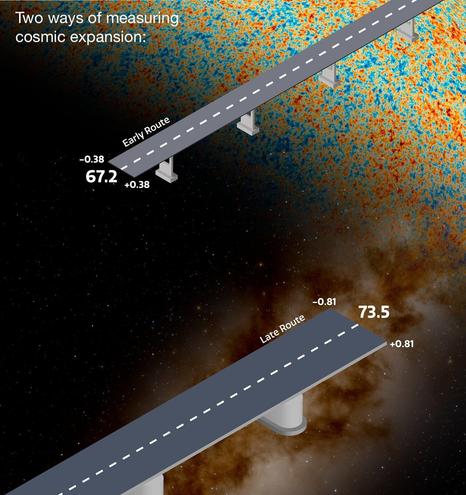
A new study confirms the "Hubble tension": measurements of the local expansion of the universe do not line up with measurements of how the universe was expanding after the Big Bang.

It's no simple experimental error. 11 different techniques agree.

https://noirlab.edu/public/news/noirlab2611/?lang #space #science #science
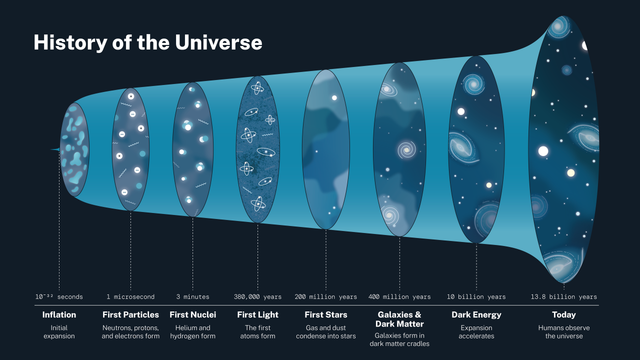
What could we be getting wrong?

Maybe we live in an atypical corner of the cosmos, giving us a misleading view.
Maybe we're missing something fundamental about the early evolution of the universe.

Either answer has huge implications.

https://www.aanda.org/component/article?access=doi&doi=10.1051/0004-6361/202557993 #space #astronomy #science #nature

@coreyspowell Obviously the answer is to send a probe to another galaxy. Let's get right on that. 😁
@coreyspowell I swear this was already answered― if you look up papers that describe the apparent discrepancy. I recall looking at something which I think is a similar, if not, the same problem in 2023. Unless since then, the hypothesis was chucked. I think the issues essentially came down to calculations of local distance-time measurements and the distances created by expanding universe model in general relativity for distant observations.
@coreyspowell I studied applied mathematics and earned a doctorate with "summa cum laude.” An algorithm I developed decades ago is still used today for numerical simulations in ultrarelativistic hydrodynamics. Yet to this day, I still don’t understand why the mathematical tools developed on Earth can describe the infinite vastness of the cosmos with such precision. I am rather surprised that theories based on our earthly mathematics extend so far. .