Artemis II crew splashes down near San Diego after historic moon mission

NASA's Artemis II astronauts returned to Earth with a splashdown landing in the Pacific Ocean after making a high-speed reentry through the atmosphere.

Glad that they're safe and sound.

It's worth pointing out that this is the first extremely public, widely acknowledged high risk mission NASA has done in over 50 years. The Shuttle was risky, but it wasn't thought of or acknowledged by NASA as being risky until very late in its lifecycle.

According to NASA's OIG, Artemis acceptable crew mortality rate is 1 in 30. Roughly 3x riskier than the shuttle. There genuinely is a world where they don't make it back home.

I am grateful that they did. And I'm grateful that we're going to go even further. I can't wait to see what Jared's cooking up (for those who don't know, he made his own version of the Gemini program in Polaris and funded it out of pocket).

> Artemis acceptable crew mortality rate is 1 in 30.

This seems insane to me. That X decades later we accept, with all our advancements in tech, a weaker system than ever before. That if we send 30 people we _accept_ that one is possible to die.

That's the starting point? That's what we document as acceptable?

Yes, and the memories of Apollo are made rosy by hagiography. I even wrote an entire thing to explain why, https://1517.substack.com/p/1-in-30-artemis-greatness-and-ri... (yeah, shameless plug, sorry - it's more for the citations than not. You can read the standards and reports I've linked to)

But if I'm allowed to repeat myself from elsewhere in the thread and the meat of the above thing,

It's physically not possible at our current level of technology to make this "safer" due to the distances and energies involved. Even with the Commercial Cargo and Crew Program (C3P), NASA has set the acceptable mortality threshold at 1 in 270 over the entire mission and 1 in 1000 on ascent / descent. If they could set it higher by gaming the math, they would. They can't.

We're a very primitive species, and the forces involved here are genuinely new. And no, Apollo wasn't much better either, at least 10 astronauts were killed in training or burned alive, as well as (far worse, because astronauts sign up for the risk) one member of ground staff.

People love to hate the Shuttle, and it ended up being subpar / fail expectations due to the political constraints NASA was under, but the Shuttle was a genuine advance for its time – a nonsensical, economically insane advance, but still an advance. If you look at the Shuttle alternative proposals / initial proposals as well as stuff like Dynasoar and Star Raker, you'll see NASA iterating through Starship style ideas. But those were rejected due to higher up front capital investment at the time.

The Shuttle is an odd franken-turduckling, because it was designed for one mission and one mission only. And that mission never happened. That cargo bay existed to capture certain Soviet assets and deploy + task certain American space assets and then bring them back to Earth.

And that's the bit that's hard to emphasize. The fact that the Shuttle could put a satellite up there, watch it fail, then go back up, grab it, bring it back, repair it, then launch again was an insane capability.

Was the program a giant fuck up at the end? Yes. But does that mean Artemis will be safer than the Shuttle? No. That's not how the energetics, time from civilization, acceptable risk profiles etc. work out.

1 in 30 – Artemis, Greatness, and Risk.

Or, why they launched Artemis II anyway.

1517 Fund

Nice article, although I'm not so sure about this part:

> There’s a reason why there wasn’t an Apollo 18, or 19 and 20. Even though funding had been secured, an executive decision was made to kill the program early, because LoC was inevitable.

Was funding really secure? I believe that was the main sticking point; a quick search [0] seems to confirm this, and the John Young quote below backs it up: "Even if they’d had the money..." Not to say the risk wasn't a factor too of course, but it doesn't look like funding was otherwise guaranteed.

Anyway, I think what sets the risk of the Shuttle apart from Apollo is summed up nicely in one of the quotes (in reference to the Apollo program): "The awareness of risk led to intense focus on reducing risk." In the Apollo program, there was a pattern of rigorously hunting down and eliminating any possible known risks, leaving unknowns as the primary source of risk; on the other hand, the Shuttle program let known risks accumulate continuously until crews paid the price for a bad draw.

When debris hit Atlantis on STS-27 [1] and the shuttle only survived on a one in a million stroke of luck -- the completely broken tile happened to be over an aluminum mounting plate -- it should have been taken as a free lesson on one more known source of risk to eliminate. Instead, it led to seven people dying completely preventable and unnecessary deaths a few years later.

Spaceflight is inherently risky, it's true. That's why things like the Orion heat shield are so worrisome; because it is physically possible at our current level of technology to make it safer, and yet for political / funding / etc. reasons we're not doing the best we can.

[0] https://airandspace.si.edu/stories/editorial/why-did-we-stop...

[1] https://en.wikipedia.org/wiki/STS-27

Ending Apollo: Why Did We Stop Going to the Moon?

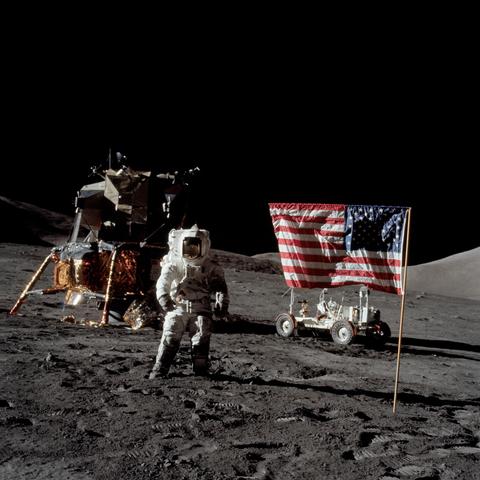
When the Apollo 17 spacecraft carrying U.S. astronauts Gene Cernan, Harrison Schmitt, and Ron Evans returned to Earth on December 19, 1972, the Apollo lunar landing program came to its end. No human has set foot on the Moon’s surface since.