 Sabine Seggelke
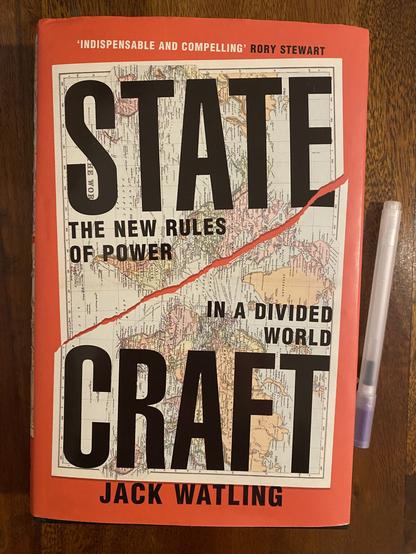
📖 This week’s #BookRecommendation is about #geopolitics : Jack Watling’s “Statecraft. The new rules of power in a divided world.”
He presents a thoughtful exploration of the dilemmas governments face today: forming economic alliances, adapting to rapid technological change, and protecting sovereignty in an era of renewed great-power rivalry.
#geopolitics #securitytransition #bookrecommendation | Sabine Seggelke
🌏 You may have found yourself using the phrase “it’s a new world” when discussing the growing geopolitical disorder and the many conflict zones we see around the globe. Yet, each time I reach for this expression, I am reminded how much we lack clear framing to capture what is truly at stake during this period of intense power competition. With this in mind, I would like to recommend a book that offers both context and insight: Jack Watling ‘s “Statecraft. The new rules of power in a divided world.” Jack Watling, Senior Research Fellow for Land Warfare at the Royal United Services Institute (RUSI) in London, draws on extensive practical experience advising governments and military leaders. His approach links strategic decision-making to real-world constraints, providing valuable guidance for those seeking to understand why states make the choices they do - and what effective policy entails in an environment marked by uncertainty. At the heart of “Statecraft” lies a thoughtful exploration of the dilemmas governments face today: forming economic alliances, adapting to rapid technological change, and protecting sovereignty in an era of renewed great-power rivalry. Watling emphasizes the need for agility, i.e. countries must carefully assess risks, cultivate flexible partnerships, and invest in intelligence to remain relevant and secure. A striking aspect of Watling’s analysis is his critique of Western strategy-making. He notes that too often, governments respond reactively, moving from crisis to crisis and committing resources only when options have already diminished. Since the Cold War’s end, strategy has sometimes devolved into lengthy policy narratives built on presumed stability — scripts that adversaries can anticipate and disrupt. Find out more: https://lnkd.in/eZFc4Kgs #Geopolitics #SecurityTransition #BookRecommendation