 john fink ok!! :goat:
Things I principally value(d) Ollama for -- multiple models and a model timeout -- are apparently easily done in llama-swap -- thing that remains for me is whether or not my AMD GPU (it sucks, but I would like it to work) will go with it. Ollama just throws in the towel and includes an entire AMD ROCm in their own distrib, which works, but I've had Problems with system-wide stock AMD GPU support. We'll see.
somewhat hilarious as AMD is *supposed* to be in the linux kernel! Which is sort of is, I guess. Also got my eye on that apparently reasonably priced Intel GPU (32GB VRAM for ~$1000) that's coming out at some point; llama.cpp amply supports Intel's GPU but afaik Ollama does not. Anyway.
 John Francis 🇨🇦🦫🍁💪⬆️
@adr how far? There are some serious tradeoffs from interacting in any way with large US tech companies. They'll steal your shit for themselves, leak your data and not blink an eye.
@johnefrancis how...far... what? this workshop was all about doing stuff on your own equipment, so none of the pieces *I* supplied fits that (of course, everyone was running US-based operating systems; nothing I can do about that.)
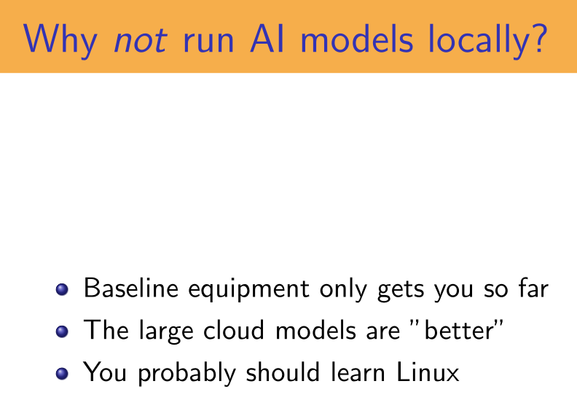
@johnefrancis oh I see. The baseline. Yeah, I was referring to laptops running small models as baseline for local stuff. You could of course build a massive ol' machine and do larger things yourself as well, but that was beyond the scope of the workshop.
@johnefrancis so "how far" depends very much on what you have on hand or can get.
@adr I remember running an early neural net that ran in excel, circa 2006. It only had 3-4 layers and maybe 25 neurons. IIRC you could train it to recognize an integer...not an image of an integer...an actual integer...and at inference it could recognize that this was the one it was trained on. That took about 40h on a nice 2006 developer workstation-replacement laptop. So...not far.
But things have changed a lot.
What useful things can one do on moderate home equipment?
@adr several photo library packages have quite good image recognition "AI". I think a home-LLM could helpa lot with effective search within a home network of devices.
@johnefrancis Sure? I don't know much about the image stuff -- I think Immich does it pretty good though right?
@johnefrancis Best way to answer that is to mess around yourself. Depending on definition of "moderate", I would try something like a 9b - 35b quantized model (the Qwen 3.5 models are good for this) and then try it out with a reasonably simple harness like OpenCode. Ollama does make this easy -- install ollama, ollama pull qwen3.5:35b, ollama launch opencode . Then ask it to make you some program or other.