"Intellectual property" was once an obscure legal backwater. Today, it is *the* dominant area of political economy, the organizing regime for almost all of our tech regulation, and the most valuable - and most controversial - aspect of global trade policy:

https://pluralistic.net/2026/04/01/minilateralism/#own-goal

--

If you'd like an essay-formatted version of this thread to read or share, here's a link to it on pluralistic.net, my surveillance-free, ad-free, tracker-free blog:

https://pluralistic.net/2026/04/08/process-knowledge-vs-bosses/#wash-dishes-cut-wood

1/

Despite (perhaps because) its centrality, "IP" is one of those maddeningly vague terms that applies to many different legal doctrines, as well as a set of nebulous, abstract thought-objects that do *not* qualify for legal protection. "IP" doesn't just refer to copyright, trademark and patent - though these "core three" systems are so heterogeneous in basis, scope and enforcement that the act of lumping them together into a single category confuses more than it clarifies.

2/

Beyond the "core three" of copyright, patent and trademark, "IP" also refers to a patchwork of "neighboring rights" that only exist to varying degrees around the world, like "anticircumvention rights," "database rights" and "personality rights." Then there are doctrines that have come to be thought of as IP, even though they were long considered separate: confidentiality, noncompete and nondisparagement.

3/

Finally, there are those "nebulous, abstract thought-objects" that get labeled "IP," even if no one can really define what they are - for example, the "format" deals that TV shows like *Love Island* or *The Traitors* make around the world, which really amount to consulting deals to help other TV networks create a local version of a popular show, but which are treated as the sale of some (nonexistent) exclusive right.

4/

It's hard to find a commonality amongst all these wildly different concepts, but a couple years ago, I hit on a working definition of "IP" that seems to cover all the bases: I say that "IP" means "any rule, law or policy that allows a company to exert control over its critics, competitors or customers":

https://locusmag.com/2020/09/cory-doctorow-ip/

Put that way, it's easy to see why "IP" would be such a central organizing principle in a modern, end-stage capitalist world.

5/

But even though "IP" is treated as a firm's most important asset, it's actually far less important than another intangible: *process knowledge*.

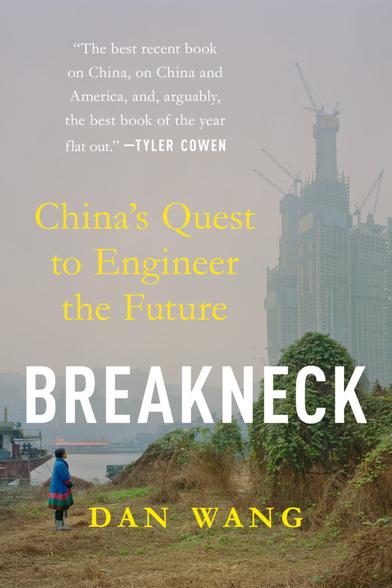
I first came across the concept of "process knowledge" in Dan Wang's *Breakneck*, a very good book about the rise and rise of Chinese manufacturing, industrialization and global dominance:

https://danwang.co/breakneck/

6/

Breakneck: China's Quest to Engineer the Future | Dan Wang

Announcing my book; whalelore; Austrian Catholicism; the legacy of Moses and Rickover; Yunnan; influencer culture; how historians work.

Dan Wang

I picked up *Breakneck* after reading others whom I admire who singled out the book's treatment of process knowledge for praise and further discussion. The political scientist Henry Farrell called process knowledge the key to economic development:

https://www.programmablemutter.com/p/process-knowledge-is-crucial-to-economic

While Dan Davies - a superb writer about organizations and their management - used England's Brompton Bicycles to make the abstract concept of process knowledge very concrete indeed:

https://backofmind.substack.com/p/the-brompton-ness-of-it-all

7/

Process knowledge is crucial to economic development

The message of Dan Wang's new book.

Programmable Mutter

So what is process knowledge? It's all the knowledge that workers collectively carry around in their heads - hard-won lessons that span firms and divisions, that can never be adequately captured through documentation. Think of a worker at a chip fab who finds themself with a load of microprocessors that have failed QA because they become unreliable when they're run above a certain clockspeed.

8/

@pluralistic for the sake of, ahem, interoperability with industrial economics: what this thread calls "process knowledge" is generally called "tacit knowledge" by economists. The invention of the term is attributed to Michael Polanyi, writing in the 1950s and 1966s.

https://en.wikipedia.org/wiki/Tacit_knowledge

1/2

Tacit knowledge - Wikipedia

@pluralistic Scholars of industrial organization pointed out that some workplace skills are hard or impossible to transmit in an abstract medium, and need to be learned on the job. The consequence of this is that tacit knowledge is an attribute of human COLLECTIVES, not individuals. Certain areas, known as "industrial districts", have acquired a productive specialization, with many companies working in the same business.

2/

@alberto_cottica @pluralistic

This is reminding me of James Scott in "Seeing Like A State" where he talks about the difference between "epistemic" knowledge and "metis", with the latter being the sort of thing you call "process knowledge" here.

@cptbutton Yes! Scott is an anthropologist, and has his own language and perspective. But basically we are all thinking of embodied, contextual, "how to" knowledge. I was not trying to play reply guy to @pluralistic, just to make his thread more relatable to those with an economics background .

@alberto_cottica @pluralistic

Digressing a bit, but an example I found in doing tech support is if the user is reporting a problem usually caused by an incorrect preference setting, and when you ask if they set it to [foo] and they say they have, walk them through the preference options menus *anyway* until they get to the [foo] and [bar] radio buttons and ask which is checked.

Or the one I've heard of telling them to unplug the computer, blow dust off the plug and replug.