"Intellectual property" was once an obscure legal backwater. Today, it is *the* dominant area of political economy, the organizing regime for almost all of our tech regulation, and the most valuable - and most controversial - aspect of global trade policy:

https://pluralistic.net/2026/04/01/minilateralism/#own-goal

--

If you'd like an essay-formatted version of this thread to read or share, here's a link to it on pluralistic.net, my surveillance-free, ad-free, tracker-free blog:

https://pluralistic.net/2026/04/08/process-knowledge-vs-bosses/#wash-dishes-cut-wood

1/

Despite (perhaps because) its centrality, "IP" is one of those maddeningly vague terms that applies to many different legal doctrines, as well as a set of nebulous, abstract thought-objects that do *not* qualify for legal protection. "IP" doesn't just refer to copyright, trademark and patent - though these "core three" systems are so heterogeneous in basis, scope and enforcement that the act of lumping them together into a single category confuses more than it clarifies.

2/

Beyond the "core three" of copyright, patent and trademark, "IP" also refers to a patchwork of "neighboring rights" that only exist to varying degrees around the world, like "anticircumvention rights," "database rights" and "personality rights." Then there are doctrines that have come to be thought of as IP, even though they were long considered separate: confidentiality, noncompete and nondisparagement.

3/

Finally, there are those "nebulous, abstract thought-objects" that get labeled "IP," even if no one can really define what they are - for example, the "format" deals that TV shows like *Love Island* or *The Traitors* make around the world, which really amount to consulting deals to help other TV networks create a local version of a popular show, but which are treated as the sale of some (nonexistent) exclusive right.

4/

It's hard to find a commonality amongst all these wildly different concepts, but a couple years ago, I hit on a working definition of "IP" that seems to cover all the bases: I say that "IP" means "any rule, law or policy that allows a company to exert control over its critics, competitors or customers":

https://locusmag.com/2020/09/cory-doctorow-ip/

Put that way, it's easy to see why "IP" would be such a central organizing principle in a modern, end-stage capitalist world.

5/

But even though "IP" is treated as a firm's most important asset, it's actually far less important than another intangible: *process knowledge*.

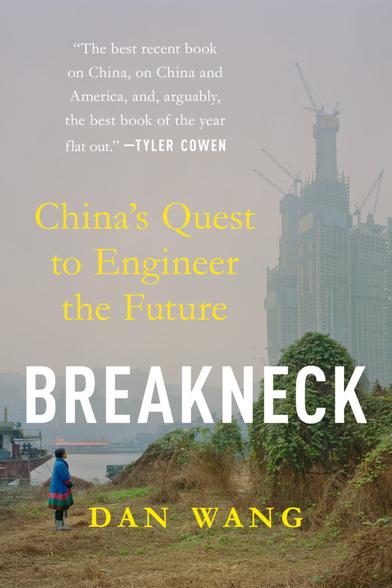
I first came across the concept of "process knowledge" in Dan Wang's *Breakneck*, a very good book about the rise and rise of Chinese manufacturing, industrialization and global dominance:

https://danwang.co/breakneck/

6/

Breakneck: China's Quest to Engineer the Future | Dan Wang

Announcing my book; whalelore; Austrian Catholicism; the legacy of Moses and Rickover; Yunnan; influencer culture; how historians work.

Dan Wang

I picked up *Breakneck* after reading others whom I admire who singled out the book's treatment of process knowledge for praise and further discussion. The political scientist Henry Farrell called process knowledge the key to economic development:

https://www.programmablemutter.com/p/process-knowledge-is-crucial-to-economic

While Dan Davies - a superb writer about organizations and their management - used England's Brompton Bicycles to make the abstract concept of process knowledge very concrete indeed:

https://backofmind.substack.com/p/the-brompton-ness-of-it-all

7/

Process knowledge is crucial to economic development

The message of Dan Wang's new book.

Programmable Mutter

So what is process knowledge? It's all the knowledge that workers collectively carry around in their heads - hard-won lessons that span firms and divisions, that can never be adequately captured through documentation. Think of a worker at a chip fab who finds themself with a load of microprocessors that have failed QA because they become unreliable when they're run above a certain clockspeed.

8/

If that worker knows enough about downstream customers' processes, they can contact one of those customers and offer the chips for use in a lower-end product, which can save the fab millions and make millions more for the customer.

This just happened to Apple, who seized upon a lot of "binned" microprocessors that were headed to the landfill and designed the Macbook Neo (a new, cheap, low-end laptop) around them, salvaging the defective chips by running them at lower speeds.

9/

The result? Apple's most successful laptop in *years*, which has now sold so well that Apple has exhausted the supply of defective chips and is scrambling to fill orders:

https://www.macrumors.com/2026/04/07/macbook-neo-massive-dilemma/

Process knowledge is squishy, contingent, and wildly important in a world filled with entropy-stricken, off-spec, and stubbornly physical things.

10/

Apple is Reportedly Facing a 'Massive Dilemma' With the MacBook Neo

The all-new MacBook Neo has been such a hit that Apple is facing a "massive dilemma," according to Taiwan-based tech columnist and former...

MacRumors

Work with a machine long enough and you'll develop a Fingerspitzengefühl (fingertip feeling) for the optimal rate to introduce a new load of feedstock to it after it runs dry. Even more importantly: if you work with that machine long enough, you'll have the mobile phone number of the retired person who knows how to un-jam it if you try to reload it too fast on your usual technician's day off. This kind of knowledge can mean the difference between profitability and bankruptcy.

11/

So why isn't process knowledge given the centrality in our conceptions of what makes a corporation valuable?

After reading Wang, Farrell and Davies, I formulated a theory: we ignore process knowledge for the same reason we exalt "IP," because process knowledge *can't* be bought or sold, can't be reflected on a balance-sheet, and can't be controlled, and because "IP" *can*.

12/

Process knowledge is far more important than "IP" (just try creating a vaccine from a set of instructions *without* the skilled technicians who have already spent years executing similar projects), but process knowledge is spread out amongst workers and *can't* be abstracted away by their bosses.

13/

Your boss can make you sign a contract assigning all your copyrights and patents to the business, but if you and your team quit your job, all that "IP" will plummet in value without the people who know how to *mobilize* it:

https://pluralistic.net/2025/09/08/process-knowledge/#dance-monkey-dance

"IP" isn't just a case of "you treasure what you measure" - it's also a case of "you measure what you treasure."

14/

Pluralistic: Fingerspitzengefühl (08 Sep 2025) – Pluralistic: Daily links from Cory Doctorow

Recently, I hit on a positively *delightful* Tumblr post that illustrated the importance of process knowledge, and the way that bosses systematically undervalue it:

https://www.tumblr.com/explorerrowan/813098951730479104

This post is one of those glorious internet documents, a novel literary form for which we have no accepted term.

15/

Reblog by @explorerrowan · 4 images

💬 6  🔁 39119  ❤️ 50057

Tumblr

It comprises 4 sections: a screenshotted Twitter thread made in reply to a throwaway post; a Tumblr reply to the screenshots; another Tumblr reply to the first; and a chorus of more than *38,000* replies, and hashtags added to it. I have no idea what to call this kind of document, in which some people are reacting to others without the others ever knowing about it, but also which is also written by so many authors, many of whom are explicitly interacting with one another.

16/

It's a "hypertext," sure, but what *kind* of hypertext?

Whatever you call it, it's amazing. As noted, it opens with a Twitter exchange. The first tweet comes from an online dating influencer, "TheEcho13":

> I interviewed a gen z girlie 6 months ago and in the interview she told me that she does not like a challenge, has no interest in career progression, prefers to just do repetitive tasks and will never complain about being bored.

> I hired her.

https://xcancel.com/TheEcho13/status/1948951885693813135#m

17/

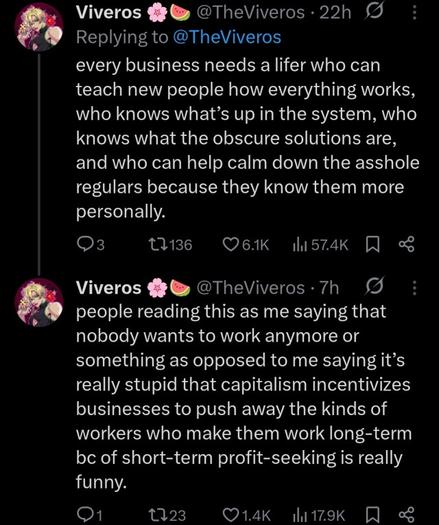
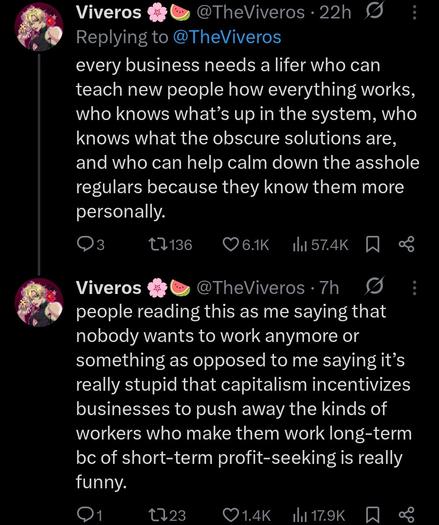
In response, Viveros (a content creator from Alberta and one of the 4m people who saw the original tweet), replied with a short thread about the value of people like this, who "keep the lights on and the business functioning at everything from restaurants to post offices but now nobody’s interested in hiring them":

https://xcancel.com/TheViveros/status/1949149720406110382#m

18/

These are the "lifer[s] who can teach new people how everything works, who knows what’s up in the system, who knows what the obscure solutions are, and who can help calm down the asshole regulars because they know them more personally." In other words, the keepers of the process knowledge.

19/

When this screenshotted exchange was posted to Tumblr, it prompted Blinkpatch, who describes themself as a "genderfluid," "ancient" "drifter" who pines for "solar-punk flavored revolution" to reply with a brilliant anecdote about their stint working as a dishwasher:

https://weaselle.tumblr.com/post/790895560390492160/whenever-i-think-about-the-value-of-something

At 16, Blinkpatch was hired as a restaurant dishwasher under the tutelage of Claudio, a 60-year old "career dish pit man."

20/

blinkpatch

Whenever I think about the value of something being done by a person who really understands the job from a lifetime of experience, I think of my first restaurant job. My goal was to work every...

Tumblr

Claudio had washed dishes for his whole life, reveling in the fact that he could get work in any city, at any time.

When Claudio realized that Blinkpatch was taking the job seriously, the training began in earnest. Claudio asked Blinkpatch if they wanted to be able to clock off at midnight at the end of each shift, and when Blinkpatch said they did, Claudio laid a lot of process knowledge on them:

21/

@pluralistic for the sake of, ahem, interoperability with industrial economics: what this thread calls "process knowledge" is generally called "tacit knowledge" by economists. The invention of the term is attributed to Michael Polanyi, writing in the 1950s and 1966s.

https://en.wikipedia.org/wiki/Tacit_knowledge

1/2

Tacit knowledge - Wikipedia

@pluralistic Scholars of industrial organization pointed out that some workplace skills are hard or impossible to transmit in an abstract medium, and need to be learned on the job. The consequence of this is that tacit knowledge is an attribute of human COLLECTIVES, not individuals. Certain areas, known as "industrial districts", have acquired a productive specialization, with many companies working in the same business.

2/

It is hard for competitors elsewhere to compete with them, because the workforce that possesses the relevant tacit knowledge is not readily available outside of the industrial districts. In this sense, tacit knowledge is something that tilts the balance of power between bosses and workers more towards the workers.

... which is why bosses do not like to acknowledge it.

3/end

@alberto_cottica @pluralistic

This is reminding me of James Scott in "Seeing Like A State" where he talks about the difference between "epistemic" knowledge and "metis", with the latter being the sort of thing you call "process knowledge" here.

@cptbutton Yes! Scott is an anthropologist, and has his own language and perspective. But basically we are all thinking of embodied, contextual, "how to" knowledge. I was not trying to play reply guy to @pluralistic, just to make his thread more relatable to those with an economics background .

@alberto_cottica @pluralistic

Digressing a bit, but an example I found in doing tech support is if the user is reporting a problem usually caused by an incorrect preference setting, and when you ask if they set it to [foo] and they say they have, walk them through the preference options menus *anyway* until they get to the [foo] and [bar] radio buttons and ask which is checked.

Or the one I've heard of telling them to unplug the computer, blow dust off the plug and replug.

@pluralistic

In my garage is a bandsaw I’ve had for 25 years. Apart from keeping it tuned properly, basic stuff, feed rate is the most critical difference between a delightful and a horrible bandsawing experience.
How fast is just right? Put a toe on the leg of the machine as you cut. Feel the vibration. The feedback will tell you. Is this in any manual or even YouTube tutorial? Not that I know of.

@CptSuperlative @pluralistic this is the #knowledge shared in stories and #apprenticeships. This is stuff machines can’t capture. This kind of #somatic #explicit knowledge is stored in #mentorships and other human relationships. This kind of sharing made the old #belllabs and makes #amateurradio fun and worthwhile despite the #whitesupremacist milieu.