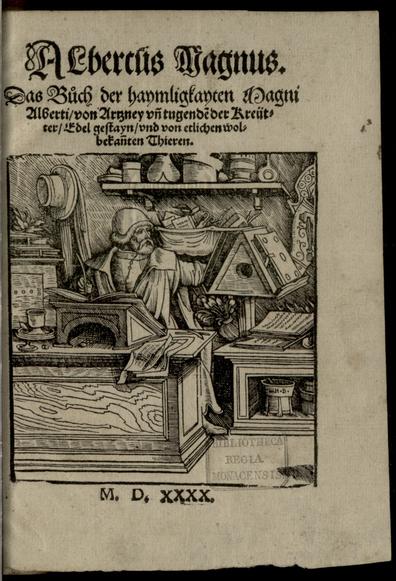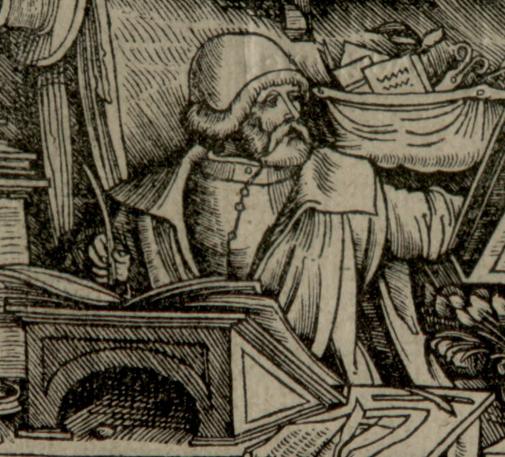
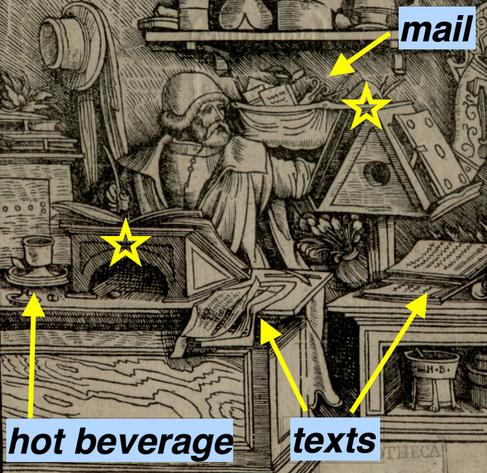
Working the morning shift as a scholar in 1540, a browser tab and a word document opened on two screens, other needed texts opened and handy, an overfull mail account nearby, and a hot beverage in reach to make for the best working condition. Bonus: wearing a thinking hat. #academicchatter
This great image of a learned man being busy in a scholarly setting was printed in Augsburg 1540. The man depicted is Albertus Magnus, who lived in the 13th century, so this 16th century image is a later imagination of a scholarly working setting. #skystorians
The quill using and multitasking writing man, also called Albert of Cologne, was a German Dominican friar, philosopher, scientist, bishop, and some more. #bookhistory You may find a digital copy of "Das Buch der haymlichkeiten Magni Alberti" over here: www.digitale-sammlungen.de/de/details/b...
If you wonder what the pair of scissors in the mail account is for: copy paste is the answer.
On the other side of this busy text production was the consumption side: reading, browsing, thinking (without a hat). As can be seen in this image of a few years later: bsky.app/profile/dbel...

RE: https://bsky.app/profile/did:plc:wwym6cglvbd5odxfkykn2uh2/post/3ldifmkpbrc26
Whatever you are working on today, remember that you are in a long line of humans working with too many mails, various opened text documents, too many other manuscripts lying around, etc. So have your thinking hat ready might be of help to tackle this situation.
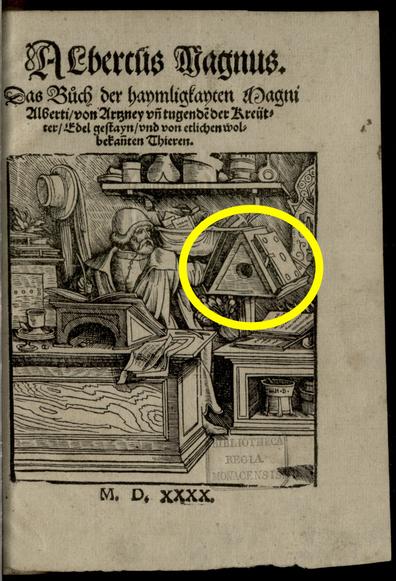
One more detail: the movable book desk features an access hole for your domestic ferret or cat. When did we stop building such animal-friendly furniture? And why?
Experts of #bookhistory and #libraryhistory might have spotted as well the prominent library stamp in the right corner: #LibraryStampMadness
And for friends of #paperhistory: when this image was printed, in mid 16th century, paper was available all over Europe. Like in this example, when you had paper sheets stored next to your working desk: bsky.app/profile/dbel...

RE: https://bsky.app/profile/did:plc:wwym6cglvbd5odxfkykn2uh2/post/3lasqxudgwk2d
But the imagined working scene is supposed to be situated in the 13th century! And at this time, you likely worked with parchment. We know that the artifact 'paper' was introduced and produced in Europe first by Arab papermakers and via Arab trade contacts from the eleventh and twelfth centuries.
So maybe, this working scene is already a paper space. As imagined too here for around 1300 AD: bsky.app/profile/dbel...

RE: https://bsky.app/profile/did:plc:wwym6cglvbd5odxfkykn2uh2/post/3lbjezmdwps2b
To finish up, this early paper user in Europe was maybe an 'early adopter'. By then, other parts of the world had already used paper for quite some time: bsky.app/profile/dbel...

RE: https://bsky.app/profile/did:plc:wwym6cglvbd5odxfkykn2uh2/post/3maalai7sic2t
As you are reading these lines on a screen, and not on parchment or paper, you might reflect on material changes and our choices of text and image production and consumption. A global view of #paper as an artifact shows:
Over a span of more than two thousand years, paper has been the primary material in the history of publishing since it first became available and was integrated into regional cultures and markets. But we are about to decide in our time, how much digital reading - on screens - do we want to have.
Multitasking might have been a typical thing for desk workers of the past, but not using paper for writing and reading is a relatively young development. We are still a paper-using humanity, but our production and consumption patterns are changing rapidly. This is written on a MacBook Air.