

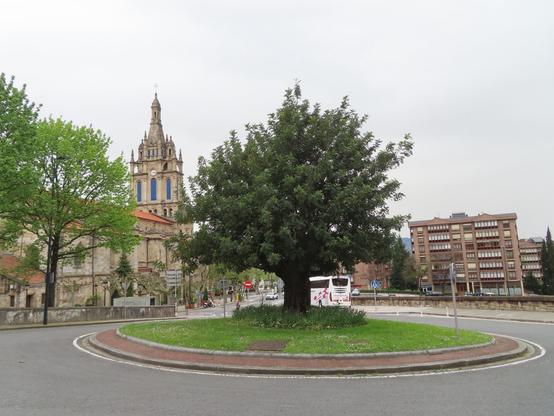
Made time today to walk up & down hills & stairs to get to this old carob tree growing in a roundabout near the Basilica Begoña. This has to be at least a couple hundred years old.

It's very rainy in Bilbao so it is not the ideal environment for Ceratonia siliqua, yet this one survives, albeit hollow and with many fungi on it. And it's either female or hermaphrodite because it is bearing young pods. #Bilbao #Spain #Espana #Carob #Algarrobo
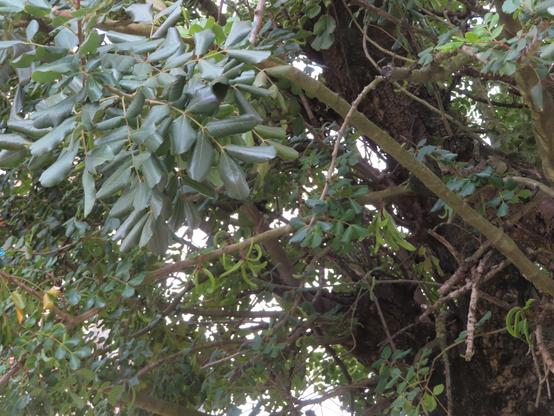
Here you can see the young pods developing.

Carob flowers at about the same time the pods are ripe. Pods are on the tree ripening about one year, more or less.

The pods this tree gives, from what I could see on the ground, are not likely standout for eating traits, but the fact that this tree has survived this rainy environment makes it worth propagating for that trait. #Bilbao #Spain #Espana #Carob #Algarrobo
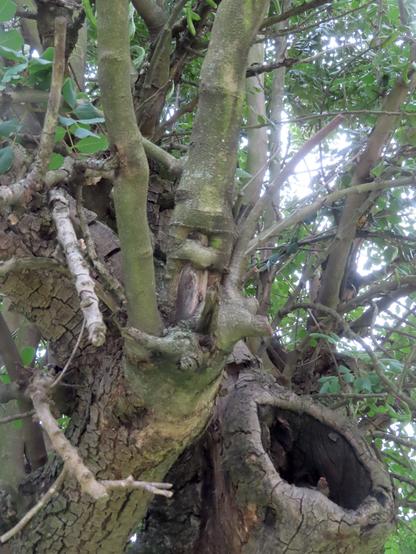
The trunk is hollow, as are several large branches. Look how something girdled this branch (girdle = chewed, cut, or tore off a semi-circle or entire circle of bark & phloem, which cuts off nutrition flow in the plant), yet the remaining bark seemed to grow right back over it.

Carob is tough, man. Carob wants to live.

#Bilbao #Spain #Espana #Carob #Algarrobo

I hope more funding gets put into studying carob. It's as if familiarity breeds contempt. This species is so old in Europe that Linnaeus himself gave it the name Ceratonia siliqua. Yet it's not studied anywhere near as deeply as other economic species.

Carob is *tough*, but how is it responding to climate change? It's probably more resilient to it than chocolate or coffee are, but does the heat change the taste or content of the pods & seeds? Not enough study is being done.

#Carob #Climate

@ml What a nice toot! Thank you for share it