 tired_n_bored
Hey we solved software development, no need to learn programming anymore (Claude's source code leak)
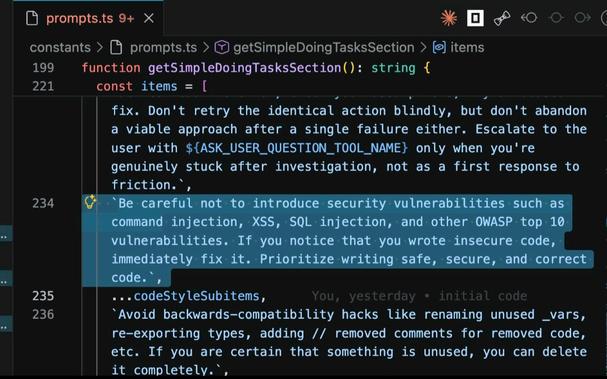
Hey we solved software development, no need to learn programming anymore (Claude's source code leak)
The problem is that words don’t have meaning in the genAI field. Everything is an agent now. So it’s difficult and confusing to compare strategies and performance.
Claude Code is a pretty solid harness. And a harness is indeed just prompts and tools.
That may actually work a little?
I mean, it scraped the entirety of StackOverflow. If someone answered with insecure code, it’s statistically likely people mentioned it in the replies meaning the token “This is insecure” (or similar) should be close to (known!!) insecure code.
I was part of that OWASP Application Security Verification Standards compliance at my work. At a high level, you choose a compliance level that suitable for the environment you expect your app to be deployed in, and then there’s a hundred pages of ‘boxes to tick’. (Download here.)
Some of them are literal ‘boxes to tick’ - do you do logging in the proscribed way? - but a lot of it is:
Not many of them are difficult, but there’s a lot of them. I’d say that’s typical of security hardening; the difficulty is in the number of things to keep track of, not really any individual thing.
As regards the ‘have you used this thing in the correct, secure way?’, I’d point my finger at something like Bouncy Castle as a troublemaker, although it’s far from alone. It’s the Java standard crypto library, so you think there would be a lot of examples showing the correct way to use it, and make sure that you’re aware of any gotchas? Hah hah fat chance. Stack Overflow has a lot of examples, a lot of them are bad, and a lot of them might have been okay once but are very outdated. I would prefer one absolutely correct example than a hundred examples have argued over, especially people that don’t necessarily know any better. And it’s easy to be ‘convincing but wrong’, and LLMs are really bad in that case. So ‘ticking the box’ to say that you’re using it correctly is extremely difficult.
I see the Claude prompt is ‘OWASP top 10’, not ‘the full OWASP compliance doc’, which would probably set all your tokens on fire. But it’s what’s needed - the most slender crack in security can be enough to render everything useless.
So I don’t know if all the other replies are pretending to be stupid, but the shown prompt is not stupid.
If you include stuff like that section in your prompt, then it has been shown that the AI will be more likely to output secure code. Hence of course the section should be included in the prompt.
If it looks stupid but it works, then it is not stupid.
since the chat bot is more likely but not certain to write secure, bug-free code, it does not in fact work
Humans are not certain to write secure, bug-free code. So human code is useless, by the very same metric?
What kind of “logic” is that?
“Don’t put in any of the Top 10 vulnerabilities. But if you put any from the 11th place and down, that’s okay, I don’t even know what those are.”
(Also, getting flashbacks from Shadiversity plugging “ugly art” and “bad anatomy” in the negative prompt as he was no doubt silently wondering why it didn’t work)
 puchaczyk
 JackbyDev
 Hamartiogonic
 renzhexiangjiao
 rozodru
 James R Kirk
 driving_crooner
 addie
addie Sundray
 underisk
 Fargeol
 Chais
Chais Rose
Rose