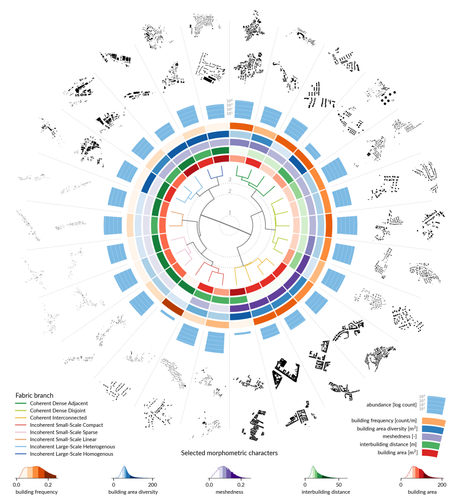
We have a new paper out! Named "The hierarchical morphotope classification: A theory-driven framework for large-scale analysis of built form”, it provides an overview of the method we used to build our Urban Taxonomy dataset.

https://authors.elsevier.com/sd/article/S0264-2751(26)00279-9

Morphology often hits scalability limits. This method is able to break those as shown by classifying over 90 million buildings (in the paper, we have 150 million + now).

1/n
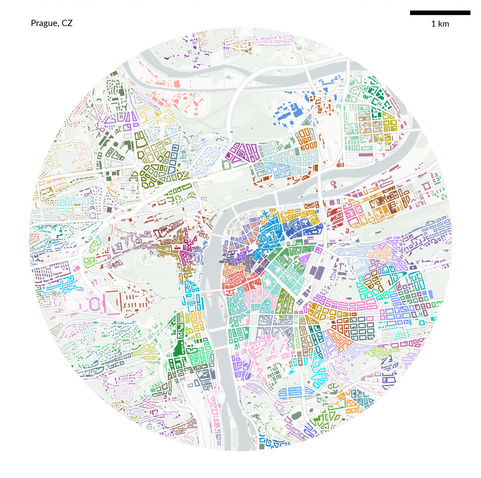
At the same time, the “data-driven" nature of quantitative methods tends to be disjoint from morphological theory.

We took concepts known from 80s and re-conceptualised them for urban morphometrics. This leads to identification of "morphotopes" (as biotopes), the smallest morphologically homogeneous regions.

And because there's a lot of them, we have organised them into a taxonomy.

2/n

@martinfleis Congrats, this looks super nice! The visualizations are excellent, I'm sure the #dataviz people will appreciate it.
@martinfleis Maybe a random question, but do you think that a similar approach could also work for things other than city plans?
Specifically, I have a similar-looking problem with my multi-channel neuroanatomical data and am desperately looking for ways to make sense out of them at scale. I actually thought about analyzing them as "cellular neighbourhoods", so maybe there's some useful conceptual transfer to be had here :)
@moritz_negwer I think the general concept is pretty generic so it might work. It is also the reason why the underlying regionalisation algorithm SA3 was contributed to spopt package, to facilitate other use cases like yours. How would it work in practice I have no idea though :D
@martinfleis thanks, super nice to hear that it was built for interoperability like this! I'll check it out and see if I can wrap my head around it.