 Awet Tesfaiesus, MdB
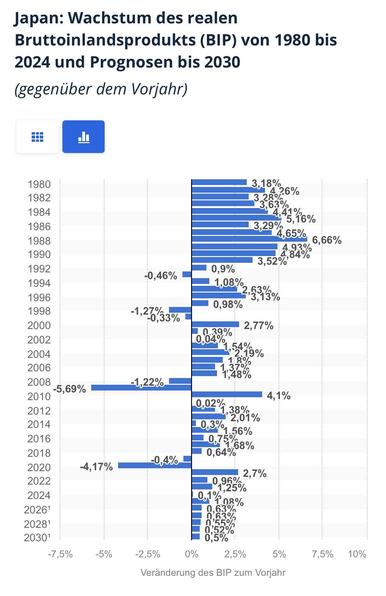
Correct me if I’m wrong, but Japan has had near-#zerogrowth for almost 25 years now, and it seems the world hasn’t come to a halt and society hasn’t collapsed.
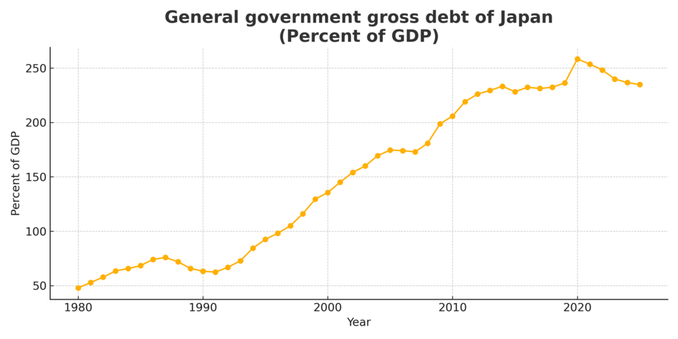
@AwetTesfaiesus not sure if this could be related: their public debt is 234.9% of their GDP.
Source: https://www.imf.org/external/datamapper/GGXWDG_NGDP@WEO/JPN?year=2025
@AwetTesfaiesus I think it is, we would need to look more closely at the tax base and inflation there.
Guessing here: Society needs to spend more, but the tax money isn't growing, so we have to finance the rest with the debt.
As some economists would say, the citizens no longer pay for the govt directly. The rich investors borrow the money and take interest.
Maybe at some point the taxes will be spent only to pay off the investors... We'll see
@saper Is there a magical number where it all breaks down? Germany is extremely cautious with gov. spending and the debt is 60% of GDP. The number itself does not invalidate the point @AwetTesfaiesus is making.
IMHO: We are living below our standards because the german government is afraid of a big numbers on the budget plan.
I find the question pointed by @AwetTesfaiesus very interesting to analyze, with no "easy" answers.
What worries me personally: who is going to be a decision maker in such a country - the taxpayers or the investors :(
The question is on the table for many years, isn't it?
When countries don't own their assets anymore, who is in charge (really)?
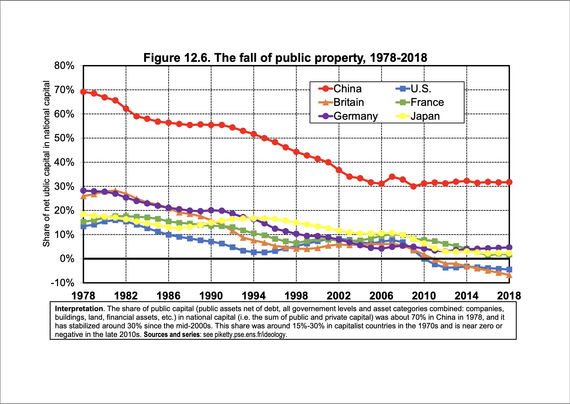
@AwetTesfaiesus Yes, very much indeed
There are many who can give an easy answer to the question who is really in charge. #conspiracy
 Marcin Cieślak
 martin