 cannedtuna
Yellow Paint
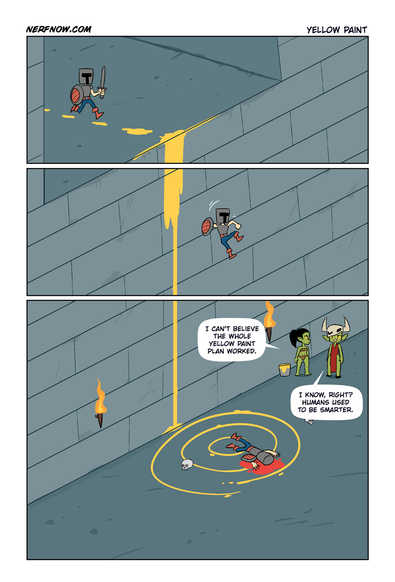
Thank you! This is something I saw coming as games got more visually detailed and environments got more visually dense. There was this generation of “detective mode”/“spirit vision”/“highlight the important shit” and I remember that in some games it was so constantly necessary to use that to figure out where you needed to go that you spent more time in desaturated rave-land than seeing that actual game.
I feel like decent signposting, guiding the player towards interactables and points of interest, etc is slowly being lost in favor of “toggleable highlight vision” and yellow paint. It’s a fucking video game, use some rim-lighting or a sparkle effect. Point a toppled lamp at the ladder. Either go all in on realistic environments and work harder to direct your players in ways that don’t break immersion or accept some element of “game-ness” and just highlight the objects.
The toggle-able highlight vision fucks with the gameplay flow, and the yellow paint on shit that doesn’t make sense unless an omniscient helper is leading us just breaks immersion and versimilitude for me more than any glowing collectable does.
The Portal games were really good at this. Using the environment to guide the player where they needed to go and then they used lighting to show what you should look at.
Portal 1 did have some red arrows and “this way” signs on the walls, but that actually made sense because there was someone helping the player character out.
Portal 1 had a very spartan level design. There was only a very limited set of interactible assets, so it was easy to learn which five assets can be interacted with. But also there wasn’t really much of anything else in the levels. Everything was clearly visible and understandable, because there really wasn’t anything there.
Try to do Portal 1 in a forest setting, or in a detailed medieval city centre environment. That kind of design language would completely fall apart.
That’s fair, although there was more stuff in the levels of the second half (but you’re right, even then the only thing you could really interact with were doors).
Try to do Portal 1 in a forest setting, or in a detailed medieval city centre environment. That kind of design language would completely fall apart.
Of course. Their design was very fitting for the kind of games they were, and different games would need something different to guide players :)
I haven’t played through them, but I believe the Half-Life games had a greater variety of environments?
I haven’t played the Half Life games, but they do firmly fall into the low-fidelity-environment category. Lower fidelity environments don’t need such a clear design language, because any object that exists usually exists for a clear purpose.
That’s fair, although there was more stuff in the levels of the second half (but you’re right, even then the only thing you could really interact with were doors).
Doors, turrets, cubes, switches, one type of “portallable” wall, that’s it. Everything else is just an obstacle. They spent the first half of the game training the player which objects are interactible, and in the second half they didn’t introduce anything new that wasn’t just an obstacle (except maybe the doors, don’t remember if they exist in the first half).
But that’s just the point: If there’s not a lot of stuff in the game and all the objects are clearly recognizable, there’s no need for yellow paint because the game world is yellow paint.
Yellow paint becomes necessary when the game is high-fidelity and trying to be photorealistic and thus stuff isn’t quite as clearly understandable. That’s why we use yellow paint in real life for mark ledges that you could stumble over or emergency exits (ok, here it’s green), or first-aid kits (here it’s red), or defibrilators (blue or green) and so on. We do use this technique in real-life.
 Quacksalber
 wizardbeard
 mschae
 joelfromaus
 Murse
Murse