 Eliot Higgins
This is epistemic humiliation: the arrangement of political culture so that large populations experience their democratic voice as both practically irrelevant and morally suspect. Experts know; you merely feel. Your feelings are noted, but they shouldn't govern policy.
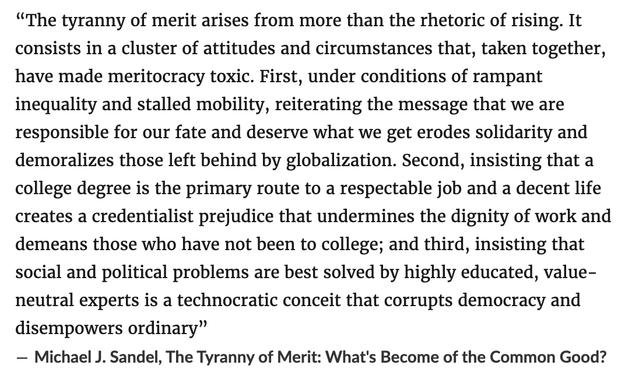
When people withdraw from epistemic infrastructure that has humiliated them, that's not irrational. It's what rational actors do when institutions fail them. You can see this as "epistemic defection", and the direction of that defection is shaped by what's available when it happens.
This is the crucial point. Humiliation and trust betrayal determine that defection occurs. They don't determine where people land, the destination depends on the epistemic environment, and right now, that environment is structurally tilted toward disorder.
So people defect from institutional epistemics for rational reasons. But where do they land? Not randomly. They land in coherent epistemic systems, structured ways of processing evidence, handling disagreement, and imposing consequence. I call these moral-epistemic stacks.
Think of a stack as a layered architecture. Where does moral authority come from? How is certainty treated? What counts as evidence? How is disagreement handled? Where does accountability flow? How tightly is identity bound to the system?
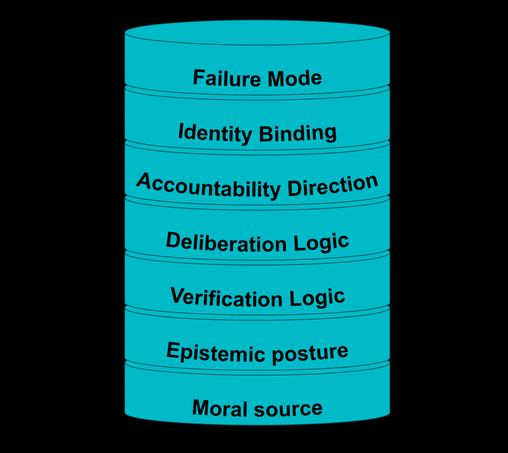
Every epistemic system, democratic or not, can be described this way. These are generic types, not a fixed list. Real-world formations combine elements and shift over time. But the types reveal where each system's architecture breaks down.
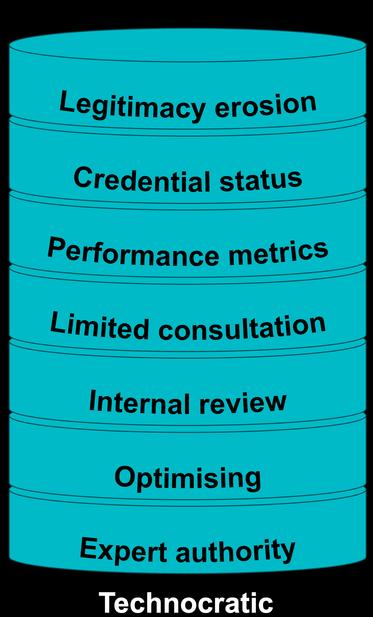
A technocratic stack: moral authority sits with expertise. Evidence is rigorous but opaque. Deliberation is minimal, disagreement is reframed as ignorance. Accountability is metric-based. It fails when its authority outpaces public consent. Sound familiar?
A populist stack: moral authority comes from "the people." Evidence is what feels true. Disagreement is betrayal. Accountability targets elites and outsiders but protects in-group leaders. It fails through authoritarian drift as constraints on leadership erode.
A conspiratorial stack: moral authority lies in revealing hidden truth. Doubt is applied to everything except the group's own claims. Evidence is selectively decoded. Accountability means naming enemies. It fails because it becomes self-sealing, nothing can disprove it.
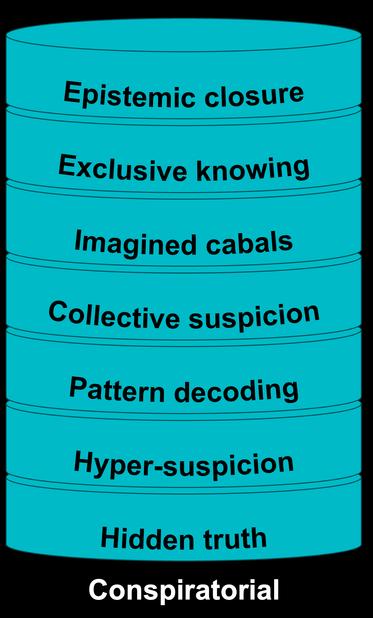
Notice: the stacks model doesn't say these people are stupid. It says each system fails at a specific architectural layer. Technocratic systems fail at deliberation. Populist systems fail at verification. Conspiratorial systems fail at epistemic posture.
And here's a crucial point: everyone has an individual stack, shaped by biography, experience, education, what institutions have done to you. We all carry layered commitments about how truth works and who deserves to be heard.
When your individual stack is compatible with a group's stack, you experience alignment. It feels like coming home. Not because you've been manipulated, but because the group's moral commitments genuinely resonate with yours.
The problem is what happens next. You're drawn in by genuine moral alignment, anti-war conviction, distrust of elites, concern about corruption. But over time, the group's verification logic and accountability direction can begin to reshape your own.
Challenging the group's conclusions starts to feel like betraying the values that drew you in. "You're saying the attack was real" becomes "you're siding with the people who lied about Iraq." A factual question becomes a loyalty test.
This is how sincere, intelligent people end up in formations that contradict their own values. Alignment is genuine at the moral source. Capture happens at the verification layer. The stacks model explains this without dismissing anyone as irrational.
Now, counterpublics. The direction a counterpublic takes depends on its epistemic architecture. Expansive counterpublics seek to widen shared reality, to bring excluded voices in. Their methodology is open to scrutiny.
Contractive counterpublics withdraw from shared reality and build enclosed epistemic spaces with their own internal validation. Questioning methods is treated as betrayal, not legitimate scrutiny.
The civil rights movement was expansive, it demanded a better shared reality, not a separate one. Conspiracy ecosystems are contractive, they reject the mainstream as captured and build closed worlds governed by internal loyalty.
Which direction isn't predetermined. It's shaped by structural conditions, how degraded the mainstream is, and whether people experience it as reformable or fundamentally hostile. As the mainstream degrades, more counterpublics move contractive.
And in the collapsed information environment, expansive counterpublics are structurally disadvantaged. They need time, rigour, and protected space. Platforms reward the opposite, conflict, tribal identity, speed. The environment selects for contraction.
The same digital transformation that enabled distributed democratic verification, open-source investigation, citizen journalism, also enabled distributed epistemic violence. Same tools, same environment, radically different architectures.
So if different epistemic systems have different architectures, the key question becomes: which systems are compatible with functional VDA? Which ones can coexist with real verification, genuine deliberation, and meaningful accountability?
Let's look at populism. Populism is not inherently anti-democratic. Populism is a family of moral-epistemic stacks, not a single pathology. And different populist configurations have radically different relationships with democratic infrastructure.
A degenerative populist stack: moral authority comes from betrayal and violated identity. Certainty is a virtue. Correction is treated as threat. Disagreement is betrayal. Accountability targets enemies but never the in-group's own leaders. Failure produces escalation, not learning.
This configuration is compatible only with simulated VDA. Real verification undermines its certainty. Genuine deliberation threatens identity cohesion. Meaningful accountability endangers its protected leaders. It needs democratic forms without democratic substance.
A regenerative populist stack looks different. Moral authority is grounded in harm caused by unaccountable power, not abstract identity. Certainty is assertive but corrigible. Evidence is expected to constrain claims. Correction weakens the claim but doesn't collapse belonging.
This configuration is compatible with functional VDA. It challenges unaccountable power while accepting that evidence should narrow and revise claims. Disagreement is bounded, not forbidden. Accountability flows upward and, crucially, inward too.
The difference isn't about tone or intensity of grievance. Both forms can be angry, confrontational, disruptive. The difference is structural: how does the system respond to correction, disagreement, and failure? Does it learn, or does it escalate?
And here's the opportunity. If functional VDA infrastructure is available at the right speed and visibility, it can support regenerative populism. It can constrain claims with evidence, channel disagreement into remedy, and resolve mobilisation through real accountability.
When functional VDA is absent or too slow, even regenerative movements get pushed toward frame hardening. Late-arriving evidence feels like narrative weakening. Delayed accountability feels like management, not justice. The window closes and the system degenerates.
So the decisive question isn't "how do we stop populism?", that usually backfires anyway. It's how can we build epistemic infrastructure that's compatible with populist energy? Can functional VDA operate at the speed moral judgement actually forms?
Suppressing populism doesn't change compatibility, it selects for stacks that can survive without functional VDA. That means degenerative configurations that thrive on simulation and coercion. The suppression strategy produces exactly what it fears.
One more crucial insight from the stacks model: different stack types can be compatible with each other. Populist, authoritarian, and conspiratorial stacks can form coalitions, not because they agree on everything, but because they share enemies and structural features.
In my opinion, this is exactly how we should understand MAGA. It's not a single ideology, it's a coalition of stacks. Populist grievance, conspiratorial epistemics, and authoritarian power structures operating together, each reinforcing the others.
The populist layer provides the moral energy, betrayal by elites, voices ignored. The conspiratorial layer provides the epistemic architecture, hidden truths, decoded evidence, designated enemies. The authoritarian layer provides the power logic, strong leadership, loyalty, punishment of dissent.
Each stack on its own has characteristic limits. But in coalition, they compensate for each other's weaknesses. Conspiratorial epistemics provide the "verification" the populist stack lacks. Authoritarian accountability protects leaders the populist stack elevates.
We can see similar dynamics in the UK. Reform UK's increasing flirtation with conspiracy theories isn't random, it reflects a degenerative populist stack seeking compatible epistemic architecture. Conspiracy provides the explanatory framework that populist grievance alone can't sustain.
This is what makes coalition formations so resilient. They're not held together by a coherent ideology. They're held together by structural compatibility, shared enemies, compatible verification logics, and mutually reinforcing accountability directions.
And this is why treating any of these elements in isolation, "it's just populism," "it's just conspiracy theories," "it's just authoritarianism", misses the point. The danger is the coalition, and the structural compatibility that makes it possible.
So if this is the diagnosis, degraded VDA, collapsed information environment, trust betrayal, epistemic defection into compatible stacks, and coalition formations, what's the reconstruction argument? What do we actually do?
First, what we don't do. We don't just try to restore the old system. Remember, the pre-collapse system excluded people and generated the humiliation that drove defection. Rebuilding the same infrastructure reproduces the same failure.
And we don't just fight disinformation. That treats the symptom, not the cause. You can fact-check every false claim on the internet and it won't rebuild the VDA infrastructure that makes shared reality possible.
Reconstruction has to do three things at once: rebuild the constraint pipeline that connects evidence to consequence, address the humiliation and exclusion that drove defection in the first place, and build infrastructure that works at the speed the current environment demands.
That means different responses for different failure modes. Where verification infrastructure has been destroyed, you rebuild production capacity. Where accountability venues have been captured, you need institutional insulation. These aren't the same problem.
History shows this can be done. Postwar Germany deliberately built VDA infrastructure, independent media, civic education, constitutional constraints. South Korea built it from below through decades of civic practice that held firm even under extreme pressure.
And this is where my own work comes in. Open-source investigation, the Bellingcat method, is a proof of concept for extra-institutional functional VDA. Distributed verification that's fast, transparent, and publicly testable.
It demonstrates that functional VDA can operate at the speed the collapsed information environment demands, providing early, binding epistemic signals before simulation or escalation takes hold. Not replacing institutions, but providing what they're too slow to deliver.
But one organisation isn't infrastructure. The reconstruction argument requires scaling this: training programmes that build verification capacity, university hubs that embed it institutionally, and curriculum work that develops epistemic dispositions from a young age.
Crucially, this has to be expansive. The rebuilt VDA circuit must serve a wider demos than the old one. Training future open-source investigators from diverse backgrounds isn't just nice, it's structurally necessary to avoid reproducing the exclusions that caused the crisis.
And institutions have a responsibility too. You can't build a citizenry trained to expect genuine VDA and then have them encounter institutions that perform it rather than practise it. That just creates better-informed disillusionment, which is raw material for degenerative formations.
The reconstruction requires both sides: citizens who practise democratic epistemic discipline, and institutions that earn the trust that discipline extends. It's a two-sided obligation, neither works without the other.
The common world, a shared reality in which we can test truth, include voices, and hold power to account, was never given to us. It was always built, and it can be built again, but only if we understand what we're building and why we lost it.
I'd argue that we can see different conditions that results in the hollowing out of democracy in different countries, than then results in the capture and colonisation of institutions and their VDA functions.
bsky.app/profile/bish...
RE: https://bsky.app/profile/did:plc:ykbzqm5kyaznvlhdy5hygfjz/post/3mitleb4yqk2t
RE: https://bsky.app/profile/did:plc:ykbzqm5kyaznvlhdy5hygfjz/post/3mitleb4yqk2t
That hollowing and capture becomes most apparent to the public in moments of crisis. I think the rise of meritocracy, neoliberalism, and technocracy in the West over the last 40 years+ has resulted in that hollowing, but that would probably be another loooong thread to dive into in detail.
Page by Eliot Higgins | @eliothiggins.bsky.social
🧵 Democracy feels like it's in a rough state at the moment across the globe, and we hear various explanations, like polarisation, extremism, disinformation, and loss of trust. But what if those explanations are mainly symptoms and we've been trying to treat them rather than the underlying causes? I...
 LittleGravitas, →EU immigrant, UK→ emigrant, anti-Brexit
Don't mention it 😊.