
This map shows the cost of charging an EV at home across the U.S. Home-charging is significantly cheaper in all 50 states than fueling a car with gasoline.

Source: Yale https://yaleclimateconnections.org/2026/04/whats-cheaper-fueling-your-car-with-gas-or-electricity/ #energy #uspol
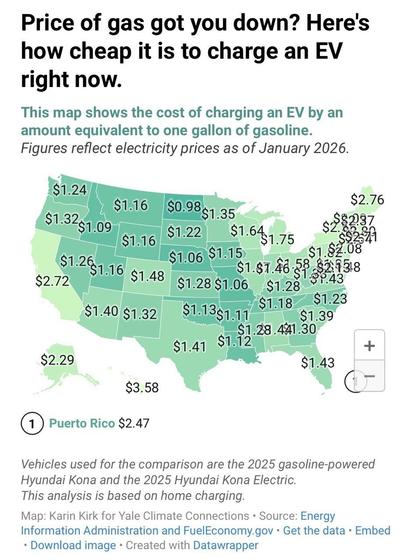

@Sheril

How much does it cost to use an electric train?

Where is the infrastructure for mass transit?

Why are personal vehicles still hailed as a viable answer to climate change's problems?

The sea is rising ever faster.

Elon's cars aren't helping anyone but Elon, and he's digging underground to hide from the rising tide.

@Sea1Am @Sheril other companies make EVs, not just Tesla.

@noodlemaz @Sheril

More trash for the heap. What is your point?

@Sea1Am @noodlemaz @Sheril What's yours? You're in favour of restricting disabled people to their homes? And you know that public transport can be EVs too? Trains, buses, etc. There are reasons for transport which aren't just individual people as well.
Why do you think it's an either/or? And I wouldn't touch a Tesla with a ten foot pole either but he's hardly the only option these days.

@ariaflame @Sea1Am @noodlemaz @Sheril There are disabled people who "need" cars, but there are (probably) many more disabled people who can't use cars, and who instead need good public transport and good pedestrian/bicycle infrastructure.

Car societies restrict people in many more ways than they enable people.

@ahltorp @Sea1Am @noodlemaz @Sheril We therefore need a mix. Good public transport, but for the times that individual (or group, or for goods transport) vehicle is needed, we want EV versions. We also should have good bike lanes, footpaths for easy walking etc. Better organisation of residential areas so that shops etc. are not long distances away.

@ariaflame @Sea1Am @noodlemaz @Sheril What we really need is a shift to a non-car-centric model. Cars can exist, sure, but they should not be the prioritised mode of transport. Cars should always be treated as the exception, and car-centric design should not be allowed to make using other modes of transport significantly worse.

This is not only about cities, in non-city environments roads have been made unusable for all vulnerable road users in large parts of the world.

@ariaflame @Sea1Am @noodlemaz @Sheril Car-centric culture is dependent on threat of violence to keep vulnerable road users off the road. It is vital to car-centric culture that people using roads or streets in ways that slow down car traffic are regularly maimed or killed, in order to instill a high threat level.

This is a very uncomfortable truth, but is easily realised once you actually think about it. Violence against pedestrians and bicycle users is not a side effect.

@ahltorp @ariaflame @noodlemaz @Sheril

I've experienced the violence of the road firsthand and I can confirm your statements. I've spent the past 5 or so years taking my electric bike out to work in a rural community, and I've had some close calls.

Let me tell you, biking around in the Canadian winter is not pleasant. But, it was a sacrifice I was more than happy to make to reduce my footprint, and I plan to continue to reduce it further.

Eden, here I come! One step at a time.

@Sea1Am On a related note, how is the sand/gravel situation where you bike? Here in Sweden both roads and dedicated bike paths are often treated with gravel after snow plowing, but many municipalities are very slow to get rid of the gravel in the spring, leading to many biking injuries and lots of dust inhalation.

Some major urban and suburban bike paths are "sweepsalted", which results in a clean surface, avoiding slippery gravel, but is probably not a reasonable solution for rural roads.

@ahltorp

In Ontario we use road salt instead of gravel pretty much everywhere, I think because there are salt deposits beneath the great lakes which make it cheap for us.

The salt gets all over the bike and corrodes everything, it's absolutely terrible.

I rode that bike until it was too far gone, I'm not sure what I'm going to do with it now. I might scrap it for the motor.

Soon, I'll be living/working at a farm this year and doing my best to get by just walking to town, or ride-sharing.

@Sea1Am I think they get away with using much less salt with the bike path "sweepsalting" method than when salting bigger roads, but the chain and wheels should be cleaned thoroughly after each trip anyway.

@ahltorp

Yea, it was never enough though. The salty slush got inside the crevices and just slowly ate it all away.

I had to replace a few parts over the years to keep it going, and I was never able to keep it clean enough in the winter.

Leaving it covered outside while I worked didn't help much.

It lasted as long as I needed thankfully.

I'll keep the battery for something.

They really want you to own a car and be a slave to the insurance companies that try their best not to pay out.

@ahltorp @ariaflame @noodlemaz @Sheril

And let's not forget the urban heat island effect. We deserve better.