 Yoïn van Spijk
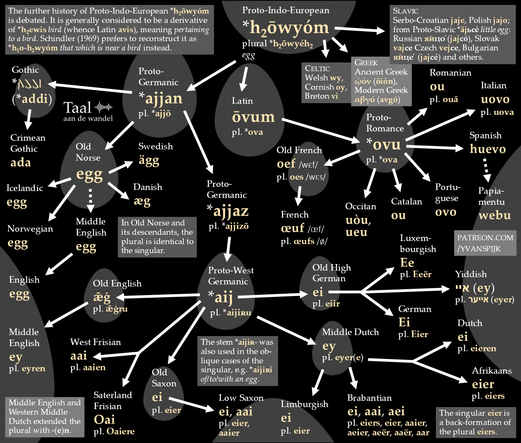
Eggs are oval. The word ‘egg’ is even etymologically related to ‘oval’.
‘Oval’ comes from Latin ‘ōvālis’ (egg-shaped), a derivative of ‘ōvum’ (egg), the ancestor of Spanish ‘huevo’, French ‘œuf’ and others.
Latin ‘ōvum’, in turn, was a distant cousin of Germanic *ajjan, the ancestor of Old Norse ‘egg’. This word was borrowed into Middle English and gradually displaced the native word ‘ey’.
Click my new infographic graphic to learn more.
See post 2 for an anecdote on ‘eggs’ and ‘eyren’.
 proedie