'In six years, we’ve suffered three major trade and supply chain interruptions – the COVID cut-off, Chinese government trade coercion and irrational US tariff attacks – and learnt nothing. [Prof] Rory Medcalf ... calls it “preparedness amnesia”.

'People’s definition of successful national security? “The continuity of normal life,” says Medcalf.

'Australia sailed gormlessly into today’s global crisis with fewer days’ fuel supply than any of the 32 member countries of the International Energy Agency. Australian oil stocks at the end of last year were enough for 49 days, according to IEA statistics. Second least prepared was New Zealand with 88. More realistic island nations’ reserves range from Britain’s 124 days to Japan’s 208.

'If Australians have to stay home and go hungry, will the government really tell us to be thankful for the $20 billion [it would cost to grow liquid fuel reserves to 3 months but which] we’ve saved from a federal budget of $800 billion, even if it inflicts major damage to our $2 trillion economic output? This is the definition of penny wise, pound foolish.

'Given that we are a country of fewer than 30 million people occupying a whole continent, far from our sources of prosperity and security, there is no alternative to the US alliance that wouldn’t be prohibitively expensive and highly risky.

'We can be completely subjugated through naval and economic means, with no agency for our country. I’m pushing for industrialisation to give us agency and freedom of action'.
https://www.smh.com.au/politics/federal/australia-is-vulnerable-that-s-not-in-doubt-can-our-leaders-keep-us-secure-we-re-about-to-find-out-20260403-p5zl5b.html

Australia is vulnerable. That’s not in doubt. Can our leaders keep us secure? We’re about to find out

Call it nonchalance, call it inertia, call it amnesia, but the complacency of governments Liberal and Labor has left us dangerously exposed to global crises.

The Sydney Morning Herald

@ravirockks

Focused on fossil fuel, electrify our transport being cheaper, faster and better for decarbonisation and national security.

@SuperMoosie Quite, but we need reliable and consistent baseload to drive that electrification.

In my view, that’s nuclear.

@ravirockks

If you want the slowest to plan*, approve and build, most expensive power, while keeping coal in the system the longest, the answer is nuclear.

The number of countries running nuclear is dropping, as is the world wide output.

The coalition plan of building 5 large nuclear and two smr** would eventually generate a pitiful 3.7% ot the total.
Meanwhile we are already over 50% renewables in the NEM and growing fast.

* We took 50 years to decide a second Syd airport, how long to decide a nuke site?

**SMR do not exist. There is none who is making small modular reactors. Building large modular reactors didn't make did not make them cheaper or quicker. It actually made them slower and more expensive.

Nuclear doesn't make sense for counties that have abundant sun and wind. Nuclear plants are prone to lomg delays and large costs overruns. - Mnerals council of Australia website ( IE the people responsible for marketing Australian uranium say it isn't viable here)

@SuperMoosie How is the worldwide output dropping when the Indians are commissioning new plants and building more?
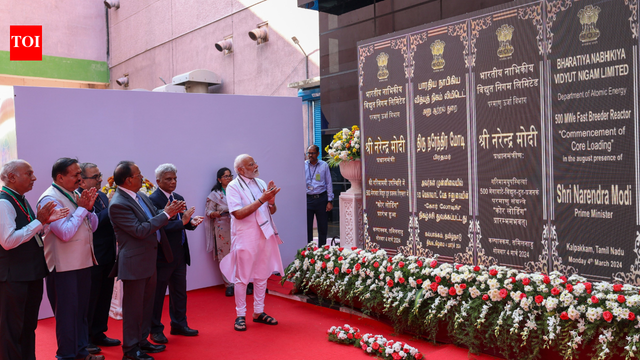
Kalpakkam's fast breeder reactor attains criticality, PM calls it 'proud moment for India' - The Times of India

News News: NEW DELHI: In a big boost for India’s civil nuclear energy production, the indigenously designed and built Prototype Fast Breeder Reactor (PFBR) at Ka.

The Times of India