 Humphrey Archer
 Levka
LevkaI pity your ignorance. You’re also rude and vulgar, but I forgive you for that. You can’t help it. Rudeness and vulgarity stem from ignorance.
Ignorance can be cured. Start here:
I pity your ignorance. You’re also rude and vulgar, but I forgive you for that. You can’t help it. Rudeness and vulgarity stem from ignorance.
Ignorance can be cured. Start here:
But wait. There’s more:
Female hunters of the early Americas
Sexual division of labor with females as gatherers and males as hunters is a major empirical regularity of hunter-gatherer ethnography, suggesting an ancestral behavioral pattern. We present an archeological discovery and meta-analysis that challenge the man-the-hunter hypothesis. Excavations at the Andean highland site of Wilamaya Patjxa reveal a 9000-year-old human burial (WMP6) associated with a hunting toolkit of stone projectile points and animal processing tools. Osteological, proteomic, and isotopic analyses indicate that this early hunter was a young adult female who subsisted on terrestrial plants and animals. Analysis of Late Pleistocene and Early Holocene burial practices throughout the Americas situate WMP6 as the earliest and most secure hunter burial in a sample that includes 10 other females in statistical parity with early male hunter burials. The findings are consistent with nongendered labor practices in which early hunter-gatherer females were big-game hunters.
Despite such theoretical considerations, some scholars have been reluctant to ascribe hunting functionality to tools associated with female burials (20–22). Concerning the Paleoindian Gordon Creek burial, Breternitz et al. (23) grappled, 'Since the burial has been determined to be a female, the inclusion of a projectile point preform has been difficult to explain. However, if the artifact had been used as a knife or scraper, typically women’s tools, then its inclusion with the burial is a more consistent association.' Nelson (24) challenged a DNA-based sex determination at Toca dos Coqueiros (25) partially on the grounds that '...[t]he presence of inferred funerary offerings in the form of chipped stone points and other tools and flakes appear to support [male estimation]....' On the one hand, such reluctance may reflect a degree of contemporary gender bias r ethnographic bias. On the other hand, ethnographically informed models of gendered subsistence labor remain plausible as quantitative phenomena or given the multiple pathways by which objects can come to be spuriously associated in the archeological record. Toward resolving the question of gendered big-game hunting practices among early hunter-gatherer populations in the Americas, we report the discovery of two Early Holocene [pre–8 thousand years (ka)] hunter-gatherer burials in association with big-game hunting paraphernalia and place these findings in the context of Early Holocene and Late Pleistocene burial practices throughout the Americas."
And . . .
"Early Women Were Hunters, Not Just Gatherers, Study Suggests
Regardless of maternal status, women hunted in almost 80 percent of recent and present-day foraging societies in a new study
People have long said that in prehistoric foraging societies, labor was divided by gender: Women gathered and men hunted. But now, a new study adds to the growing body of work challenging this idea, suggesting that prehistoric women were just as skilled at killing game as men were.
'We’ve had scattered reports here and there about women’s hunting,’ Vivek Venkataraman, an evolutionary anthropologist at the University of Calgary in Canada who was not involved with the research, tells Science’s Bridget Alex. But the new research 'pulls a lot of these things together.'
In the paper, published Wednesday in the journal PLOS ONE, a team of international researchers identified 391 foraging societies across the world, from the 1800s to present day. (Scientists use modern foraging societies as a window into past human behavior, reports NPR’s Nurith Aizenman.) Of these, they obtained data on hunting from 63 societies.
'We were reading papers written by people who had lived with these groups and had studied their behavior,’ study co-author Cara Wall-Scheffler, a professor and co-chair of biology at Seattle Pacific University, tells Live Science’s Jennifer Nalewicki. 'They were looking at people and recording what they did.'
Their analysis revealed that regardless of maternal status, women hunted in 50 of these societies—or about 79 percent. And more than 70 percent of female hunting appeared to be intentional—rather than opportunistically killing animals while doing other activities, per the study. In societies where hunting was the most important activity for subsistence, women participated in hunting 100 percent of the time.
'The hunting was purposeful,‘ Wall-Scheffler tells NPR. 'Women had their own tool kit. They had favorite weapons. Grandmas were the best hunters of the village.'
The researchers also found that women played an active role in teaching hunting, and they used a wider variety of weapons and hunting strategies than men did. For example, while men tended to hunt alone or in pairs, women hunted alone, with a man or with groups of women, children or dogs. Women hunted small game in 46 percent of the studied societies and took down medium or large game in 48 percent of them. In 4 percent of societies, they hunted game of all sizes.
While previous research has found that women may have rivaled males when it came to taking down big game, historically, scientists have dismissed females’ hunting prowess, possibly because of researcher bias, per the paper. But recent studies have increasingly shown women as hunters: In the Americas, a 2020 study found that females likely represented up to 50 percent of prehistoric big game hunters, suggesting the practice was gender neutral.
And the remains of women, like men, have been discovered buried alongside hunting weapons. Yet, while researchers presume stone projectiles found buried with men are hunting tools, they are “'ess persuaded when projectiles are associated with females,' per the new paper.
Wall-Scheffler tells NPR that stories of gender differences in our ancestors have percolated into our society today, which can lead people to assume dividing labor based on gender is a more natural way to live.
‘It can be damaging,’ Nurith Aizenman reports for NPR. ‘They use that to argue that gender roles should be more rigid today.’"
But don’t stop there. Read these:
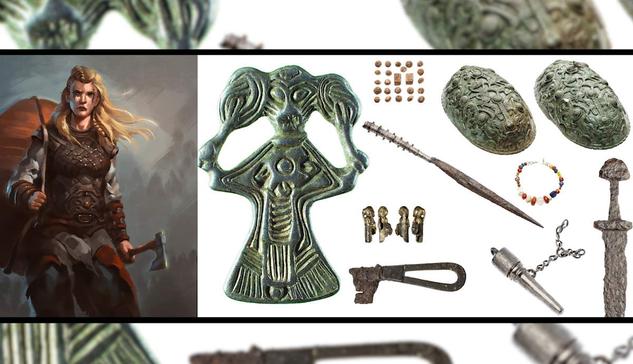
https://www.thecollector.com/incredible-burial-excavations-viking-women/