
I need help to work out the aperture settings for a vintage lens, believed to be approx 1915. The lens is marked:

H Duplouich, Paris, Rectilicne Extra Rapid

That is all: no max aperture and no focal length (my guess for the latter is 100mm).

The aperture scale runs from 2 to 22 with equidistant segments. 2 is the smallest aperture, 22 is WIDE OPEN, so it is not related to an f-stop scale. I think it is the aperture diameter in mm.

An idea how to work out f-stops?
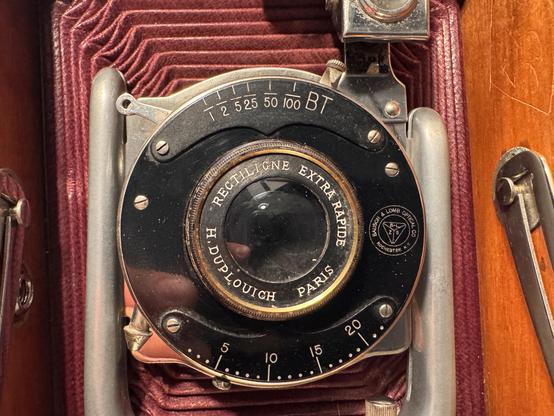
#vintagelens #vintagecamera

@tapasinthesun any experience with older cameras like this @Documentally ?
@LDJ @tapasinthesun I think you’re right in regards to aperture measurement and if you are sure it’s a 100mm lens then wide open at 22mm will be f4.5. And if 22 mm = f4.5, 20 mm = f5, 15 = f6.7 and so on. Each F-stop should change by a factor of √2 ≈ 1.414
But I would definitely run a test for film through it first. Logging alongside a light meter :-)

@Documentally Thank you for the info. It is much appreciated!

I will try to confirm the focal length and the aperture diameter numbers as best I can. Then do the maths and carry out film testing. I will post the results here, possibly even do a blog post. But it may take a while…
@LDJ

@tapasinthesun @LDJ cool. Look forward to it. There’s nothing like resurrecting old glass. :-)
It's been ages since I did any optics stuff back at university, but it should be as simple as N = f/D, with f being the focal length and D being the entrance pupil diameter. So the lens goes from N = 100/2, i.e. f/50 through to N = 100/22, i.e. f/4.545... (I think, anyway...)

(Light transmission etc. is probably way worse than a modern lens with anti-reflective coatings and suchlike!)

Anyway - fun thing! Looking forwards to seeing what you do with it.

@coprolite9000 Thank you for the info. It is much appreciated!

I will try to confirm the focal length and the aperture diameter numbers as best I can. Then do the maths and carry out film testing. I will post the results here, possibly even do a blog post. But it may take a while…

I hope to use glass plates and film with this camera, once I have worked out the aperture settings and got everything working.

@tapasinthesun @rdm focal length ‘f’ is the distance from the aperture iris to a sheet of paper when the wide-open lens casts an in-focus (upside-down) image of a distant object on the paper.

F-stops are literally a fraction. f/8 means “aperture diameter is focal length divided by 8”

The relationship between focal-length, stop number and diameter is d=f/n or f=nd or n=f/d

So with f=100 and d=5mm that’s n=20 (d=f/20)

f=100 and d=22 gives you f/4.5

ETA: the reason we use stop numbers rather than diameters is that they’re comparable between lenses. f/8 on a 100mm lens gives you the same exposure as f/8 on a 25mm lens. The ratio between adjacent stop number is such that the area doubles at each stop, which means if you open up one stop and halve the shutter speed at the same time, the exposure is equivalent; you no longer need to do math to set exposure, just count clicks.

@Unixbigot @tapasinthesun @rdm What a delightfully clear, concise and useful explanation. Thank you!

@Unixbigot Thank you for the info. Very clear and easy to follow. It is much appreciated!

I will try to confirm the focal length and the aperture diameter numbers as best I can. Then do the maths and carry out film testing. I will post the results here, possibly even do a blog post. But it may take a while…

I hope to use glass plates and film with this camera, once I have worked out the aperture settings and got everything working.
@rdm

@tapasinthesun @rdm that’s fabulous, what an adventure. If you can find a copy of Ansel Adams’s “The Camera” it’s probably The Book on view cameras.
@Unixbigot I have all three Ansel Adams books. Maybe I should look at them again!
@rdm