
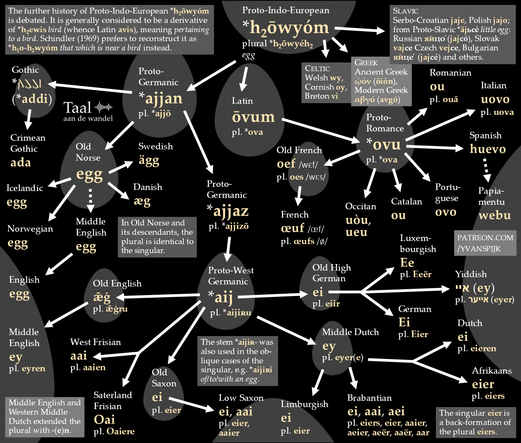
Eggs are oval. The word ‘egg’ is even etymologically related to ‘oval’.

‘Oval’ comes from Latin ‘ōvālis’ (egg-shaped), a derivative of ‘ōvum’ (egg), the ancestor of Spanish ‘huevo’, French ‘œuf’ and others.

Latin ‘ōvum’, in turn, was a distant cousin of Germanic *ajjan, the ancestor of Old Norse ‘egg’. This word was borrowed into Middle English and gradually displaced the native word ‘ey’.

Click my new infographic graphic to learn more.

See post 2 for an anecdote on ‘eggs’ and ‘eyren’.
2/

In 1490, William Caxton wrote an anecdote on ‘eggs’ and ‘eyren’. Commenting on the linguistic diversity of English, which made creating a standardised English hard, he told the story of a group of northern merchants asking a southern lady for eggs:

“And one of them, named Sheffelde, a mercer, cam in to an hows and axed for mete, and specyally he axyd after eggys. And the goode wyf answerde that she coude speke no frenshe. And the marchaunt ... 2/

3/

... was angry for he also coude speak no frenshe, but wolde have hadde egges and she understode hym not. And thenne at laste a nother sayd that he wolde have eyren; then the good wyf sayd that she understood hym wel.
Loo, what sholde a man in thyse dayes now wryte: egges or eyren? Certaynly it is harde to playse every man bycause of dyversite & chaunge of langage.”

(And one of them, named Sheffeld, a mercer, entered a house and asked for food, and specifically he asked for eggs. ... 3/

4/ ... the good lady answered that she couldn’t speak French. And the merchant was angry because he couldn’t speak French either, but he wanted to have eggs and she didn’t understand him. And then, at last, another person said that he wanted to have eyren; then the good lady said that she understood him well.
Oh, what should one write nowadays: egges or eyren? It’s certainly hard to please everyone because of diversity and change of language.)
@yvanspijk (Never would I have believed that the word “diversity” was already in use - exactly with today’s meaning! - more than half a millennium ago. 😍)
@swoonie @yvanspijk i understood the merchant well. Funny, that.

@lindarosesmit @swoonie @yvanspijk

I recognised eyren as related to modern Dutch eieren, and in Scots eggs (in plural) are sometimes called "eggis" (which likely also influenced the formation of the plural in dialects of Northern England)

https://www.dsl.ac.uk/entry/dost/eg_n

Dictionaries of the Scots Language:: DOST :: eg n