 Prof. Sam Lawler
RE: https://telescoper.blog/2026/04/03/finding-easter/
I'm an astronomer, and I teach at a Catholic college (though I'm not religious myself).
I had absolutely no idea how complicated the date of Easter is. Wow.
RE: https://telescoper.blog/2026/04/03/finding-easter/
I'm an astronomer, and I teach at a Catholic college (though I'm not religious myself).
I had absolutely no idea how complicated the date of Easter is. Wow.
I never understood why it always changes.
@grb090423 Backwards compatibility. It's tied to a Jewish holiday, and the Jewish lunisolar calendar is built radically differently from the solar-dominant Roman calendars that grew dominant in the Christian parts of Europe.
Thank you for explaining this. I did not know 👍🙂
I did. Thanks! 👍🙂
@grb090423 In the early days of the Christianity, the Easter date could be determined in Rome, and just, effectively, mailed to wherever there were Christian congregations. But by the late 400s / early 500s, the Roman Empire was in such a delapidated state that reliable mailing started to be an increasing problem, so various offline methods for the Easter determination were considered. The officially adopted one was eventually based on an algorithm developed by one Dionysios Exiguus, or Dennis the Geek, potentially partly because of its another important benefit: it allowed the steps to be unambiguously independently verified, and mistakes caught. (There were a couple of embarrassing mistakes in some Easter tables that the early Popes published. Big scandals in their days, because holidays were Serious Business. Literally.)
You are educating me! I can definitely say TIL.
Dennis the geek... Is that real?!
Do you know so much about this because you have studied it?
It's sort-of real. 
Dionysios was once a popular Greek name, derived from the name of the ancient Greek deity of drinking and being merry. The modern English Dennis is an adaptation of it, the same way a lot of modern English names are adaptations of Greek names poularised by Christianity's spread. This particular Dionysios was a monk known for being small and humble ('Exiguus' literally means 'Humble'), and, well, also for enjoying computing things. Hence, I submit that 'the Geek' is a defensible translation of his Greek nickname. 
I know these things because Knuth's The Art of Computer Programming includes a passage about the Computus, as an example of an early elaborate algorithm, and, being an #ADHD kid, I promptly descended into the rabbit-hole.
This is great!
And I agree, Dennis the Geek should absolutely be accepted 👍🙂
Thanks so much for widening my knowledge today! I didn't know any of this 🙂
@riley @grb090423 @sundogplanets I didn't know he was called Dennis (sorry).
Anyway, thanks for sharing.
@nxskok He probably wasn't, in his days. He lived in the 'Civilised World'(tm); the still-chugging-on Roman Empire, where both Greek-speaking Romans and Latin-speaking Romans would have used some recognisable form of 'Dionysios' or 'Dionysius'. The 'Dennis' form probably only arose as the name got exported into the 'Barbarian World', probably starting from the semi-"wild", semi-Roman, Gaul of the day, where the two had some of the relatively friendliest encounters. Old Greek is a bit weird, as languages go, in that it has a marker suffix for the nominative case; most other European languages don't, and as the Greek and Latin words started to seep into the developing European languages, many of them kind of bulk-snapped the -os and -us nominative suffixes off from Roman words, and names. With that, and some vowel merging, Dionysios became Dennis for English (and Denis / Денис for Bulgarian). It's the same process that made 'Mathaios' into 'Matthew', 'Petros' into 'Peter', and 'Ioannes' into English 'John' and German 'Hans' and Slavic 'Ivan'.
@nxskok Anyway, it turns out that there's a Saint Dionysios of Paris, also known as Saint Denis of Paris, who lived somewhen in the middle of the 200s, was, as the legend goes, beheaded in Lutetia the 250s, moved into his own abbey in the 600s, and as his career progressed, eventually rose to be a patron saint of France and headaches. Unfortunately, reliable data about his life is scarce; we don't even know for sure if the root cause of his final headache was Valerian.
But he lived about two centuries before Dionysios Exiguus, and moved from Rome to Lutetia, so odds are, if Dennis the Geek was discussed in Gaul in a local vernacular during his lifetime, he would already have been called 'Denis'.
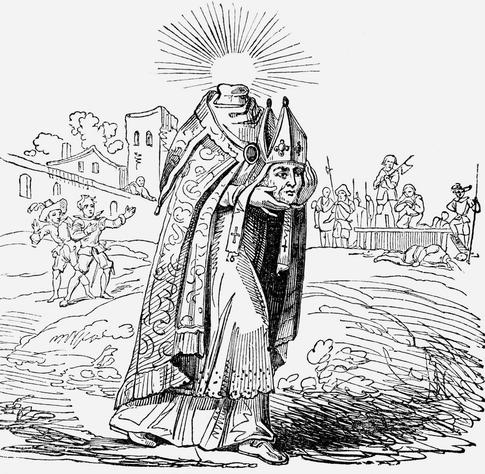
St. Denis was allegedly the first bishop of Paris and an early Christian martyr. He is a patron saint of France and Paris. St. Denis is also venerated as one of the 14 Holy Helpers, a group of saints who were especially popular in the Middle Ages for their powers of intercession.
@riley @grb090423 @sundogplanets
Though it doesn't always (nearly) coincide with Pesach.
 Eye
Eye Riley S. Faelan
 Ken Butler
 always tired