 Erik Uden 🚩
"I am convinced there is only one way to eliminate these grave evils, namely through the establishment of a socialist economy."
— Albert Einstein, Why Socialism
Happy Birthday Albert Einstein 
"I am convinced there is only one way to eliminate these grave evils, namely through the establishment of a socialist economy."
— Albert Einstein, Why Socialism
Happy Birthday Albert Einstein
I should much rather see agreement with the Arabs on the basis of living together in peace than the creation of a Jewish state.
— Albert Einstein, speech to The National Labor Committee for Palestine delivered at the Commodore Hotel, New York, April 17, 1938.
As long as the British are ruling Palestine there will be no peace between Jews and Arabs. British colonial rule is based on the 'native'—do you know what it is, the 'native'? He is a very exploited man.
[The Arabs won't resist Jewish immigration] if they are not instigated. If people work together, they won't worry who has the greater number.
[A Jewish state in Palestine] is not according to my heart. I cannot understand why it is needed. It is connected with narrowmindedess and economic obstacles. I believe it is bad. I have always been against it.
— Albert Einstein, 11th of January 1946 as a witness to the Anglo-American Committee of Inquiry on Palestine, as cited by the New York Times
Additionally, Albert Einstein stated the following (although no official quotes exist):
Smiling benignly, Professor Einstein launched into the most wholehearted denunciation of British colonial policy that the committee has yet heard. He said that he was formerly an admirer of the British system and regretted that he had now reached the contrary conviction.
(1) He is convinced, though regretfully, that British colonial policy is such as to render Great Britain unfit for further administration of her mandate over Palestine.
(2) A trusteeship should be set up by the United Nations to administer Palestine and it should not be confined to any single power, including the United States.
(3) The great majority of Jewish refugees in Europe should be settled in Palestine.
(4) He has never seen any necessity for a Jewish commonwealth such as is advocated by the Zionist Organizations for Palestine.

Testifies in Arabs behalf, joint comm to investigate Palestine
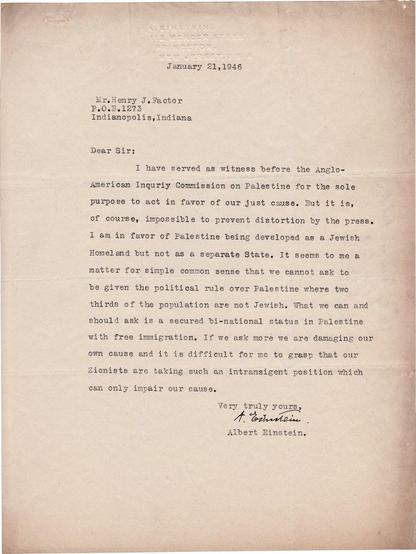
I have served as witness before the Anglo-American Inquiry Committee on Palestine for the sole purpose to act in favor of our just cause. But it is, of course, impossible to prevent distortion by the press. I am in favor of Palestine being developed as a Jewish Homeland but not as a separate State. It seems to me a matter for simple common sense that we cannot ask to be given the political rule over Palestine where two-thirds of the population are not Jewish. What we can and should ask is a secured bi-national status in Palestine with free immigration. If we ask more we are damaging own cause and it is difficult for me to grasp that our Zionists are taking such an intransigent position which can only impair our cause.
— Albert Einstein in a letter to Henry J. Factor, written in Princeton, New Jersey, USA on January 21st, 1946
Among the most disturbing political phenomena of our times is the emergence in the newly created state of Israel of the "Freedom Party" (Tnuat Haherut), a political party closely akin in its organization, methods, political philosophy and social appeal to the Nazi and Fascist parties. It was formed out of the membership and following of the former Irgun Zvai Leumi, a terrorist, right-wing, chauvinist organization in Palestine. The current visit of Menachem Begin, leader of this party, to the United States is obviously calculated to give the impression of American support for his party in the coming Israeli elections, and to cement political ties with conservative Zionist elements in the United States. Several Americans of national repute have lent their names to welcome his visit. It is inconceivable that those who oppose fascism throughout the world, if correctly informed as to Mr. Begin's political record and perspectives, could add their names and support to the movement he represents. […] In the light of the foregoing considerations, it is imperative that the truth about Mr. Begin and his movement be made known in this country. It is all the more tragic that the top leadership of American Zionism has refused to campaign against Begin's efforts, or even to expose to its own constituents the dangers to Israel from support to Begin.
— Albert Einstein, written on December 2nd, 1948 in a published Letter to the New York Times [1] [2]
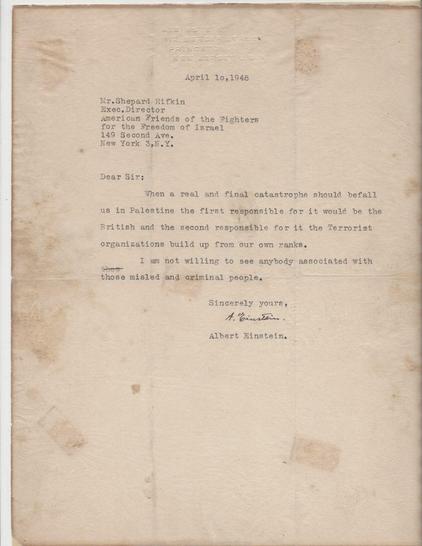
When a real and final catastrophe should befall us in Palestine the first responsible for it would be the British and the second responsible for it the terrorist organizations built up from our own ranks. I am not willing to see anybody associated with those misled and criminal people.
— Albert Einstein, April 10th 1948 in a letter to the “American Friends of the Fighters for the Freedom of Israel”
Tell me what to do if [Albert Einstein accepts to become president of Israel]! I've had to offer the post to him because it's impossible not to. But if he accepts, we are in for trouble.
— paraphrased from Israeli Prime Minister David Ben-Gurion, claimed to have said this in 1952 according to his political secretary Yitzhak Navon who remembered it in a 1979 symposium
@ErikUden This kind of evidence from the historical record is so important. People in the global Jewish community were objecting to Zionist* settle-colonial violence *from the start*, which includes a decade or two before WWII.
*I use this term sparingly and only to refer to those people who called themselves that. I'm aware that antisemites use it to attack all Jews.
 Rainer Zufall
 Lars Fischer
 Kit Rhett Aultman
 🍉Karl☭Skalidin🌱
 Orion Ussner kidder