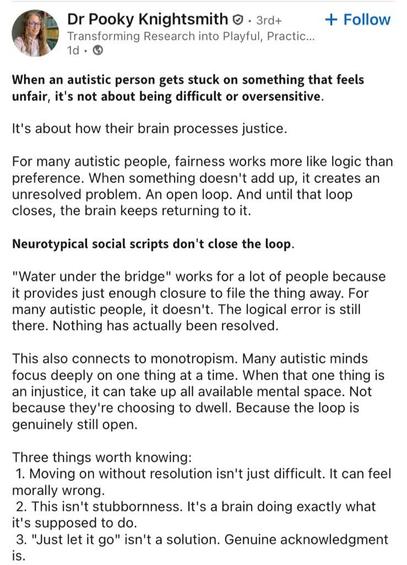
I wonder if spicy brains (on the tism spectrum) are more inclined towards deontological arguments and inability to move past things that are "wrong" (the famous "das Bild hängt schief")?

These can feel almost like physical pain and ... aren't always well suited for dealing constructively with reality when it's being, well, reality.

Requires reframing so that the world is no longer entirely wrong to regain agency.
@larsmb autistic person here, somewhat disagreeing. Iirc, part of the clinical questionnaire for autism is whether the person is adhering strongly to a moral code even if doing so is socially detrimental. However, iirc another part of the questionnaire is whether the person has made up own moral rules that are outside the social group's ethical norms, e.g. strong own opinions about religion outside of the group's dogma. As a person who has been to different self-help groups related to autism, I can confirm that the things that autistic people consider right or wrong and then stick to it even under group pressure can be wildly different sets of ethics. The pro-AI TESCREAL crowd, which I find abhorrent, attracts a high percentage of autistic people, see also the Zizians.
@larsmb I have observed that a neurotypical trait is to agree that we all know something is wrong but an authority figure can then signal to the social group to let's just not talk about it anymore. The neurotypical group willingly complies to please the leader, while an autistic person can't simply agree to that forced agreement and is perceived as obnoxious for it. This has also been described elsewhere: