 Aral Balkan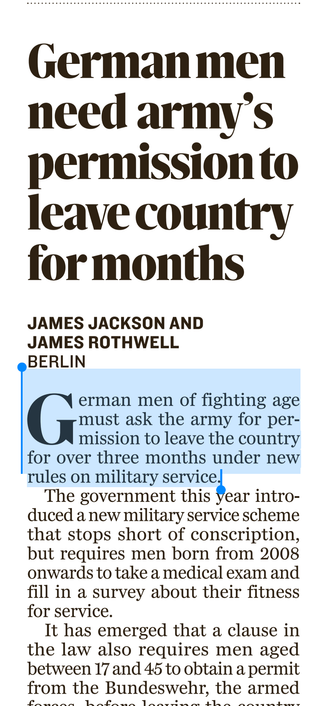
 Lyrial
@aral What's the source for this?
 Fynn Ellie Be
 groff 🇺🇦
 Maik 🇪🇺
@mvsde @lyrial @aral Read the complete Text please.
https://www.gesetze-im-internet.de/wehrpflg/BJNR006510956.html
"Die §§ 3 bis 52 gelten im Spannungs- oder Verteidigungsfall."
"Sections 3 to 52 apply in the event of tension or defense."
And this is currently not the case.
https://www.gesetze-im-internet.de/wehrpflg/BJNR006510956.html
"Die §§ 3 bis 52 gelten im Spannungs- oder Verteidigungsfall."
"Sections 3 to 52 apply in the event of tension or defense."
And this is currently not the case.
 stephie
 Gondor
That's the old version. It was replaced by the recent decision.
The current version deleted that "apply of tension or defense".
Source:
https://www.fr.de/politik/genehmigung-drastische-wehrpflicht-aenderung-maenner-die-deutschland-laenger-wollen-brauchen-zr-94248132.html?utm_source=flipboard&utm_medium=activitypub
Artikel-Zitat:
"Das bedeutet schlicht, dass die Regelung des Paragraphen 3 nun grundsätzlich immer gilt."
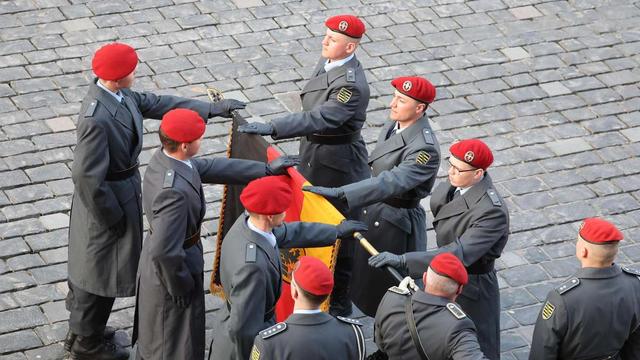
@lyrial See alt text.
 Reiner Jung 🇬🇱 🇺🇦 🇪🇺
 Benjamin Braatz
 Fnordinger
@HeptaSean You’re wrong. Before the beginning of this year, this was only necessary in times of military tension or defence. Now the permission is necessary at all times.
@Fnordinger No, _you_ are wrong. The restriction to tension and defence was only _introduced_ in 2011. For most of us older people, the exact same rule was in place the whole time up until 2011. @prefec2 @lyrial @aral
@HeptaSean But it was only active in two scenarios as explained by §2 and further explained with sources in my orher reply to you
@HeptaSean The changes can be seen here https://www.buzer.de/gesetz/5521/v335580-2026-01-01.htm
While §2 used to say:
Die §§ 3 bis 53 gelten im Spannungs- oder Verteidigungsfall.
They now added §2 (3): “Außerhalb des Spannungs- oder Verteidigungsfalls gelten die §§ 3, 8a bis 20b, 25, 32 bis 35, 44 und 45.”
@Fnordinger For example, the Wehrpflichtgesetz of 1995: http://www.bgbl.de/xaver/bgbl/start.xav?startbk=Bundesanzeiger_BGBl&jumpTo=bgbl195s1756.pdf
§3 already said that you had to ask the Kreiswehrersatzamt for permission to leave the country.
The restriction in §2 was not there until 2011 (introduction of „Freiwilliger Wehrdienst“). As I said.
§3 already said that you had to ask the Kreiswehrersatzamt for permission to leave the country.
The restriction in §2 was not there until 2011 (introduction of „Freiwilliger Wehrdienst“). As I said.
@HeptaSean ah shit you’re right, my bad, I misread your initial message. There are still some issues I habe with that rule, but it is indeed the same problematic rule that existed before 2011.
Now the main problem is that they reintroduce Wehrpflicht-times rules during non-Wehrpflicht-times (at least officially), and that apparently the Careercenters don’t issue the permissionslips, because they have no official guidelines yet.
@HeptaSean But that’s my personal taste (I’d much rather not ask for permission to make use of a human right), politicians being dishonest and public officials being unable to make any sort of executive decisions.