 Natasha
  🇪🇺
🇪🇺The true meaning of Easter, by Stephen Collins (who writes his own amazing #AltText)
"PAGAN GODDESS: Aisle four is full of products, with no hint of the true meaning of the festival!
BECKY: You mean … Jesus …?
PAGAN GODDESS: I mean shagging, Vicky."
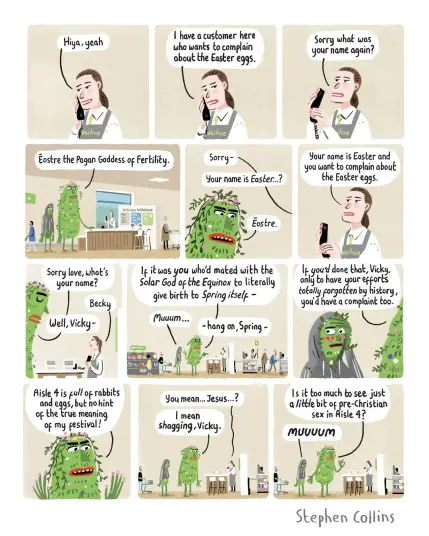
The true meaning of Easter, by Stephen Collins (who writes his own amazing #AltText)
"PAGAN GODDESS: Aisle four is full of products, with no hint of the true meaning of the festival!
BECKY: You mean … Jesus …?
PAGAN GODDESS: I mean shagging, Vicky."
@Natasha_Jay For what it's worth, I very recently saw that this might not actually be true. I thought it was for decades though, because it does make a lot of sense.
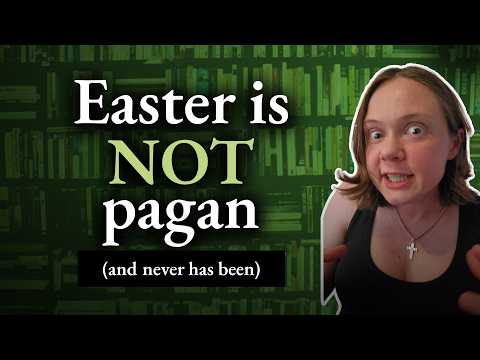
@vwbusguy @Natasha_Jay @Meerkat26 I’d take her more serious without the two (!) crosses on extra display.
Around 2:40 she loses the plot. Yes, age 8, but there’s still the possibility of having acquired knowledge from the household, and we all are sad that knowledge from those times was not generally preserved in writing (or whatever writing was on hasn’t endured, or was burnt by people like her, etc).
I would be interested in UPG from people-with-some-credibility about these, though.
What she does here is try to approach this with a double-role of christian scholar and evidence-based historian. Everything else does not count in her eyes.
Around 3:40 she completely loses it again.
As for rabbits, mediæval people associated them with the Virgin Mary because mediæval people thought that rabbits experienced virgin birth.
I have been assured by farm-type people, lady, that people living in such a setting (mediæval farm-type) know intimately well where offspring (especially of lifestock) comes from. (Now, people who’ve grown up in cloisters from age 8… might not know well, unless they were assigned to the section (out of sight, out of mind) who cared for theirs, instead of being their scholars and historians.) (This point does of course not prove a connection between rabbits and Ēostre-or-what-have you, but it does sow sufficient doubt in the presentation of a whole and her methods. (And, in fact, the whole rabbits-and-eggs to fertility link never sat well with me anyway, but hips (think of that Venus-of-someplace statue from prehistoric times) and things… are.)
Roughly a thousand years after the conversation to Christianity
She’s not aware of…
…, is she? She sounds like one of these evangelical narrow-minded ivy tower preachers here. (Again, not arguing in favour of that specific link. But, substrates exist, as does merging of “local traditions” (nice euphemism) and “christian” holidays.)
… I cannot believe I didn’t DNF this.
@vwbusguy @Natasha_Jay @Meerkat26 and then there’s this whole other point (which a double-crossing (literally) christian like her could not conceive):
If, over hundreds of years, enough people associated eggs and hares with Ēostre and/or fertility… it now is an aspect of this pagan goddess. (Even if those people did not self-identify as pagans. In those times, it was safer to do the christian thing (in the flavour the current people-with-the-weapons prescribed, catholic, protestant/evangelical/lutheran, orthodox, …) and call the rest “folk belief”; this has a long tradition, and lots of catholic and orthodox practices stem from it.
It’s not as if paganism were a thing of the past.
@antopatriarca @vwbusguy @Natasha_Jay @Meerkat26 have you read my analysis of the video and the multiple arguments I brought?
(And calling “there’s un-written-down things as well, keep an open mind, and especially if there’s people carrying this for hundreds of years it’s a pagan thing now” “blinded by faith”… I don’t think it’s justifyable even when not following the argument.)
And even assuming this Eostre existed, Easter didn't come from England.
Yes, of course not.
 Scott Williams 🐧
 mirabilos
 Antonio Patriarca