do you make music on Linux, and what's your favorite software to work with? and what do you miss the most from Linux music/audio software that exists on other platforms?
yes, having lots of fun with lmms 1.2.2
@cinap_lenrek fun fact, i first included BSD and plan9 in my post but then edited it out again to focus :D
dont worry. the tools dont really matter. 9front has a very active music scene šŸ™‚
@cinap_lenrek hehe yeah the tools matter a little bit to me :D if i constantly have to fight the thing, i'm not making music
@mntmn I feel like tagging @aeva here (in case you don't follow each other?) since I know she works on both OSes... and writes her own stuff, too.

I haven't done anything more serious than just having 'play sessions', rather than "let's make a song!" sessions so my insight probably isn't as valuable as others, but I like Ardour as much as I think I can get comfortable with any DAW and I enjoy using Helm and
https://zynaddsubfx.sourceforge.io/ for various software synth stuff (they have a plugin you can).

I enjoyed playing around with the Bitwig Studio demo but I don't know how
good it is for stuff. But the synth options were pretty awesome and easy to use for someone who isn't overly familiar with a lot of the standard types of levers to manipulate, so to speak
About ZynAddSubFX

@aud @aeva unfortunately no arm64 support in linux bitwig
@mntmn @aeva ah, makes sense; to be honest, I was surprised that something with that slick of an interface was sold on Linux in the first place, in a lot of ways.
@mntmn @aud @aeva this has bothered me for awhile and I was hoping that somehow Apple's move to their arm would somehow make it easier for them to make a Linux/arm64 build of Bitwig.
@mntmn @aud @aeva but that said, my answer is Bitwig. I even run it on my Steam deck.

@aud @mntmn my favorite Linux music software is #mollytime, but I'm biased because I wrote it.

Rosegarden handles realtime playback completely wrong, but it is ok as a MIDI editor. I've been using Tenacity for simple edits of recordings and to converting WAVs to other formats.

I don't really use Windows for music (beyond keeping the windows version of mollytime more or less at parity), and I've never used Macos for music.

@aud @mntmn fwiw I actively dislike most music software in general, which I guess is the sort of thing that usually motivates people to write weird music software instead
@aud @mntmn to save you time, mollytime also does not support arm64 at the moment (for lack of a suitable device to test it on)
@aud @mntmn I don't see any reason on paper that would prevent mollytime from running nice on a MNT Reform or Pocket. My current minspec is a desktop I built in 2012.
@aeva @mntmn would a test build on a pi-like device be a good test for getting support running? I wouldn't mind trying that out myself, honestly, if it would lead towards MNT Reform/Pocket support.
@aud @mntmn the RPI-400 i have on hand only has 4 GB, which makes the device very infuriating to use for normal tasks like "opening websites in firefox", so I haven't tried to use it for much of anything else. I tried to use it to tide me over when my laptop broke a while back, and it was so bad I ended up buying a steamdeck instead. In theory 4 GB should be significantly more than enough to actually run mollytime. I don't remember what the clock speed is on the device.
@aud @mntmn supporting arm64 (and riscv) is something I want to do eventually as libre software running on libre hardware is a niche that is near and dear to my heart
@aeva @aud mollytime looks cool, i hadn't come across it yet! can try to build/run it on our hw soon
@mntmn @aud This is where the source currently lives https://github.com/Aeva/mollytime "excelsior" is the main branch. README.md walks through the basic installation instructions, BUILD.md documents everything necessary to build it and what all the mollybuild.py wraps (as well as what dependencies you may need to install yourself), and BUILD-linux.md contains some additional notes. iirc most of the dependencies are automatically cloned from upstream repositories by mollybuild.py
GitHub - Aeva/mollytime: virtual synthesizer

virtual synthesizer. Contribute to Aeva/mollytime development by creating an account on GitHub.

GitHub

@mntmn @aud if you try it out let me know!

also if you get it to run, there's a hoard of patches in the (poorly curated) examples folder. "drums4.beep" is my current goto for confirming if basic functionality is working. "breath_of_the_world.beep", "tape_loop.beep", "central_dynamo.beep" are probably the main highlights for hearing something pleasant, and in general it is a good idea to keep your volume down low when opening an unfamiliar patch.
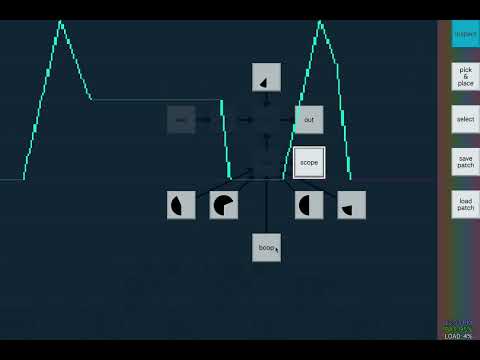
@mntmn @aud the patches in examples/midi are all midi instruments. I usually use aplaymidi to feed midi streams into them or use a midi controller. molytime has 32 lanes of polyphony for midi patches by default which makes them a lot more expensive. starting mollytime with `-p 16` will set it to use 16 lanes instead, etc. Generally you want to see the LOAD indicator run below 50% for midi patches, below 20% is better.
@mntmn @aud I'll be happy to help if you run into any problems getting it running.
@mntmn @aud also as a stopgap for not having proper documentation, this video walks through the basics of how to write and manipulate patches https://www.youtube.com/watch?v=7gWxtttdr0s
mollytime basic operation

YouTube

@mntmn
The needed tool is very dependent of what you want to do.
Mix ? Mixxx
Record ? Ardour
Write ? Musescore
Jam ? Carla

On proprietary, all devs say "yeah my soft can do anything" but it's obviously wrong.
On floss, we know that one good soft is build for on usage.

If you want, i've do a collection of tools (french) at https://l2m2p.lebib.org/?LesOutils

Cherchez ici l'outil de vos rĆŖves

L2M2P est une base d'information communautaire sur les outils libres de production multimedia et pour la scĆØne

l2m2p

@mntmn Yes, Ardour, third party support.

Relying on yabridge and some special wine versions isn't fun for professional work.

@[email protected] Bookmarking this because I’m very interested in the responses!

I’ve tried and failed so far, but i want to keep trying. (So far tried reaper and ardour). What I’m missing:

⁃ Audio device predictability: something about my setup means opening these daws will sometimes kill my wireplumber session in a way I don’t know how to recover without a reboot, and not repeatable enough that I know ā€œwhat not to doā€

The rest is around specific plugins, which I hope the responses provide some good recommendations.
@ruben @mntmn Use ALSA unless you need muxing at the stream level, honestly.
@[email protected] @[email protected] I haven’t been able to get any sound out of ALSA in my current setup
@[email protected] @ruben Oh weird. Are you using an external mixer/sound card?
@[email protected] Sometimes. But I’ll figure it out at some point. Rather than going down the debugging route, the reason I mentioned it is that when I’m in a ā€œmake musicā€ mood i’m not in a ā€œdebug Linux audioā€ mood, and it just makes me not go to my Linux machine for making music.

I can only imagine this is worse for non technical users.
@mntmn loving PureData at the moment.

@mntmn i would say that ardour (if it doesn't crash, but that improved a lot over the years?), x42-plugins and surge xt are pretty nice.

i honestly only miss minor things such as having a "real" piano roll or having the scale highlighted in the piano roll (or... whatever that thing in ardour is called). adding new tracks takes ages in ardour, that's a bit annoying. especially in huge projects.

i use melodyne and that works pretty well with yabridge.

so all in all its pretty okay tbh? don't really miss a lot

@mntmn I do & my favorite music software is Renoise, although I also use some software I made myself (Pebble Music Engine).

Switching to Renoise on Linux from Renoise on Windows, I did lose access to a bunch of free plugins I had collected, but I haven't really missed them all too much tbh

@mntmn there's a lot under the domain of "making music" – & different tools for different things. off the top of my head i use musescore for writing out scores, audacity/tenacity for making rough edits to audio & transcribing things, reaper (ardour in the past as well) for more serious recording work, renoise for midi-controlled synth sounds & programming.

biggest problem you can run into i think is plugins. there are a lot of linux native plugins, some of them very good, but most commercial VSTs are mac or windows only. you can sometimes get windows VSTs working through wine (yabridge) but it's a pain and may not work.

i don't use a computer much in my professional music work so it's all good enough for me.

@mntmn oh – a useful resource i found is this website – https://linuxdaw.org/ – all kinds of things (mainly plugins) listed there.
Linux DAW

Quality audio software for Linux Audio Production such as LV2, VST2, VST3, and CLAP effects, synthesizers and sampler plugins.

Linux DAW
@mntmn I tried with Reaper but found I missed FL Studio too much. I wish ImageLine would make a Linux version.
@Undercat @mntmn LMMS is usually recommended for people coming from FL Studio https://lmms.io/
@mntmn I used Bitwig on Linux a few times. It’s not open-source and a lot of people take issue with that, but it’s a fine piece of software
@fabio yeah, i had a license once, a long time ago, but unfortunately they didn't make an arm64 linux version
@mntmn @fabio I recently asked for it and the idea wasn't completely rejected. Maybe if enough people ask for it?
@decibyte @mntmn they have an Apple silicon version and they kinda brag about having a portable runtime, so I think it’s possible
@fabio @mntmn there's also release for Windows on ARM.
@mntmn I've gotten comfortable with Ardour.

@mntmn I do not yet make music on Linux but the things I worry about are: SoX, a useful DAW (currently use Logic, small list of plugins I like but could live with stock plugins), I/O — I have a merging tech Hapi interface and also an RME babyface & Cranbourne: getting multiple streams of audio in, out, and round trip (through hardware processors) is a critical thing for me and something I always assume is a nightmare on Linux given third party AD/DA converters are part of that.

Beyond that functional MIDI I/O to drive controllers and hardware synths.

@mntmn I could also imagine completely blowing up my audio process and focusing on SoX, SuperCollider (I am in the monome/norns hardware world), and something node-based and treating everything like a 50s electronic music studio environment.
@gahlord @mntmn I do a lot with SoX and supercollider on a cli daw.
There is a ton of learning curve and some tools are just fundamentally user-unfriendly (even if providing numeric arguments to a function does make sense to you, compand is still harder to dial in than any other compressor or gate ive seen)
But it is fun and let's you get some very interesting results

@vomithatsteve @mntmn that is useful to hear. Definitely if I end up going that route I would be intentionally seeking to set aside my mostly ā€œtapeā€ metaphor of recording and replace it with something completely foreign or available only in digital lands like node-based or code-process etc. It would be a wholesale changing out of learned practice for something new. Like the difference between playing bass guitar and making patches on the modular.

That said I am very curious about a CLI DAW!

@gahlord @mntmn ultimately, I use GUI reaper as my main daw, but the CLI tools are mostly a procedural instrument

The modular comparison is pretty apt

@vomithatsteve @mntmn Sweet, I have tried Reaper and I could definitely get by with it as a DAW. Didn’t realise it has CLI too, I think that could be fun to learn.
@gahlord @mntmn oh, sorry I didn't mean reaper cli (I don't know what it has in that regard). I means sox and supercollider
@mntmn I have been trying to make music on Linux for around 20 years now. I've worked with Ardour, LMMS, Reaper, Non, and various trackers. So far my favorite (and most productive, despite me having only released 3 songs so far) is SunVox, which is free but closed source. I really wish Neil would compile on modern systems; I may hack at it at some point.
@mntmn Out of the DAWs I've used, I have probably gotten the most done with Ardour. I like LMMS, and I'd intrigued by Reaper, but haven't really spent enough time with them to do much yet.
@mntmn Renoise. Was a bit of ft2-clone before.
@mntmn bespokesynth is good fun for jams
@mntmn currently,
Synths: yoshimi, BespokeSynth, VCV Rack, LMMS synth plugins
DAWs: Ardour (recording & mixing & effects) & LMMS (arranging, drums, effects, midi instruments),
Writing: Helio (midi piano roll, etc)
Effects: Dragonfly Reverb, Calf, EasyEffects, (some running on Carla)
@mntmn I did very little music on linux, and I us Reaper with vst. Reaper is really really really great for audio montages.

@mntmn I've been a happy Reaper user for many years, so very cool that I can still use it on Linux. Surge XT has become my go-to "super synth," and I'm using Cardinal for a lot of what I used to use Biome for (modular fx processing).

The main things I miss are Sound Forge and Reaktor.

@mntmn

Bitwig Studio, but I am just starting.
@mntmn I’m partial to Bitwig. For native plugins I miss having Valhalla reverbs and some useful LUFS monitoring tools that I use via Yabridge, though maybe there is something native and haven’t look hard enough

@bd Ardour has some really good built-in loudness monitoring tools now, which won't help you in Bitwig, but just in case it's useful! :)

@mntmn

@mntmn i used to use FL Studio on Windows but I have yet to find a good alternative on Linux. It does not really matter though since I never made music seriously, just messing around as a hobby.