
The geat were eating nit under the each.

‘Geat’, ‘nit’, ‘each’– this is what the original plural forms of ‘goat’, ‘nut’, and ‘oak’ would’ve looked like if they hadn’t been replaced by ‘goats’, ‘nuts’, and ‘oaks’.

How did plurals with a vowel alternation came to be, such as ‘man ~ men’ and ‘mouse ~ mice’?

What would the lost ones have sounded like if they’d been preserved?

My short video will tell you:
https://youtube.com/shorts/CTjYP8skREc
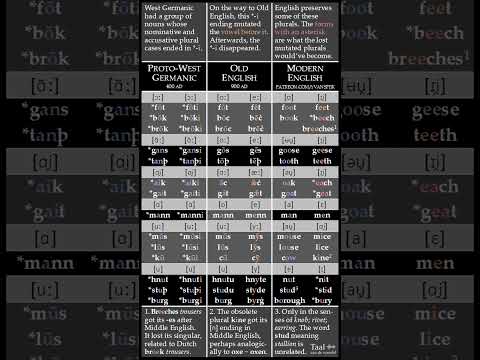
58: One goat, two geat

YouTube
@yvanspijk
The plural of oak „each“ is very similar to the singular in German: „Eiche“
coincidence or not?

@elnecesario That's indeed a coincidence. In 'each', the <ch> spelling represents a different sound, and it arose in a different way. In German, West Germanic *aik became 'Eiche' because single k became the Ich/Ach-laut regardless of neighbouring sounds, while in English, k only bechame the ch sound of 'cheese' if it was followed or preceded by an i: *aiki > *each.
Compare 'milk', 'to make', 'book' with 'Milch', 'machen', 'Buch'.

(Of course, 'oak' and 'Eiche' do have the same ancestor: *aik.)

@yvanspijk very interesting! Thanks for the explanation :)