 Don_Dickle
Has society or scientists ever solved definitively the Chicken and the Egg theory? Or is it just like a whose on first thing?
My stance is that creatures were laying eggs millions of years before the first chicken was born.
 Paragone
 JohnnyEnzyme
Yes, based on a quick lookup, it appears that the first (internal) egg was produced by sexually-reproducing animals over 600m yrs ago. Later, shelled (external) eggs seem to have appeared about ~315yrs ago.
So basically, the egg was a very ancient, fundamental innovation in complex life that appeared well before galliforms (chickens and relatives) did, ~85m yrs ago.
 krank55
At that point the genetic difference would be too small to not call that bird some sort of chicken.
Nope.
There will be an exact egg that contains the first chicken (defined as an animal that can fuck other chickens and produce offspring IIRC), that came before the first chicken because the chicken was in the egg.
I’m no biologist, but I’m pretty sure this ignores how fluid the evolution is from regular bird to proto-chicken to chicken.
Not really there is a well defined line that defines what is/isn’t a chicken, that’s really the only thing needed for this question.
The issue is the term proto-chicken isn’t well defined.
But for it to be considered a different species it would have to not be able to reproduce with a modern chicken (which doesn’t mean it can’t reproduce with early chickens).
there is a well defined line that defines what is/isn’t a chicken
You’ll have no problem citing the exact definition then.
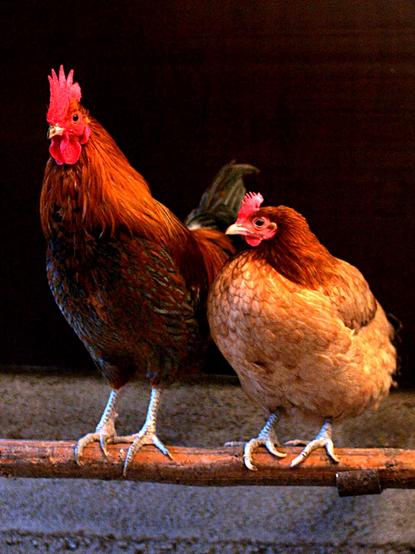
The chicken (Gallus gallus domesticus) is a domesticated form of the red junglefowl (Gallus gallus), originally native to Southeast Asia. It was first domesticated around 8,000 years ago and is one of the most common and widespread domesticated animals in the world. Chickens are primarily kept for their meat and eggs, though they are also kept as pets.[1]
The red junglefowl (Gallus gallus), also known as the Indian red junglefowl (and formerly the bankiva or bankiva-fowl), is a species of tropical, galliform bird in the phasianid family, found across much of Southeast and parts of South Asia.
en.wikipedia.org/wiki/Red_junglefowl
A species (pl. species) is the basic unit of classification and a taxonomic rank of an organism, as well as a unit of biodiversity. It can be defined as the largest group of organisms in which any two individuals of the appropriate sexes or mating types can produce fertile offspring, typically by sexual reproduction.
The first two links are irrelevant because they describe physical characteristics and not a well defined line. The quotes you copied are vague descriptions at best.
The last quote you emphasized says “it can be defined” which shows it’s not a well defined line. Also, there are quite a few cross-species hybrids that have produced fertile offspring.
African forest elephants and African bush elephants are known to hybridize with each other where their ranges overlap.[17] Evidence shows that they can form hybrid zones where their ranges overlap, particularly in the Democratic Republic of Congo and Uganda. Hybrids have been found to be fertile, and a significant number of elephants in hybrid zones, such as Kibale National Park in Uganda, show intermediate physical characteristics.
These birds aren’t even in the same family and have hybridized
The red-crested cardinal (Paroaria coronata, family Thraupidae) has hybridized between the northern cardinal (Cardinalia cardinalis, family Cardinalidae), shiny cowbird (Molothrus bonariensis, family Icteridae), and chestnut-capped blackbird.
The concept of a species is a lot more flexible and less-defined than you think.
That was never a “serious” question in that sense. It’s just a philosophical paradox.
The real answer is that you need to look at the ancestry tree. There wasn’t a moment that a chicken popped up, it was a gradual evolution between an ancestor and until a point that we decided “yup, that’s a chicken”.
It’s not so much a philosophical challenge as a grammatical question.
Was the egg that the very first chicken hatched from a chicken egg, even though it was laid by a non-chicken?
If I waved a scientifically-advanced biotech wand and impregnated a chicken with a small dinosaur, would the resultant egg be a chicken egg even though a dinosaur came out?
 neatchee
I’m going to try to give you an actual answer to your question as I believe you intend it …
First: Let’s agree that the question being asked is NOT “did chickens or eggs exist first?” but rather “If chickens lay chicken eggs, and chickens are born from chicken eggs, and any egg not in this category is not a chicken egg, then is this not a paradox? If there was no chicken, how could a chicken egg be laid? And if there was no chicken egg, how could a chicken be born?”
The “real” answer: What this question actually demonstrates is a weakness in language. It is an ambiguity in the term “chicken egg”. It leaves open for interpretation by the listener what a “chicken egg” actually is, what makes it a “chicken egg”. On the one hand it could be “eggs produced by chickens”. It could be “eggs from which chickens hatch”. It cannot actually be both; they are different, though in practice only slightly. So the answer changes based on how you define “chicken egg”.
My “best effort” answer: If I want to try to answer the question literally, I define “chicken egg” as “An egg which, if allowed to hatch, reach maturity, and breed, will likely produce another of itself (i.e. another chicken egg).” In which case the answer is clear: the chicken egg came first. There was a proto-chicken, someone very much like a chicken but not quite a chicken. It laid an egg with the genetic mutation that made it a “chicken egg” instead of a “proto-chicken egg”. And thus began chickens.
 🇰 🌀 🇱 🇦 🇳 🇦 🇰 🇮
 The answer is pretty obvious if you know and understand evolution. Something that wasn’t quite a chicken laid a chicken egg and hatched the first chicken.
People are confidently saying that the egg came first. But the answer really depends on the askers definition of what a “chicken egg” is. Is it an egg that a chicken hatches out of? Or is it an egg, laid by a chicken? If it’s the former, then yes the egg came first. If it’s the later, then the chicken came first.
If you’re talking about the chicken and egg problem in the abstract, i.e. how do you determine “what caused what” in a system that feeds back into itself… the answer is that in feedback systems, determining blame or ascribing one or the other as the cause is simply meaningless, and you need to examine how the system behaves as a whole, and how the different parts contribute to the output of the system in various configurations.
 Hanrahan