 Mx. Chara Aznable (they/them) of Pnictogen
There's probably a fair number of Americans who believe that the United States destroyed #fascism with The Bomb™, in some indistinct symbolic way. Thus, the very idea that the United States of America is the host for a powerful fascist government must seem unimaginable to them, absurd according to their definitions of terms. The United States is good, fascism is bad, and the United States would never do anything bad, right? The U.S. is the land of #freedom! Well...no, not really. In truth the United States has failed to uphold its principles.
Does that seem unjust? Overly general?
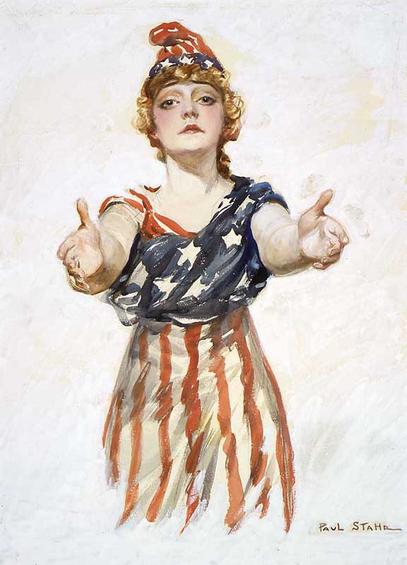
The United States of America. "Uncle Sam". The United States, like the British Empire with "John Bull", got its aggressively masculine avatar. But the feminine avatar of the United States, Columbia...where is she? Mostly she's a fascist dystopia in a video game.
Now I know why I can't really avoid playing #BioShock Infinite: it's in my brief to investigate mythopoeia in video games, more or less, and putting Columbia into a holding pattern, a loop in time...that was a nifty trick. It's a unique achievement in #videogames, you have to admit that! BioShock Infinite is powered by the memory of a folk goddess, the American genius loci: https://en.wikipedia.org/wiki/Columbia_(personification)
And yes, I take such things very seriously: I can feel the power that quivers in such spiritual entities, and I choose to honor it as best I can. The reader is free to tell me that I am simply non compos mentis.
 Floaty Birb