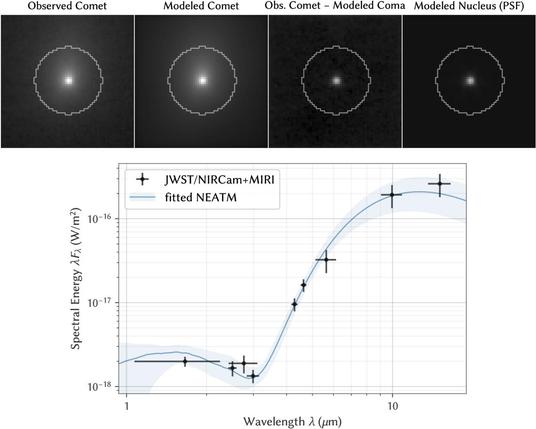
Preliminary Nucleus Size Estimate for #Kreutz Sungrazer C/2026 A1 (MAPS): https://iopscience.iop.org/article/10.3847/2515-5172/ae5220 -> "JWST imagery of the approaching Kreutz sungrazer C/2026 A1 (MAPS) appears sufficient to distinguish the comet’s nucleus from the surrounding dust. Coma model fitting indicates the morphology is compatible with a ∼0.4 km diameter nucleus—likely larger than those of the minor Kreutz fragments routinely discovered with coronagraphs, and comparable to or slightly smaller than that of C/2011 W3 (Lovejoy). However, since C/2026 A1 is the only Kreutz sungrazer whose nucleus has been directly observed, these comparisons should be treated with caution" -> https://groups.io/g/comets-ml/message/35035 / https://scicomm.xyz/@qicheng@cometary.org/116245251072721081
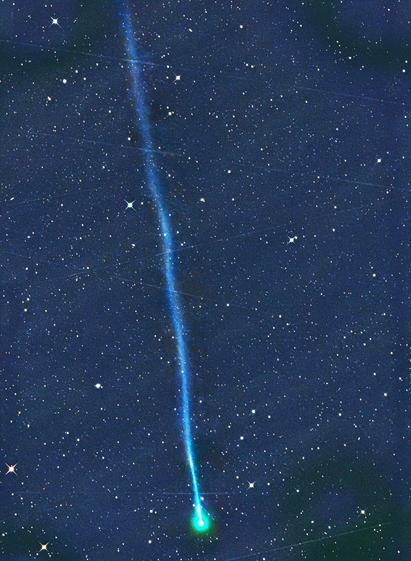
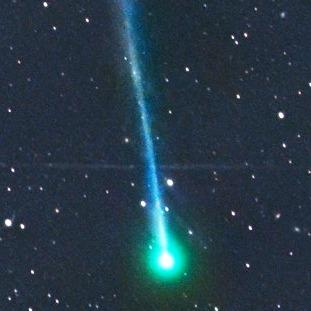
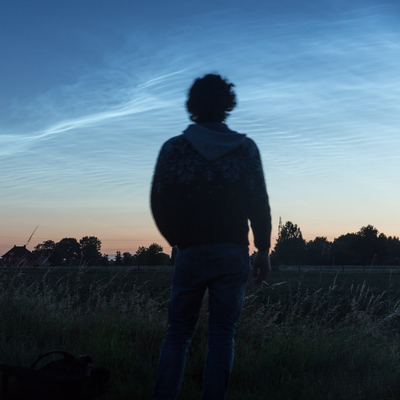
Whatever eagerly awaited #Kreutz #comet C/2026 A1 (MAPS) is up to - see also https://groups.io/g/comets-ml/topic/118409957 and https://nitter.net/JAtanackov/status/2035718257060036738 and https://scicomm.xyz/@qicheng@cometary.org/116262858373488354 - less than two weeks from perihelion, it has developed a long plasma tail now: https://www.facebook.com/photo/?fbid=25816609931372735 (Rhemann & Jäger yesterday with a 12 inch telescope; full and detail).

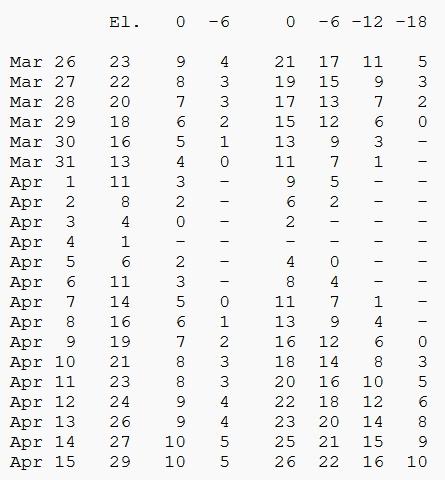
The uncertain brightness and tail(s) development of #Kreutz #comet C/2026 A1 (MAPS) is one thing - see the curves in https://astro.vanbuitenen.nl/comet/2026A1 and https://aerith.net/comet/catalog/2026A1/2026A1.html for guesses and https://cobs.si/obs_list?id=2688 for the current value which is ~8.5 mag. - but the viewing geometry is the other: here it is for 51.5° North (my place Bochum) and 22.5° South (Windhoek) as the view is much better from the southern hemisphere.

The elongation (angle between comet and Sun in the sky) is followed by the altitude of the comet at the solar depressions given in the top line, for Bochum and Windhoek: sunset and end of civilian twilight and for the latter also the end of nautical and astronomical twilight, i.e. the onset of night.

Also of importance is the angle of a hypothetical dust tail (simulated in https://hdr-astrophotography.com) after perihelion, which again would be much better oriented in the South: https://britastro.org/section_news_item/c-2026-a1-maps-a-kreutz-group-sungrazer - but first MAPS has to survive its close approach to the Sun *and* release a lot of dust at the right time immediately afterwards ...

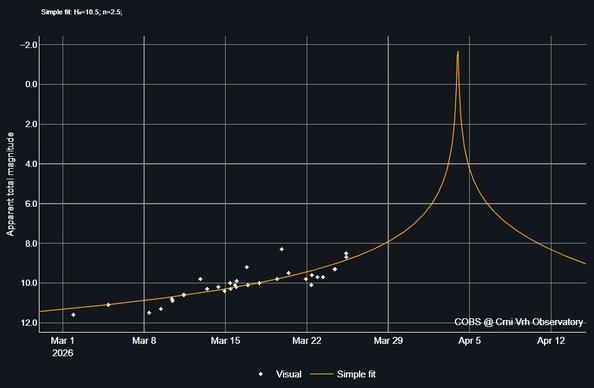
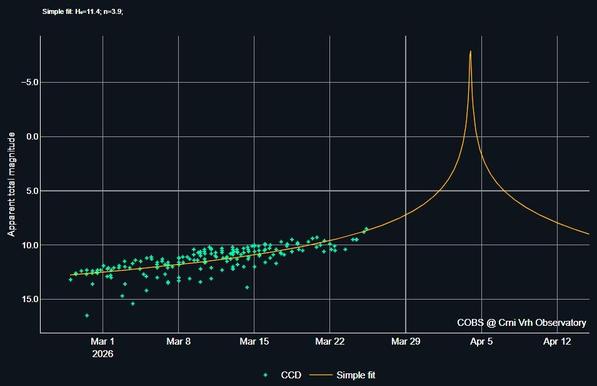
Two attempts to simply extrapolate the brightness of #Kreutz comet C/2026 A1 (MAPS) from what happened in the past few weeks, from all visual observations reported to COBS (left) and from all CCD observations of the past month which would have the brightness climb a bit faster. But as the previous post in the thread has shown even in the geometrically preferred southern hemisphere MAPS is lost in twilight from about March 30 to April 7 - and even in the optimistic model the comet has reached only 6th magnitude when it is lost and is down again to 5th when it is recovered: unless something drastic would happen *all* hope for an interesting show rests on a possible post-perihelion dust tail. Good luck ...
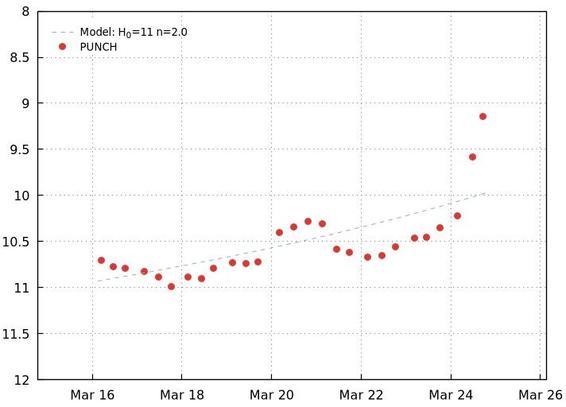
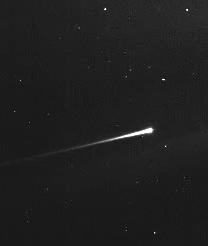
Whoa, what has the #Kreutz comet C/2026 A1 (MAPS) done now?!? Photometry from images by the outer corona observing satellite constellation PUNCH - by Thomas Lehmann; https://groups.io/g/comets-ml/message/35106 - shows a sudden increase in coma brightness ... whatever that means for the apparently quite fragile nucleus. PUNCH can follow the comet closer to the Sun than ground-based observers who will lose sight by month's end.
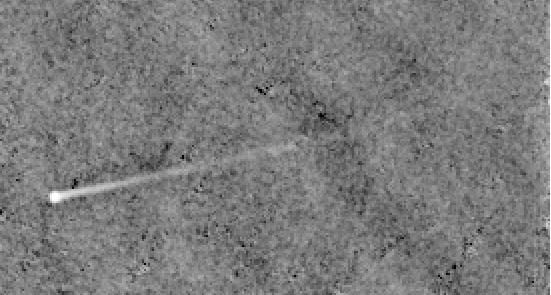
This image shows the #Kreutz comet C/2026 A1 (MAPS) "on a stack build from (star subtracted) difference images [from the PUNCH satellites] between March 26, 7:28 UT and 13:36 UT. The visible tail extends to about 6 degrees" - but the recent brightness surge has levelled off at about 8.8 mag.: https://groups.io/g/comets-ml/message/35114
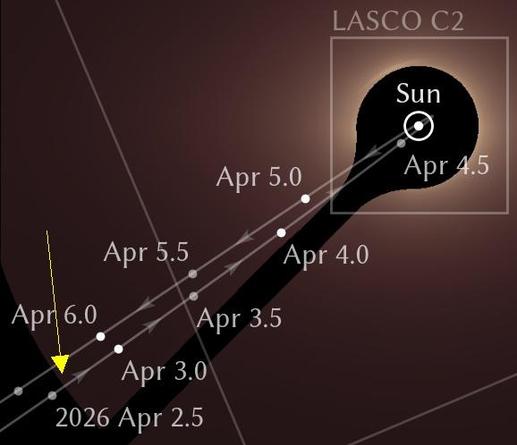
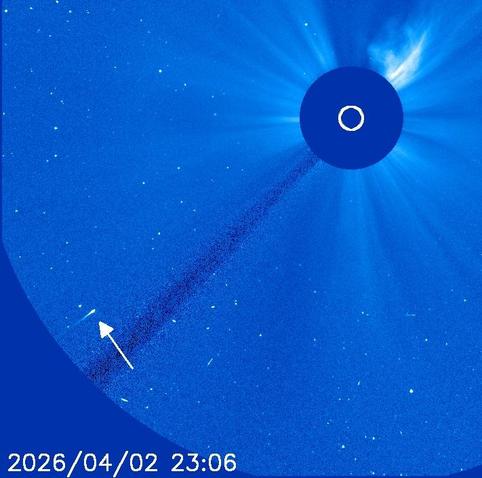
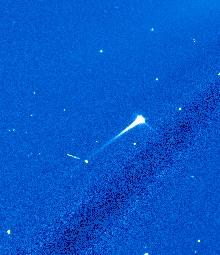
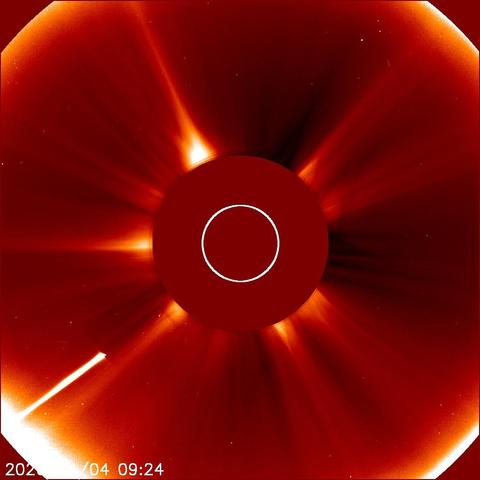
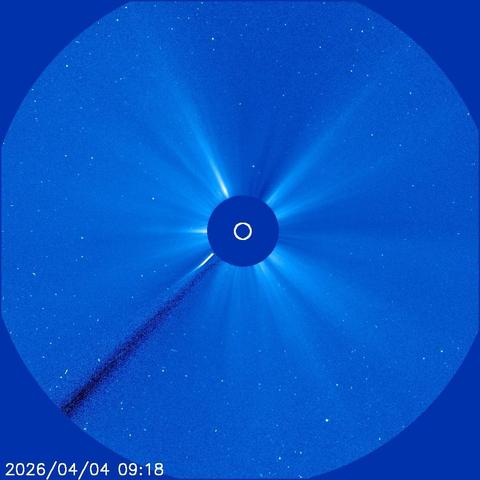
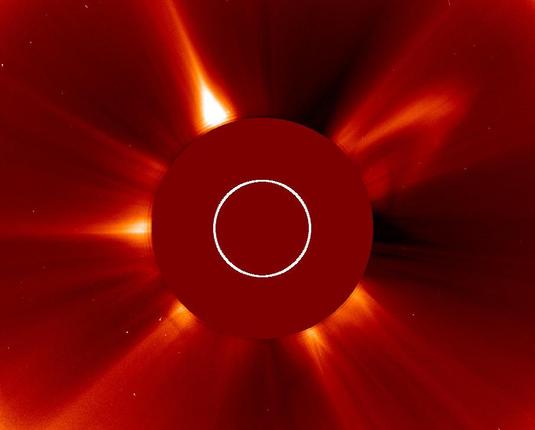
This afternoon UTC #Kreutz comet C/2026 A1 (MAPS) - which has been tracked in recent days with PUNCH and STEREO and is still in one piece, it seems - will enter the field of view of the coronagraph LASCO C3 on SOHO (the brown background; arrow): comparisions with earlier sungrazers in the same instrument will be telling.
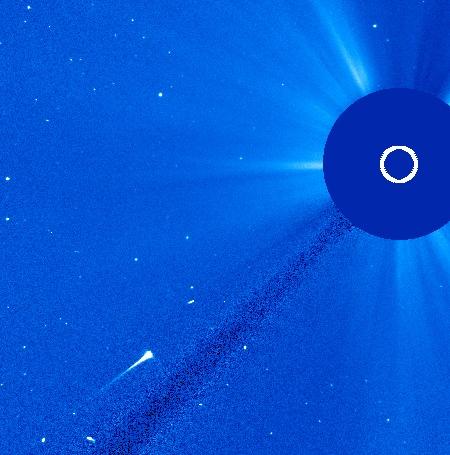
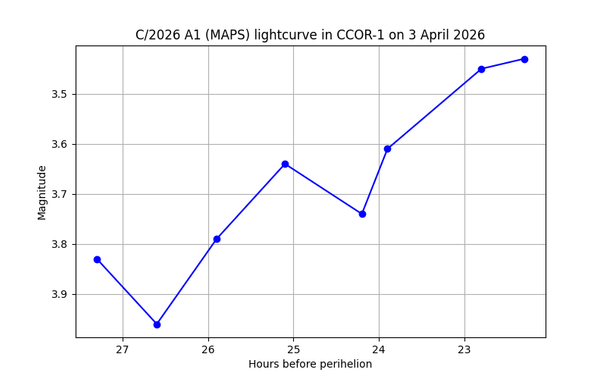
The #Kreutz comet C/2026 A1 (MAPS) is now in the field of view of SOHO's LASCO C3, https://soho.nascom.nasa.gov/data/realtime/c3/1024/latest.gif - and has only 4th magnitude or so. Here is how Lovejoy entered in 2011 which eventually did great: https://nitter.net/JAtanackov/status/2039812615988224394#m. Meanwhile here is the light curve of MAPS from PUNCH: https://groups.io/g/comets-ml/message/35159
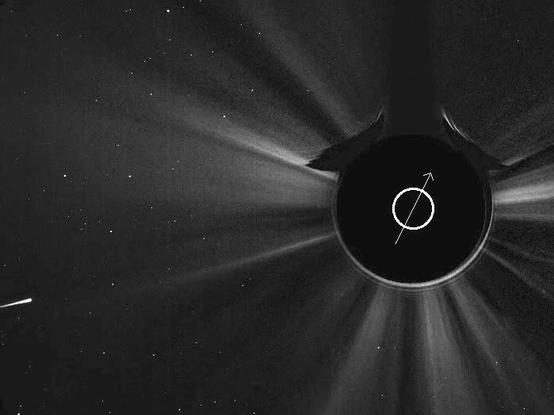
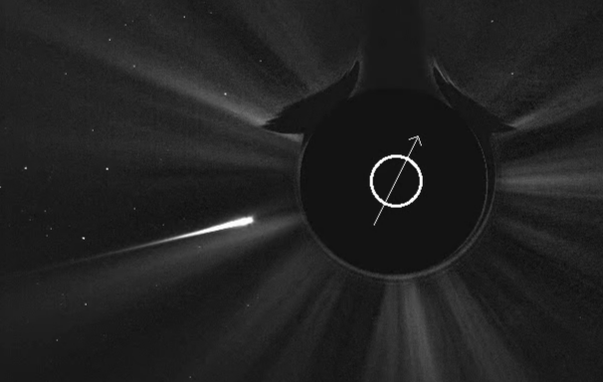
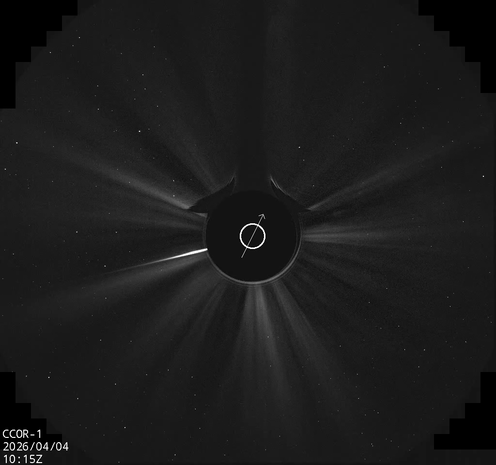
The #Kreutz comet MAPS is now also in the field of view of the coronagraph CCOR-1: help yourself to the latest images at https://ccor.nrl.navy.mil/ccor_realtime/last_image_MinBckgnd.png (15 minute cadence). What SOHO's LASCO C3 and PUNCH's NFI see and what it all means I've just summarized the bottom of https://skyweek.wordpress.com/2026/04/01/artemis-ii-vor-dem-start-maps-vor-dem-perihel/ with the still growing thread https://groups.io/g/comets-ml/topic/118640744 as the major source - in a nutshell there is still some life in this sungrazer (25 hours til perihelion!) and no evidence that it's beginning to fall apart which it will certainly do at one point.
Progress report for #Kreutz come C/2026 A1 (MAPS) as it marches towards the Sun in the LASCO and CCOR coronagraphs where it is brightening: https://groups.io/g/comets-ml/message/35184 - at https://ccor.nrl.navy.mil/realtime-movie you can watch an animation of the most recent CCOR images.
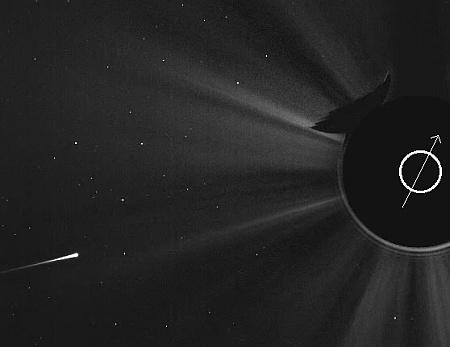
How #Kreutz comet C/2026 A1 (MAPS) is doing: LASCO and CCOR images from 19:30 and 20:00 UTC respectively. Under 18 hours til perihelion now ...
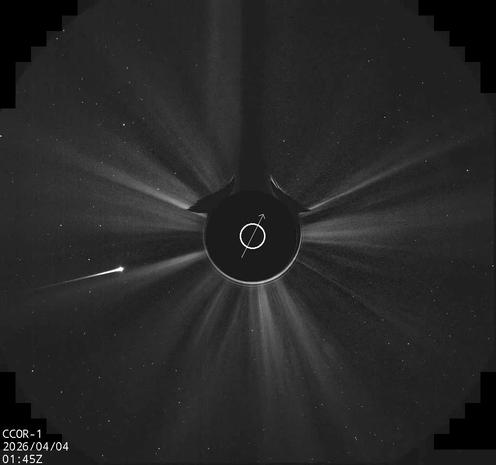
Twelve hours to go till #Kreutz comet C/2026 A1 (MAPS) reaches its perihelion - and it's still healthy for CCOR-1 in this image from 1:45 UTC today. Fresh ones at https://ccor.nrl.navy.mil/ccor_realtime/last_image_MinBckgnd.png every 15 minutes - and (uplifting) assessments of what's going on in https://www.facebook.com/groups/633346904255340/posts/2004738737116143 and https://www.facebook.com/photo/?fbid=10233680923429250
Six hours till perihelion for #Kreutz comet MAPS ... and in the CCOR-1 view from 7:45 UTC it's still doing great!
The coma of #Kreutz comet MAPS has now vanished behind the occulter in CCOR-1 while in the delayed LASCO images it is getting increasingly dimmed by the coronagraph system which has to suppress more light closer to the Sun.
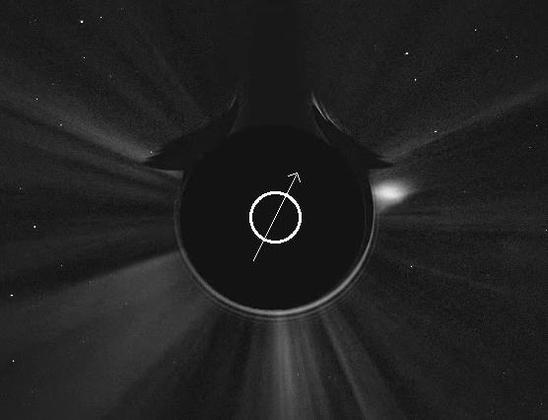
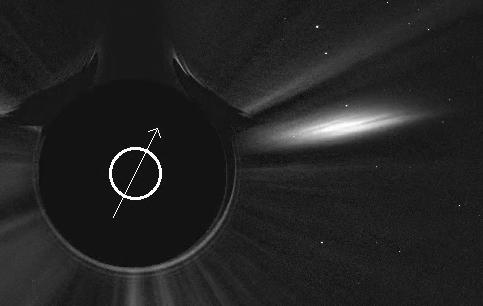
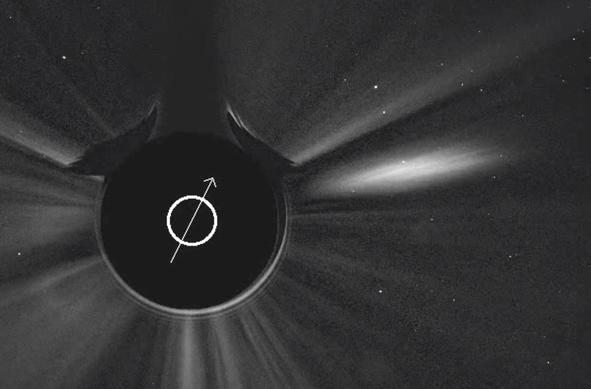
What remained of #Kreutz comet MAPS after perihelion: nothing reappeared on the left side of the Sun where a solid body would have been expected - but on the *other* side (~2 o'clock) a unique feature is now visible. It may be a dust cloud formed when the nucleus came apart near the closest point to the Sun: early thoughts at https://nitter.net/JAtanackov/status/2040532199527661879
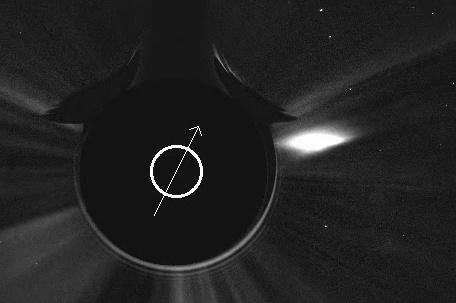
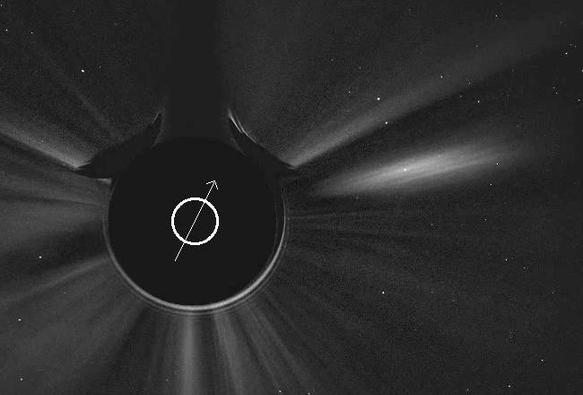
The dust cloud born out of the demise of #Kreutz comet MAPS yesterday continues to evolve dramatically in https://ccor.nrl.navy.mil/ccor_realtime/last_image_MinBckgnd.png images, here from 0:45 and 2:30 UTC Sunday - most think it's a former dust tail the comet formed hours before perihelion, with particles being pushed away from the Sun by radiation pressure far enough that they survived their personal perihelia while the comet itself did not. At least for this coronagraph the surface brightness looks pretty high ...
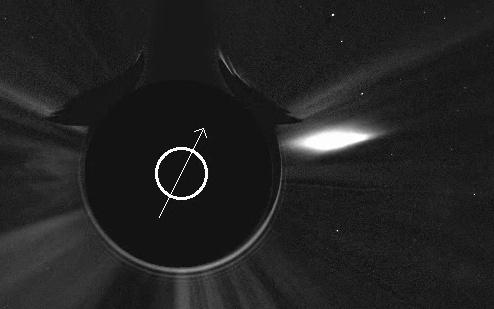
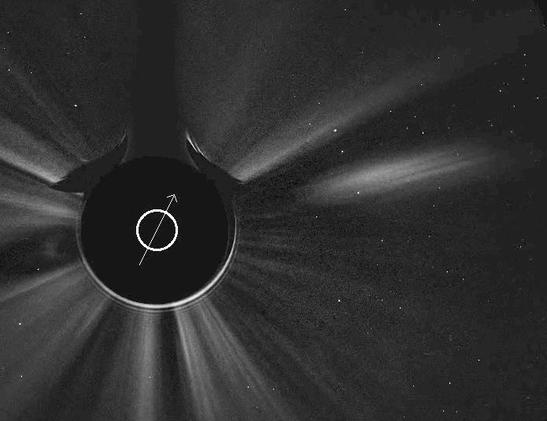
The detached remnant dust tail of #Kreutz ex-comet MAPS is slowly fading in CCOR-1 - check out https://ccor.nrl.navy.mil/realtime-movie for a *wild* animation - but on the other hand showing lots of striations. These three images cover a span of 7 hours today. Will anyone be able to spot it from the ground .... or the Artemis II crew exactly 30 hours from now when their solar eclipse begins? Fingers crossed and ISO high ... ;-)
Exactly 24 hours from now - at 0:35 UTC on 7 April - the total eclipse for the #ArtemisII crew will begin ... will they see / be able to photograph the fading detached dust tail of #Kreutz comet MAPS imaged here by https://ccor.nrl.navy.mil/ccor_realtime/last_image_MinBckgnd.png at 0:00 UTC on 6 April (image contrast-boosted a lot)? Deep images of the outer corona / #ZodiacalLight / potential dust hovering over the lunar limb might record it as well.
@cosmos4u I made a version of the animation in which I cut out old the wild / bright / flickery parts.
@benknispel Nice! Although the rough original better captures the panic the poor comet was experiencing when he read on the web that almost nobody expected him to survive ...
@cosmos4u Is it accurate to call that the comet “tail”, though? Isn’t it also the remnants of the disintegrated nucleus?
@vrruiz I call it detached tail (and its surface brightness is fading rapidly) - but it's not a 'ghost comet' which would be a diffuse cloud on the original orbit.