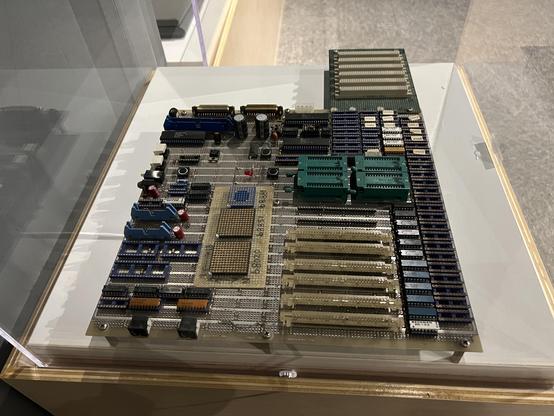
After watching the wonderful @mac84tv video on the MIMMS iNSPIRE exhibit, I noticed this early Macintosh ii prototype.

I have to admit I got *very* excited, as this is only the second Macintosh ii prototype I've seen. (YACCintosh and the Big Mac technically don't count, as they're a different architecture)

(Thanks to Mac84 for sending me a few more photos of the exhibit!)

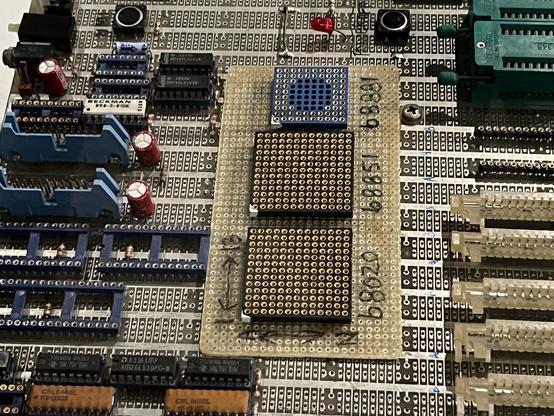
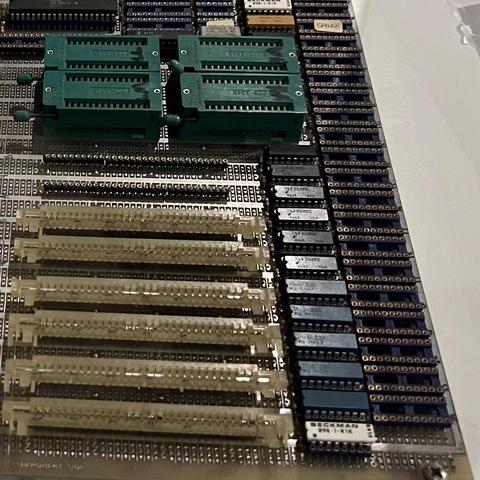
So this is almost definitely a Macintosh II as it has a socket for a 68020, 68851 MMU, and 68881 FPU.

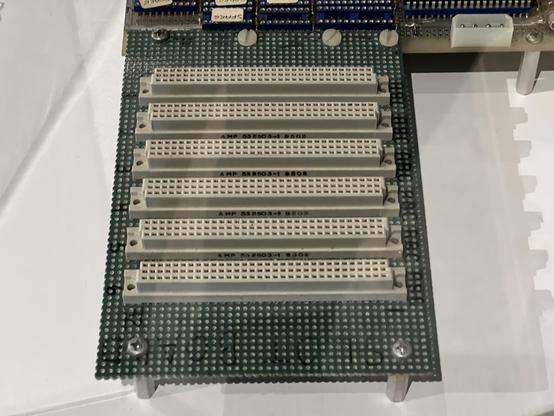
It also has six 96 pin slots - likely NuBus.

As far as I'm aware, only the Macintosh ii prototypes had NuBus as the expansion. The other prototypes didn't!

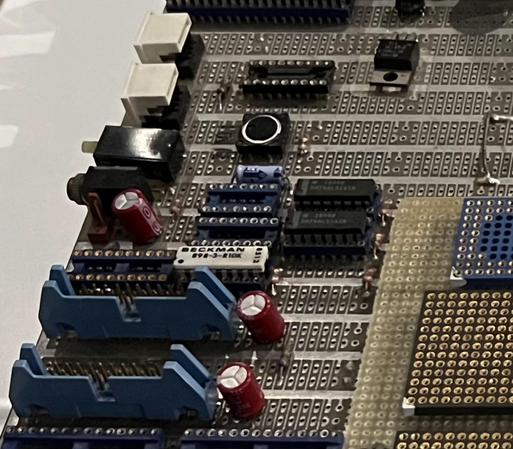
I probably need to actually annotate this board, but other indicators that this is a macintosh ii are the presence of a 8530 SCSI controller (granted this was also on the big mac, but shh!), two 6522 VIAs, socket for an IWM (next to two 20 pin headers), and a socket for an SCC.

There's also some surviving ICs for Appletalk - with a pair of mini DIN 8 connectors.

There's also a pair of mini din connectors that's likely for ADB.

So this gets me excited for two reasons.

The first is that it answers a question I had for a while - it seems every time a different architecture was developed within Apple, a Veroboard version of the architecture was built first before committing to a PCB.

Obviously that makes perfect sense, but it's nice to see some confirmation of that, and seeing that version of the Macintosh ii!

The second reason this gets me a bit excited is that there's *no* custom logic.

The Macintosh ii had two custom ICs (aside from the IWM), the ASC (sound chip) and the GLU (just... Glue logic).
These were both PLCC ICs, which are nowhere to be seen in the sockets! Only what appears to be PALs!

Again, makes sense, but nice to see!

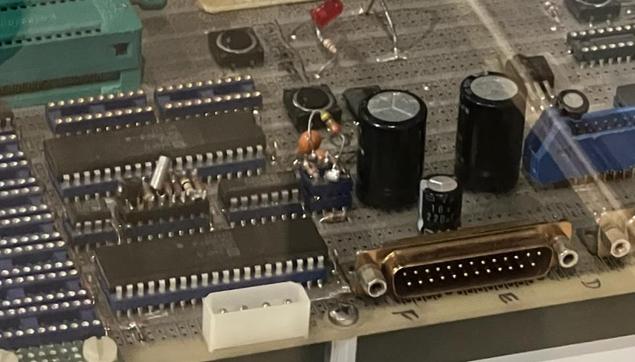
It appears that the sound was generated by a Macintosh plus style circuit. I say that as there appears to be a pair of 74LS161s near a 3.5mm connector. There also appears to be a spot for a single 20 pin PAL (ASG?) with some other support circuitry. Also seems that's where the reset button is.

As the Sony SND handles audio amplification and reset, it makes sense for it to be there!

In terms of what's pretending to be a GLU... It's PALs. A bloody load of PALs.

Judging from the IC sockets being 20 pins and being next to 74F258s (which in turn are next to 30 pin RAM sockets), it looks like the GLU was implemented in about 18 (?) 16R8 PALs. (At least from the placement of the "SPARE" stickers)

Also note the excellent looking white 30 pin SIMMs, as well as the four ZIF ROM sockets.

So there's also the two 6522s, and an 8 pin IC next to one of them - likely the RTC.

There's a bit of a mystery. There's a random DB25 connector next to the external SCSI DB25 connector.

As this is right next to three pretty large caps, and next to a molex hard drive connector - it's likely this is actually being used as a power input (!).

If not, it's probably a 25 pin RS232 connector for debugging, but, that could've been done by the SCC and the eight pin Serial ports.

A Macintosh of this era requires at least three voltage rails, 5v, 12v and -12v (-5v is also needed, but I believe that's generated by a 7905 onboard).

The molex could be the power input... But that only has four pins. I'd say it's likely this is for the internal SCSI hard drive. The connector for that is pretty close by!
At the end of the day I could probably be very very wrong with my assumptions.

It also doesn't particularly help too much with any sort of Macintosh ii cloning efforts - the PALs have all been removed, likely for an actual PCB of the Mac ii prototype that's probably lost to time/in a landfill somewhere.

The original equations are almost certainly lost to time as well!

However! It's not all bad news.
It does mean that the GLU was originally implemented as PALs.
This means it's likely it can be implemented in PALs again!

Wow that was an info dump
@DosFox thank you for the info dump. I saw it in the video and immediately wished you were there to study it and hold forth
@wotsac I want to flip it upside down *so badly*