I think today "publish more papers" is bad career advice for young people. Better to publish fewer and better work

Most good institutions, both employers and funders, have stopped counting papers. What's more, often in applications you are asked for "your 3 most important works". If you salami-sliced your work into thin papers then your 3 best papers will look anemic. No quantity of papers can save you

The only institutions that still count papers are fhe ones you don't want to end up anyway. Clearly their management consists of nitwits who will make your life miserable
@sophiehuiberts OK but what about the other common advice: "publish more A/A* papers", which is quite compatible with the "3 most important works" requirements?
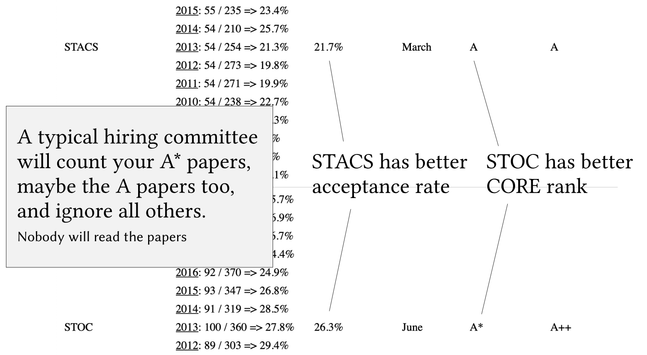
I'm thinking for instance of the following excerpt from these slides https://mimuw.edu.pl/~bojan/slides/slajdomat/teaching/soft%20skills/Research_Landscape/?step=30

@tito I think "Nobody will read the papers" is too cynical. Good institutions sign + follow DORA, which says to judge papers on their individual merit and not on venue reputation.

On the other hand, I do think its wise to always shoot for the best conference you can get into. Here, 'best' means the one that gets the most eyeballs on your work, from among the audience you want to read your work. Sometimes that means STOC/FOCS/ICALP, sometimes that means a conference for your subfield.

What I recommend students is to be mindful of which results are worth writing up. Just because you proved something, doesn't mean its exciting enough to invest the effort of making a paper out of it. Sometimes that means a result never sees the light of day, and that's fine. And sometimes you later stumble on a different & more exciting problem where your old proof technique can really shine, and then that's the right moment to put it out there.

@sophiehuiberts I hope you are right but I'm too far from academia to really know.
@sophiehuiberts Unfortunately this kind of advice is heavily dependent on context: which country, which field. Each will have its own habits and expectations, and my only general advice for academic career is to not follow any general advice, but seek specific advice for one's precise context.
@BrKloeckner True, advice should always come from mentors in one's own area!