bookofjoe
iNaturalist

The iNaturalist API is an absolute gem. It doesn't require authentication for read-only operations and it has open CORS headers which means it's amazing for demos and tutorials.
My partner and I built this website with it a few years ago: https://www.owlsnearme.com/
(I realize this is a bit on-brand for me but I also use it to track pelicans https://tools.simonwillison.net/species-observation-map#%7B%... )
I also love the Seek app that they provide (maybe this overlaps with the linked app in functionality?). As someone who's grown fonder of Nature in general over the last decade but who has little actual knowledge of the regional flora and fauna, it's a great way to engage with the plants and little bugs in my garden (or others' while on walks and such).
Fun to travel and "pokemon" some new local stuff too.
Seek throws up a „please don‘t disturb nature“ modal at every single start that you need to click away. Usually at that point the bird has gone away, too.
The iNaturalist app doesn‘t. It has more features, but Seek‘s former advantage „let me just the a photo and auto-identify“ is now in the iNaturalist main app, as well, so it is my default now.
>Seek throws up a „please don‘t disturb nature“ modal at every single start that you need to click away.
Frustration shared.
Sure, it's "doing its job" much in the way a podcast advert you've already heard 1000 times is "doing its job".
That's great to know, I'll give it a shot for sure.
wow, that would be my cue to uninstall the app and write zeros repeatedly over the place it used to be!
This guy deletes!
I’ve been pretty disappointed in the seeks applications ability to identify vegetation or insects. It seemed like it was really good a year or two ago and now I just seem to get so many bad predictions.
It is a gem. There are all kinds of fun location/organism-specific tools you can put together with the public read-only data, and owlsnearme is a good example of that. I just used it to check my area and learned there are snowy owls nearby, which is new to me!
The iNat API certainly has some quirks and shortcomings, but in terms of usability it's uncommonly good compared to most biodiversity platforms. I maintain the python API client[1], which is used for data visualizations, doing useful things with your own observation data (which is how I got into it), Jupyter notebooks, Discord bots, and some research/education workflows.
And I made this silly game. Name the beast, where you get a picture and try to guess (or know) the scientific name. https://name-the-beast.skabb.com
I know this app!
I once used it to check whether it would identify some birds that are prevalent in my area.
Not related to the app's fubctionality, but it was pretty funny when I replayed my recording of parrot noises to crop it and the next moment, a walnut shell dropped from the tree above.
Animals apparently don't like being recorded!
I use iNaturalist semi-regularly and was about to start using it for a rewilding project I'm involved in, so looked into that and some of the alternatives.
I really like how easy it is to use, the various views on the data (incl. geofenced projects and places), the fact you can export it all back out again, the volunteer and "AI" assist on IDing stuff etc.
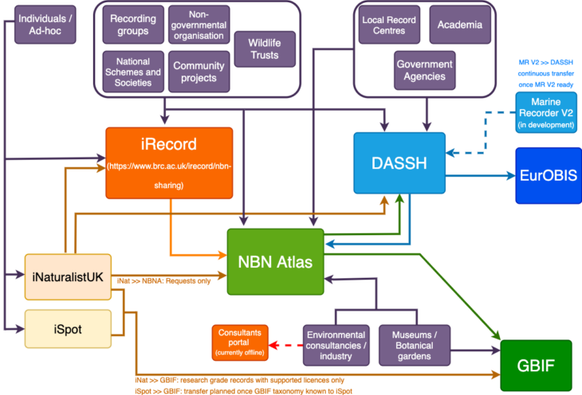
But I guess the main other pro for me was that, in the UK at least, most of the data I've put into iNaturalist that's made Research Grade has also been imported into iRecord and NBNAtlas which wouldn't happen the other way round, so 3 for the price of 1. See
https://nbn.org.uk/inaturalistuk/inaturalistuk-and-its-place...
I know there's various grumblings about observation quality from iRecord users relating to iNaturalist records, but I'm assuming this is people just not following the published guidance???