 bookofjoe
iNaturalist

The iNaturalist API is an absolute gem. It doesn't require authentication for read-only operations and it has open CORS headers which means it's amazing for demos and tutorials.
My partner and I built this website with it a few years ago: https://www.owlsnearme.com/
(I realize this is a bit on-brand for me but I also use it to track pelicans https://tools.simonwillison.net/species-observation-map#%7B%... )
I also love the Seek app that they provide (maybe this overlaps with the linked app in functionality?). As someone who's grown fonder of Nature in general over the last decade but who has little actual knowledge of the regional flora and fauna, it's a great way to engage with the plants and little bugs in my garden (or others' while on walks and such).
Fun to travel and "pokemon" some new local stuff too.
Seek throws up a „please don‘t disturb nature“ modal at every single start that you need to click away. Usually at that point the bird has gone away, too.
The iNaturalist app doesn‘t. It has more features, but Seek‘s former advantage „let me just the a photo and auto-identify“ is now in the iNaturalist main app, as well, so it is my default now.
>Seek throws up a „please don‘t disturb nature“ modal at every single start that you need to click away.
Frustration shared.
Sure, it's "doing its job" much in the way a podcast advert you've already heard 1000 times is "doing its job".
That's great to know, I'll give it a shot for sure.
wow, that would be my cue to uninstall the app and write zeros repeatedly over the place it used to be!
This guy deletes!
I’ve been pretty disappointed in the seeks applications ability to identify vegetation or insects. It seemed like it was really good a year or two ago and now I just seem to get so many bad predictions.
It is a gem. There are all kinds of fun location/organism-specific tools you can put together with the public read-only data, and owlsnearme is a good example of that. I just used it to check my area and learned there are snowy owls nearby, which is new to me!
The iNat API certainly has some quirks and shortcomings, but in terms of usability it's uncommonly good compared to most biodiversity platforms. I maintain the python API client[1], which is used for data visualizations, doing useful things with your own observation data (which is how I got into it), Jupyter notebooks, Discord bots, and some research/education workflows.
And I made this silly game. Name the beast, where you get a picture and try to guess (or know) the scientific name. https://name-the-beast.skabb.com
I know this app!
I once used it to check whether it would identify some birds that are prevalent in my area.
Not related to the app's fubctionality, but it was pretty funny when I replayed my recording of parrot noises to crop it and the next moment, a walnut shell dropped from the tree above.
Animals apparently don't like being recorded!
I use iNaturalist semi-regularly and was about to start using it for a rewilding project I'm involved in, so looked into that and some of the alternatives.
I really like how easy it is to use, the various views on the data (incl. geofenced projects and places), the fact you can export it all back out again, the volunteer and "AI" assist on IDing stuff etc.
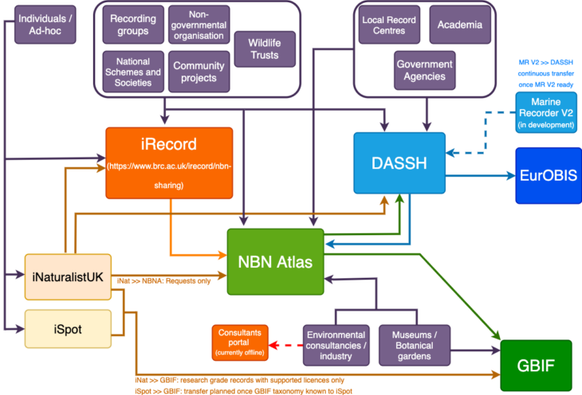
But I guess the main other pro for me was that, in the UK at least, most of the data I've put into iNaturalist that's made Research Grade has also been imported into iRecord and NBNAtlas which wouldn't happen the other way round, so 3 for the price of 1. See
https://nbn.org.uk/inaturalistuk/inaturalistuk-and-its-place...
I know there's various grumblings about observation quality from iRecord users relating to iNaturalist records, but I'm assuming this is people just not following the published guidance???
Similar category: Merlin Bird ID [1]. Uses audio to identify the birds around you.

Merlin Bird ID - Home
Identify Bird Songs and Calls Sound ID listens to the birds around you and shows real-time suggestions for who’s singing. Compare your recording to the songs and calls in Merlin to confirm what you heard. Sound ID works completely offline, so you can identify birds you hear no matter where you ar
Aaand if you like birds, Listers documentary is a lot of fun https://youtu.be/zl-wAqplQAo

LISTERS: A Glimpse Into Extreme Birdwatching
The funny thing is I got into birds because of the app. I hike alone often. Identifying the bird and then challenging myself to identify it correctly from memory going forward (before double checking with the app) is a fun game that draws one into the environment. Then, once you remember the bird (or, in my case, whatever nickname I came up with) you start learning and remembering facts about the bird.
I'm a big fan of Merlin and learning more about its development changed my perspective on software development! I wrote about that here: https://digitalseams.com/blog/what-birdsong-and-backends-can...
There's Merlin and then there's Birdnet too https://birdnet.cornell.edu/. Both by Cornell.
I've been using birdnet, but it seems to want an internet connection to do the identification and sometimes that is dicey when there is a bird that I want to identify. (Also birds seem to shut up around the time you get the app open.)
I'm going to give Merlin a try - the app has UI to download the network for offline use.
Requiring an internet connection for a nature app is absurd. As annoying as it is I get why a big tech company like Google fails at this sort of thing, many of their employees probably never leave a city and so the products always work well for them. But a nature app has no excuse, normal usage will get blocked by that all the time.
birdnet pi or go run the model locally
with an option to push observations
back to Cornell

I love this app, but it's also a significant doxxing risk especially for the large number of non-technical users that it has. A quick look at the map reveals the home addresses and names of many iNaturalist users in my neighborhood, lots of them older folks that probably don't realize that adding all of the neat wildlife that they see in their backyard (or uploading things they see on remote hikes without any 3G coverage once their phone connects to their home wifi network) is also putting their home address on display by adding a cluster of photos right next to their house that are all attached to their account.
Yeah.. there should be a prompt that gauges how savvy the user is, and if the user doesn't understand the implications of this, the default should be low precision location data with a random offset per item + random offset per user.
It has options to hide or obscure the location, which I use whenever I'm anywhere near my house, but it should be a little better about prompting users to use that.
Strava (a running tracking app) provides two helpful controls you can set as your default:
1. “Hide the start and end points of activities that start at SPECIFIC addresses.”
2. “Hide start and end no matter where they happen.”
Then it can be useful to add your home/work/routine locations.
If iNaturalist doesn’t have a setting like that, it’s a nice approach — especially if it’s included as part of initial onboarding flow — so it helps people without needing to remember to make visibility choices each time.
Does this matter if my account is some random username about birds?
Like all people learn is "someone does in fact live at that address and they use this app"
Yah, this is what I do, however I think this is what GP is talking about when they say savvy (or maybe I'm flattering myself). Plenty of folks with their full details on their profile.
Home ownership is in the public record tho, right?
I can hide my home-based observation locations, but others usually do not. People who post observations in my front yard cause other iNat users to visit. This hasn't been a problem in that there have been only a few additional visitors, and they are friendly. Still, I don't like my yard being publicized.
People who walk by the yard might tell their friends, but ordinary word-of-mouth can't be queried online. Not yet.
EDIT: We did have what turned out to be a significant invasive species observation. It was published in my SO's account with the location obscured. I looked up the species online and realized it might be a concern, so I killed it and put it in the freezer. In the meantime, the California Agricultural Inspectors got wind of it and contacted iNat to obtain the email address associated with the account. After making contact, they sent someone to pick up my specimen, and the later, 4 inspectors (yes, really, 3 inspectors and a supervisor) were sent to look for additional specimens. None were found.
Unrelated to this incident, I posted endangered species (not on our property) in my account, and iNat automatically obscures the location. Later on, I got an ~~email~~ message via iNat from the California Department of Fish and Wildlife asking for access to the precise locations, which I gladly provided.
Wow, I didn’t know that iNaturalist was so proactive about that sort of thing. It also sounds like you have a really cool yard! :)
I didn't mean to suggest that iNat is proactive, they may well be.
IIRC, the exact chain of events was: Invasive Species Observation posted -> a curator at the LA Natural History saw the post and notified the CDFA (Agriculture Inspectors) -> CDFA contacts iNat to get email address -> CDFA contacts my SO. I don't recall whether iNat had a built-in messaging service at the time (they do now).
Regarding endangered species, the California Department of Fish and Wildlife evidently joined iNaturalist, in part to enhance their data collection. They seem to be monitoring iNaturalist and contacting users who have relevant observations. They seem very sensitive to privacy concerns, and cooperation is voluntary. I'm thrilled a state agency is engaging the public in protecting our natural resources.
These state employees have indeed been proactive.
I have my house covered in observations and it would not take a rocket scientist to figure out where I live. I'm also a big believer in accurately tagging observations with locations of things in case someone else wants to try to find it. If someone wants to come to my house and take pictures of spring tails they're welcome to lol
