
Folks, I think I am finally ready to Program on my Computer
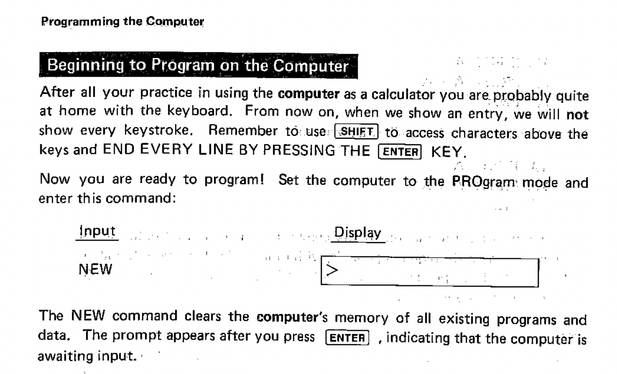
@nina_kali_nina The all caps text shows they were really serious about this.
@eoaiuastwg I think it probably was a very common request from users, to which the software engineers probably replied with "No, we can't change the ROM anymore" :D
@nina_kali_nina Is a big and exciting step!
@nina_kali_nina not me frantically dropping NEW into a terminal window before leaning back in my chair, looking up and out the window, and murmuring to myself, "i'm free. i'm ... finally free"
@darby3 too bad, you forgot to set the computer to the PROgram mode
@nina_kali_nina From the look... is this an IBM manual, mid '70s? It reminds me of the manual series for the 5100-series machines. The main thing leading me to doubt is the exclamation point.
@stepleton this one is SHARP from the 80s; the "service manual" part of it even has a bit of Japanese (by mistake?)
@nina_kali_nina @stepleton that's weirdly competent English for a Japanese electronics company in the 80s, they were still very much in the "work out who has the best English on the team and have them translate"
@nina_kali_nina @stepleton let me rephrase that thinking about how it worked 20-odd years later, the person on the team who spoke the best English but wasn't critical to project success (which often ruled me out)
@malcolm @stepleton they were selling it worldwide, probably hired the locals for English and French translations?
@nina_kali_nina @stepleton Yeah that was unusual at the time even for stuff that wasn't even sold in Japan. I once built the UI for a product that was going to be UK only and the (Japanese) customer "fixed" my English
@nina_kali_nina @stepleton back in the 80s my grandfather worked on translating a bunch of technical manuals into Farsi for Japanese companies and they provided them in "English" - he had to rely on my dad, an electronic engineer, to decipher what they meant to write
@nina_kali_nina @stepleton more recently partnered with a Japanese company on a product they only sold in the US (but all the engineers were in Japan) and I asked if they had any Japanese documentation (as I had to translate it back into Japanese for reasons) and apparently they ran the whole team in English (but IDK about the team make-up)
@nina_kali_nina Is this from the TRS-80 Pocket Computer manual? That line was rebadged Sharp computers.
@thalia it's not, it's actual Sharp with a Sharp CPU
@nina_kali_nina And yet much more accessible to newcomers than modern programming environment.

@nina_kali_nina

"The NEW command clears the computer's memory of all existing programs and data."

So it's aliased to [ rm -rf ]?

@Ralph it ALSO erases the programs from the RAM, so it's more than that
@nina_kali_nina I almost forgotten the NEW command. I recommend CLS too.
@ElPamplina there's no CLS on this computer, but that's not an issue

@nina_kali_nina

After all your practice!

»I am adding
And subtracting
I'm controlling
And composing

By pressing down a special key
It plays a little melody
By pressing down a special key
It plays a little melody

I'm the operator
With my pocket calculator
I'm the operator
With my pocket calculator…«

@nina_kali_nina Are you at home with this newfangled keyboard?
@amoroso yep, it's a very tiny thing, "credit card sized", says some advertisment. But it's more like smartphone sized
@nina_kali_nina
Why the hell is that particular image invoking a memory I can't quite recall properly?
@nina_kali_nina all caps was old school vibe coding
@nina_kali_nina does this go on to explain how you can save the program to audio tape using a tape recorder provided at considerable additional expense?
@wnd it does, except you need an additional accessory to connect to the tape recorder.
@nina_kali_nina the old "this special wire" not the full "new tape recorder" switcheroo. Handy if you 1. have a generic tape recorder at hand 2. are good at soldering your own cables and/or 3. have enough money left to buy a special wire... #capitalism
@wnd it seems to have an amp and does some weird stuff with singal going to two pins for reading the tape in, and one of those signals is controlled by the computer somehow but not as in "stop/play signal". So it's definitely beyond a simple cable. The DIY version has a transistor and a couple of diodes