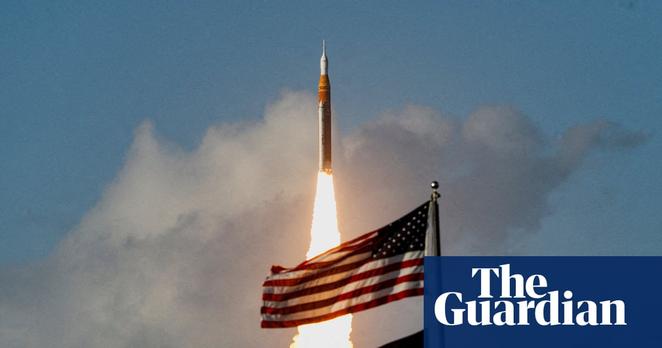
Yet another #Artemis II article (from a French press agency, no less) ignoring that propulsion, power, & life support to the Orion capsule are provided by ESA’s European Service Module.

Built in Bremen by Airbus, with parts from all over Europe, e.g. solar wings made in Leiden.

Also no mention of the fact that the ESM’s for the Moon-landing Artemis IV & V missions are to be supplied as part of ESA’s contribution to the Lunar Gateway.

Which NASA cancelled last week.

https://www.theguardian.com/science/2026/apr/03/artemis-ii-astronauts-rocket-towards-the-moon-after-breaking-free-of-earths-orbit

Artemis II astronauts rocket towards the moon after breaking free of Earth’s orbit

Spacecraft’s engine fired up for six minutes to propell astronauts on their three-day voyage towards Earth’s natural satellite

The Guardian

The ESM’s for Artemis I, II, III, & VI (if there ever is a VI if SLS is also cancelled) are provided by ESA as part of the barter for continued access to the ISS by European astronauts.

But ESM-4 & 5 are explicitly linked to Gateway, as are many other European-provided modules already under development, & which is now dead.

The trade also included seats on Artemis for European astronauts.

More on the ESM here:

https://www.esa.int/Science_Exploration/Human_and_Robotic_Exploration/Orion/European_Service_Module

https://en.wikipedia.org/wiki/European_Service_Module

https://www.airbus.com/en/newsroom/press-releases/2026-03-heart-of-the-mission-airbus-built-esm-to-power-historic-artemis-ii-crew-to-the-moon

European Service Module

The European Service Module is ESA’s contribution to NASA’s Orion spacecraft that will send astronauts to the Moon and beyond. It provides electricity, water, oxygen and nitrogen as well as keeping the spacecraft at the right temperature and on course.

To be clear, yes, the article is in a British newspaper, @guardian, but is directly sourced from @AFP.

Not that the articles written by the Guardian’s own journalists are necessarily any better, mind you:

https://www.theguardian.com/science/2026/apr/02/artemis-ii-nasa-moon-launch-american-moment

And this is no UK anti-Europe bias; same across most Euro-media.

Some are doing better though, & I know the BBC are doing a piece today about the key role being played by the ESM, & ESA themselves are of course talking up the ESM.

Artemis II marks Nasa’s new moon age, wrapped in patriotism and global promise

The moonshot gave US spectacle a broader face with the first woman, first person of color and first non-American

The Guardian

All of which begs the question of why this is.

Perhaps it’s a combination of media laziness, elisions in the material being issued by NASA, and the general view that only NASA does space anyway (despite plenty of evidence to the contrary).

Or is there perhaps a lack of interest from the European public in Artemis, not least given the broad rejection of the current US government & its ugly imperialism, much of which manifests itself in anti-European rhetoric & action?

And of course it’s entirely possible (personally, I think likely) that the wider European public isn’t especially interested in human spaceflight.

At least not in the way that superpowers like the US & China are, where it’s part of soft power propaganda & national myth-making.

After all, there are many other priorities on this planet, arguably more pressing than going to the Moon, such as climate change, security, & resource management, areas where space also plays a critical role though.

These are issues that ESA will have to carefully & honestly examine with its Member States in the coming months, as they try to come up with a strategy for human spaceflight that takes into account its deep current dependence on an increasingly unreliable partner.

Do European governments & the European public believe that an independent human spaceflight capability is desirable & affordable?

IMO, it’s perfectly ok if the answer to that is no. But the current model appears very broken.

@markmccaughrean

Here's some food for thought: Where are the scientific publications that are coming out of the actual crewed space flights?

When you look at robotic missions (deep space probes, space telescopes, research satellites, etc.) it's easy enough to find your paper alerts being flooded with published results. There's a also a lot of publications on the engineering side.

But when it comes to crewed space flight? There's a lot less there. We're talking of several OOM discrepancy.

@datenwolf One of my jobs at ESA was to give regular updates to our various committees & boards on scientific results from both the robotic missions & the human spaceflight programme.

That there’s a lot of material from the former goes without saying, but there is plenty from the latter too. That said it tends to be less “cosmically awesome”, relating to human & plant biology, materials science, fundamental physics, etc., less immediately exciting than stars, planets, & galaxies.

@datenwolf It also tends to be a lot more “bitty”, coming in small chunks as experiments are modified & upgraded over time. It’s also often a bit buried in wider studies of which the spaceflight experiments are just part.

Of course, I’m deliberately avoiding saying whether the cost-science benefit ratio is worth it compared to robotic missions, but arguably the two pots of money aren’t really fungible. Science is a by-product of other human spaceflight, not the primary goal.

@markmccaughrean

I'm well aware of the experiments that are done on the ISS (or back in the day on the STS and Mir). Heck, a couple of years ago some hardware for a medical study went up to the ISS what was in part built (or rather modified from the commercial system) by colleagues of me (optical coherence tomography to investigate the eyesight problems astronauts develop in microgravity).

1/

@markmccaughrean

What's puzzling to me is, that so little of what's done on the ISS ends up being discussed during lunch, or over the post seminar pizza. Whereas so much other research, often in very far removed fields tends to be brought up.
It's a quite remarkable situation: Crewed space flight is a very "popular" topic; almost everyone in the 1st and 2nd world knows about it and that "a lot of science" is happening there.

But among my earthbound researcher peers it's discussed very little.

@datenwolf I agree, & little of the science done there is covered by media either, hence burying it from the public radar screen too. Possibly because in part it’s visually unexciting, just humans & boxes of gear.

There’s also an element of truth in that it’s a bit of an insider club, with the same groups getting experiments approved all the time, partly because they already know the ropes & partly because they then sit on the committees deciding future strategy & experiments.

@datenwolf And that you get weird outliers like AMS-02, a hugely expensive piece of kit that made its way to the ISS despite not being highly-ranked in peer review, despite huge technical problems during test which led to the cryomagnet being dumped, making the experiment less sensitive, & despite needing congressional approval for a whole extra shuttle flight to get it there.

The power of a Nobel prize winner very adept at playing politics, to be sure, but good for science?