 da_cow (she/her)
Just do it.
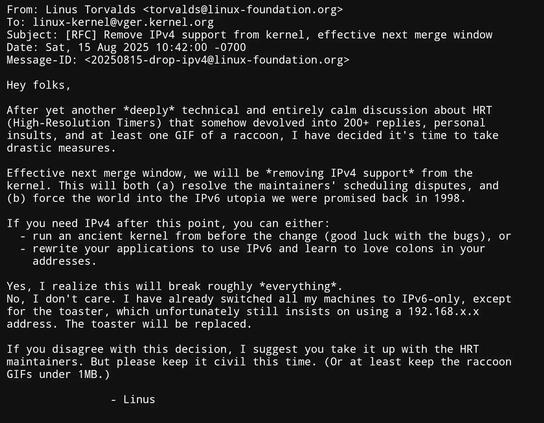
The thing is. Any year can be the year of IPv6. Google is on ipv6, youtube is on ipv6, facebook is on ipv6. Pretty much every datacentre I've used (OK limited to Europe) give you IPv6 for free by default. Deploying a web site to be IPv4 and IPv6 is trivial and people that use automation should be able to quite easily apply ipv6 to those scripts.
It's really just the ISPs (more so in the US as I understand it), lazy IT people and the FUD myths holding us back at this point.
IPv6. No. Badly configured IPv6 routers, yes. But that's something that would fix itself if it became the only protocol in use. And most routers now are pretty good at it from what I've seen. But it used to be the case it was easy to find bad routers.
The myth seems to be that NAT provides security. But a good default configuration for consumer routers would give the same security as NAT while providing the advantages and extra security IPv6 provides.
IPv6 usually has privacy extensions enabled. Which means it will generate throwaway IP addresses that rotate regularly for your outgoing connections, these IPs do not accept incoming connections. So someone cannot nmap you to find open ports based on the IP you connected to their server with.
Not to mention that most ISPs give each user more IPs than the whole IPv4 internet has. So, port scanning an entire /64 is not going to be fun.
Good points, the difference being NAT crossing requires something on the inside to enable it, while IP6 security requires the consumer router to be properly configured.
And I disagree with the assumption that badly configured routers won’t exist if IP6 were the default. Bad design doesn’t magically go away.
The bottom line is small LANs don’t benefit from IP6 today. Large LANS don’t benefit because they already have extensive IP4 configuration in place, and attempting to migrate is costly, risky, and without a clear benefit to offset those costs and risks.
Most likely enterprises may use 6 on new networks, but even that is questionable when so many extant products still rely on 4 - you don’t want to create a problem for those systems.
In one word: no. In more words: some addressing methods can lead to privacy and security issues, but those aren’t widely used anymore.
IPv6 addresses can be assigned to interfaces by several systems. One of those is SLAAC, or stateless address auto-configuration (comparable to APIPA and the 169.254.0.0/16 address space for IPv4). One method by which it generates globally unique routable addresses is by inserting the interface’s MAC address into the IPv6 address. Since IPv6 generally doesn’t use network address translation (and thus no masquerading), this would advertise your computer’s MAC address to the whole internet. More recently, SLAAC uses pseudorandom temporary (or “privacy”) addresses for interfaces, together with a unique network prefix assigned to the customer (analogous to the single public IPv4 address).
It’s also possible to assign IPv6 addresses statically or by using DHCPv6.
In theory, no.
In practice, yes.
No idea if it was this one, but I find it amusing
Well you could accept the default generated one, or set it to fe80::1 manually. Don't most good routers now have a DNS server in? So you could make it router.local or something?
I think some even by default make a DNS entry call router.local or similar pointing to themselves. This isn't a real problem and if IPv6 were adopted fully, then all routers would likely come with something like this setup anyway.
I hate IPv6 so fucking much.
I had to write an address validator and sanitizer once. Never again what the fuck were they thinking with the short forms?
I do like having a lot more addresses, that’s great. The short forms, embedded ipv4, bridges, etc are confusing as hell. Oh, also, you have to add that all to your email validator script, enjoy!
Yes. Now try 0177.0x1.
I’m pretty sure that IPv4 address formats are more complicated than IPv6 forms, if you are actually doing RFC-compliant validation.
So you’re now scared of :: padding oh no.
Also why are you writing an address validator yourself? Shouldn’t be there like a bazillion libraries by now? xD
Does anyone have some kind of beginner’s guide to transition a home network from v4 to v6? Everything I found is way too technical.
Asking here but feel free to direct me to a more appropriate sub
Meh, it doesn’t really offer anything for a home network.
And this is why it really hasn’t be adopted even by business - there’s already a network in place that works. Migrating to 6 doesn’t offer any meaningful benefit to balance the effort and risk of the change.
Now if you’re an SMB with 3 servers and a handful of computers, would you spend what little IT money you have making this change?
And if you’re an enterprise with a thousand servers and tens of thousands of users, are you making this change?
Imagine the cost of reconfiguring routers, and the outages you’d experience doing this.
There’s just no pressing urgency to change, and LOTS of cost and risk to do so.
And if you’re in a larger company, you’re the guy or team that gets blamed for every. goddamn. network. problem. that happens after the transition.
Fuck that.
 lmr0x61
 r00ty
r00ty django
 carrylex
 RustyNova
 Reznik
 I Cast Fist
 OpenStars
 SeductiveTortoise
 𝕸𝖔𝖘𝖘
𝕸𝖔𝖘𝖘 jballs
 Boomer Humor Doomergod
 JackbyDev
 Magister
 WhiteOakBayou
 tal
tal thisbenzingring
 ikidd
ikidd gizmonicus