 flypapers
https://doi.org/doi:10.1038/s44319-026-00741-4
https://pubmed.ncbi.nlm.nih.gov/41922845/
#Drosophila
Conserved but mechanistically diverse piRNA defence against endogenous retroviruses in insects - EMBO Reports
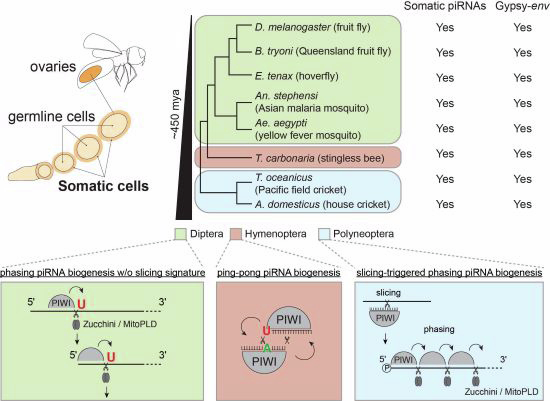
Defence systems against genetic mobile elements are highly adaptable, yet their long-term evolutionary stability remains unclear. To address this, we examined the conservation of Piwi-interacting RNA (piRNA)-mediated defence against envelope-carrying gypsy long terminal repeat (LTR) retrotransposons across insects beyond Drosophila. We show that Aedes aegypti (yellow fever mosquito) and Anopheles stephensi (Asian malaria mosquito), as well as Tetragonula carbonaria (stingless bees), Acheta domesticus (house cricket) and Teleogryllus oceanicus (Pacific field cricket), all produce piRNAs targeting gypsy elements in ovarian somatic cells—the same cellular niche where Drosophila mounts piRNA defence against gypsy—indicating a persistent arms race for more than 400 million years of insect evolution. Notably, in Aedes aegypti, ovarian somatic cells express the same piRNA clusters as other somatic tissues, where they are known to target RNA viruses—suggesting a shared origin of anti-viral and anti-retrotransposon defences. Furthermore, we observe lineage-specific differences in ovarian somatic piRNA biogenesis: slicing-independent phasing appears to dominate in dipterans, ping-pong amplification in bees, and slicing-dependent phasing in crickets. Together, these findings indicate that distinct piRNA pathways have independently evolved at different timepoints to silence the same class of retrotransposons in insect evolution.