 ⠵⠻⠷⠕⠭ 🍥🍉⚪🌹
 Alex Kretzschmar
Brutal.
When Microsoft acquired GitHub.
No they are suggesting that VC shareholders forced the sale to Microsoft. Same as Twitter VC shareholders forced the sale to Musk, even though literally nobody but them wanted it to happen.
@ali1234 @tml @mc @ironicbadger I just read "VC" and thought "Why would someone arrive to the conclusion that they must stay away from Version Control"
... So carry on!
@mc As the context is GitHub, I spent a bit too long time figuring out that this was venture capital, not version control. "How is this a lesson that I should stay away from version control???" I'll keep using forgejo, thankyouverymuch!"
@Tubsta Yep still 0% uptime from my IPv6 only server point of view.
Azure.
Azure?
If you bought MSFT 5 years ago, you would be "as you were" ( and a bit of a loser ).
https://g.co/finance/MSFT:NASDAQ?window=1Y
Check out these other losers:
https://www.google.com/finance/portfolio/413d47c7-2932-4196-8b7b-3d073a637f14
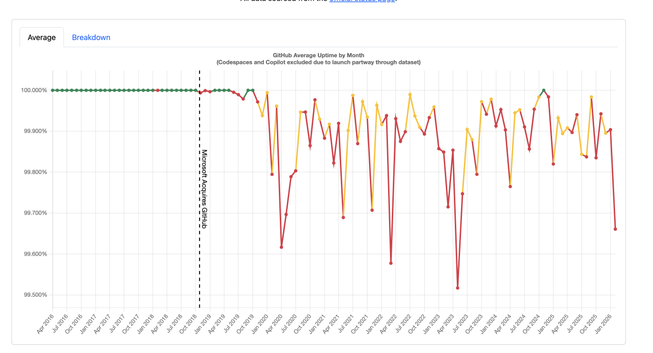
A graph demonstrating that the GitHub website's uptime suffered considerably after being acquired by Microsoft.
The graph shows average uptime of the website by-month from April 2016 to January 2026. Months that earn 100% are colored green, while months that miss that goal are colored either red or yellow, depending on some undisclosed metric of severity.
A line is marked in November 2018 where Microsoft acquired GitHub. Before that, no months were visibly worse than 100%. There's one red dot, but it's not visibly different otherwise. For the first year after the acquisition uptime is worse but acceptable, and stays above 99.95%: six out of 12 months earn 100%.
After October 2019 the story flips completely. Only one month has earned 100% uptime since then, and the remaining months vary wildly from 99.98% to about 99.70%. May 2023 was the worst, crashing almost as low as 99.5% uptime.
Honestly, it looks like a seismograph that's started recording an active earthquake.
@ironicbadger big oof (for smallish values of oof) but I’d also like to see that graphed against active usage volume to get the full picture
(yes, regardless, a “hyperscaler” should be able to handle the volume)
Why settle for Five Nines of reliability when you can get Nine Fives?
That is the least of the problems with it, got that damn AI stealing everyones hard work
@ironicbadger hmm, quite a few opinions on that chart 😀 tl;dr it’s complicated.
Most of GitHub services, until I left a couple of years ago were not on Azure.
@aburka @ironicbadger ah I was replying to a different post about it being Azure or Azure management. I did Mastodon wrong, sorry.
I will say after the acquisition when GitHub became rapidly more complex as features were added, the definition of downtime requiring a status change became a lot more strict and focused (for some teams). A bit more loose and easy beforehand.
@harris @aburka @ironicbadger yes that’s one of the factors.
Status is an indicator controlled by the company. As GitHub sold more into businesses and became more crucial to them eg: Actions part of deployments - uptime became more critical and monitored more.
In Actions we built lots of sensitive metrics and quickly became more and more transparent about downtime, customers noticed it.
@harris @aburka @ironicbadger status was also one metric for all of GitHub, it was split into 6 or more around the time Actions was coming out. So more granularity too.
Surprised copilot isn’t on the status page yet.
@a_different_jlh https://damrnelson.github.io/github-historical-uptime/
Sorry I should have linked to the source
@Jourei AFAIK they started to use Azure more and more. That would explain the initial stability after the buy event. Also they might have shifted from stability to ship feature after feature. Before Microsoft bought them, their feature set was rather stable.
@Jourei @ironicbadger "restructuring"
They fired huge chunks of the existing staff and terrified the rest.
@Jourei @ironicbadger Yeah, this is likely just a bad graph. Before vs after the change was likely a change in either the definition of, or the measuring of "down time", and the two end up not comparable.
I suspect the data went from tracking as "most/key things working=up" to "anything not working=not up"
@[email protected] https://damrnelson.github.io/github-historical-uptime/ Sorry I should have linked to the source
@ironicbadger @isotopp Thanks! So it is indeed the data from the official status page. Yes, since microslop took over reliability has gotten even worse, but it was bad before as well. They just often did not mark the services as down on the status page, even though they were.
So, the general conclusion here is still correct, but the data for the visualization is not reliable IMO.
 Alfred J. Kwak (audiokontor) ☕
 Tor Lillqvist
 Alistair Buxton
 Nil
Nil Lett Osprey
 🍉
🍉 
 Jason Tubnor 🇦🇺
 Andrew
 Miyuru Sankalpa
 The Orange Theme
 Cap Ybarra
 The Doctor
 Arapalla
 Amgine
 Ashwin Dixit
 Acorn Squashbuckler
 Cassandrich
 jmelesky
 aerique
 crispy branzino ☭ (sold out forever)
 itgrrl
 Dave Wilburn
  Kaito
Kaito Oliver D. Reithmaier
 Pietervdvn
 Ari [APz] Sovijärvi
 Just Bob
 Andy McKay 🇨🇦
 aburka 🫣
 Harris Lapiroff
 Orion Ussner kidder
 deadbeef lives
 maarten brouwers
 llewelly
 Jourei
 Marius Gedminas
 Christoph Petrausch
 Mu-An
Mu-An derptron
 deefdragon
 thunfisch
 Martin Vermeer FCD
 Ingo Schildmann