 Jaap Burger
The Dutch energy supplier NextEnergy is offering its customers a free 2 kWh plug-in battery.
The (4-year) monthly lease is €20.83, with guaranteed yearly savings of €250.
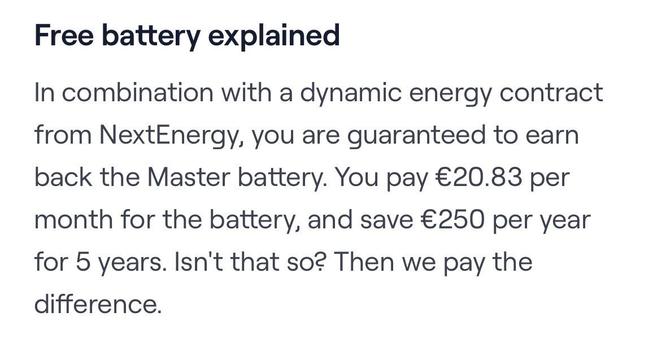
The Dutch energy supplier NextEnergy is offering its customers a free 2 kWh plug-in battery.
The (4-year) monthly lease is €20.83, with guaranteed yearly savings of €250.
@burger_jaap Wow! That is a real profit! Paying at about 250 euro a year to save 250 euro a year.....
Well, at least then you don't lose money.
You may lose privacy for your real time energy use (P1 port).
@cm @AngelaScholder @burger_jaap
Sadly, yes. The 15 min data from smart meters is also privacy leak, and it will take more to fix that one.
@KingmaYpe @cm @burger_jaap Ype, indeed it is an absolute privacy invasion where I would have to trust my energy supplier to not build a profile for us based on our use.
Especially with a dynamic tariff contract they could build a profile of our daily routines.
With the variable contract we're on I think it's only every other day they take the reading, unless you have the insight active for your use.
I didn't give permission, but here it is Liander takes a reading every three days.
It all >2
@KingmaYpe @cm @burger_jaap 2) is something you should be wanting to keep private. Certainly as you also have to trust them to keep the data safe.
I would be OK with a monthly read-out, or have a button "Send meter reading" where I have control.
If we are away from home, our daily use is 20-30% less than average. So, it is a perect means of determining if we are on a (short) holiday, or not.
This is an absolute security risk.
@AngelaScholder @cm @burger_jaap
Even with a monthly bill for a dynamic contract, it is possible to have full privacy for your meter values. The privacy leak is a design flaw in the current system.
@cm @AngelaScholder @burger_jaap
It needs a trusted third party, the key adder.
Encrypt meter value by adding a new large random key, and send the result to the adder/aggregator. Share the key with the key adder, and let the key adder only provider a key sum when there are be enough participants.
That gives a real time sum for P1 values.
For the monthly bill, do a similar encryption for the quarter values of one participant. The key adder and aggregator weigh with dynamic proces.
That's it.
@cm @AngelaScholder @burger_jaap
Compressed into one post :)
For more text and figures, see the first 12 (?) slides of my latest presentation for NLLGG, in Dutch:
https://codeberg.org/Ype/publications
Very much the same in English in the February presentation in Delft.
@cm @AngelaScholder @burger_jaap
Thanks. The older articles at the same link have references to the inspiration for this. For the privacy I added the minimum number of real time participants and the minimum bill period.
The key adder delivers this privacy, so it should be controlled only by the participants. At the moment I am looking for a party to take this role, initially locally.
Lack of separation is known as collusion in cryptography: playing together.
@KingmaYpe @cm @burger_jaap My issue is that with every option you will need at least one trusted 3rd party.
Yes, there are more situations where I will need to trust an other party, like my ISP, Freedom.
Also, with an energy supplier like Vattenfall I need to trust them and trust then to have their security and our privacy in high regard.
With a 3rd party for them it will be the same.
Bad situation is PWN who is totally dependent on MS. They are responsible for critical infrastructure, >2
@KingmaYpe @cm @burger_jaap 2) our clean drinking water supply.
Fully on MS, I simply do not trust MS.
So, for for my energy supplier and dynamic tariff my only really acceptable option would be a real smart-meter where the meter is given the rate, and then calculates the amount where a total would be sent to the energy supplier at the most every week.
 Angela Scholder
 Ype Kingma
 christian mock