 Artyom Bologov
@neauoire are you by any chance aware of some work doing “useful” computation with cellular automatons?
 Devine Lu Linvega
@aartaka what do you have in mind by useful?
@neauoire like getting some information out of it. Calculating numbers, getting an image, proving a theorem.
@aartaka if midi information as output is valid, and you consider orca a CA, then I'd say yes, it's very useful. It's likely the most efficient UX in terms of density for livecoding beating 1d textual representation. And it allows for the encoding of data in a very dense way.
https://llllllll.co/t/orca-livecoding-tool/17689/2296
Someone else mentioned wireworld which works the same way, if you use the edge of the world as IO
https://www.youtube.com/watch?v=m5kT47US7ek
Neural nets are not too far from cellular automata too, only they don't map to a rigid grid. But for tasks that aren't sequential, or can be distributed, CA are very efficient, think of Green Arrays for example.
https://wiki.xxiivv.com/site/neural_nets.html
You can also consider the memory model behind BQN and APL as CA, as state changes on memory is applied non-deterministically.
https://mlochbaum.github.io/BQN/commentary/why.html
Orca - Livecoding Tool
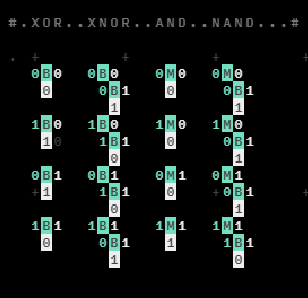
@rRr No, you don’t need to change, they both have pretty much feature parity in terms of basic operators. Pick whichever you feel most comfortable using. Tic Tac Toe Tic Tac Toe(using Vacuum’s lock-picking pattern) Bad Apple In an incredible tour de force, @vacuumbeef implemented Bad Apple in Orca A tiny extra omiindustriies figured out that the default B behavior is actually a XOR, and that M is a AND gate.
@neauoire the experiments with making a Turing machine in orca were definitely on my mind! And neural networks merge with CAs inti neural CAs, so yeah, it’s there.
Thanks for the reference!