 Artyom Bologov
@neauoire are you by any chance aware of some work doing “useful” computation with cellular automatons?
 hairylarry
Now I want to look that up.
wikipedia
In the 1980s, Stephen Wolfram engaged in a systematic study of one-dimensional cellular automata, or what he calls elementary cellular automata; his research assistant Matthew Cook showed that one of these rules is Turing-complete.
I find that interesting. They also cover toroidal cellular automata which are actually easier to define the rectangular cellular automata.
part1
part 2
von Neumann came to realize the great difficulty of building a self-replicating robot
Again interesting.
Ulam and von Neumann created a method for calculating liquid motion in the late 1950s.
Are there 3 dimensional cellular automata? n dimensional?
Also in 1969 computer scientist Alvy Ray Smith completed a Stanford PhD dissertation on Cellular Automata Theory, the first mathematical treatment of CA as a general class of computers.
part 3
The Game of Life can emulate a universal Turing machine.
Biology
Several biological processes or phenomena can be simulated using cellular automata.
Chemistry
The Belousov–Zhabotinsky reaction is a spatio-temporal chemical oscillator that can be simulated by means of a cellular automaton.
Physics
Probabilistic cellular automata are used in statistical and condensed matter physics to study phenomena like fluid dynamics and phase transitions.
Fascinating
@aartaka I was thinking about some applications in using it to generate mazes, or carving out naturalistic spaces and applying multistate CAs. Things like Markov Junior.
If we broaden things, CAs can be model as rewriting rules in 2D space. @noa has done some cool work here and has even show cased whole games. Now that I am recalling more examples, a very direct example is pong with CAs
@aartaka if midi information as output is valid, and you consider orca a CA, then I'd say yes, it's very useful. It's likely the most efficient UX in terms of density for livecoding beating 1d textual representation. And it allows for the encoding of data in a very dense way.
https://llllllll.co/t/orca-livecoding-tool/17689/2296
Someone else mentioned wireworld which works the same way, if you use the edge of the world as IO
https://www.youtube.com/watch?v=m5kT47US7ek
Neural nets are not too far from cellular automata too, only they don't map to a rigid grid. But for tasks that aren't sequential, or can be distributed, CA are very efficient, think of Green Arrays for example.
https://wiki.xxiivv.com/site/neural_nets.html
You can also consider the memory model behind BQN and APL as CA, as state changes on memory is applied non-deterministically.
https://mlochbaum.github.io/BQN/commentary/why.html
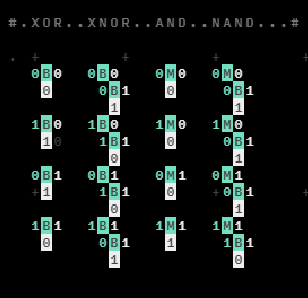
@rRr No, you don’t need to change, they both have pretty much feature parity in terms of basic operators. Pick whichever you feel most comfortable using. Tic Tac Toe Tic Tac Toe(using Vacuum’s lock-picking pattern) Bad Apple In an incredible tour de force, @vacuumbeef implemented Bad Apple in Orca A tiny extra omiindustriies figured out that the default B behavior is actually a XOR, and that M is a AND gate.
@neauoire the experiments with making a Turing machine in orca were definitely on my mind! And neural networks merge with CAs inti neural CAs, so yeah, it’s there.
Thanks for the reference!
am not neauoire, but in my experience cellular automata is very useful for simulating physical processes
aside from the usual falling sand stuff, I've also used it to simulate cloud formation
code: https://codeberg.org/notchoc/deluge-domain/src/branch/main/cloudsim/main.tal
sim: https://codeberg.org/notchoc/deluge-domain/src/branch/main/cloudsim.rom
result: https://codeberg.org/notchoc/deluge-domain/src/branch/main/Clouds.rom
quite a few papers on the topic if you're interested ^^
 ... and and and and ...
 WimⓂ️
WimⓂ️ Kapunta
 Devine Lu Linvega
 notchoc
 pat
pat
 Normal Mode