This year's April Fool's Day science papers are coming online.

First, from our favorite astrophysicist @sundogplanets

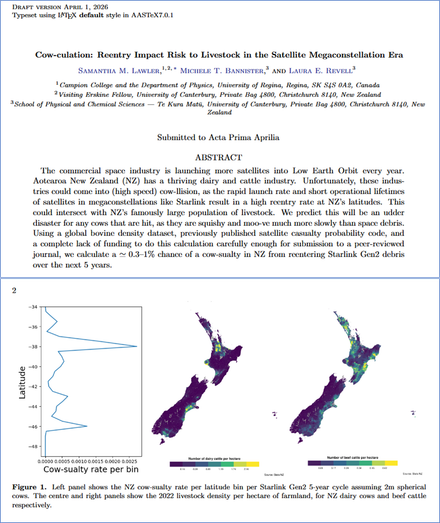
1. Cow-culation: Reentry Impact Risk to Livestock in the Satellite Megaconstellation Era

... is launching more satellites into LEO every year.
This could intersect with NZ’s famously large population of livestock. We predict this will be an udder disaster for any cows that are hit, as they are squishy and moo-ve much more slowly than space debris.
https://arxiv.org/abs/2603.29324
1/n

April 1 paper 2.

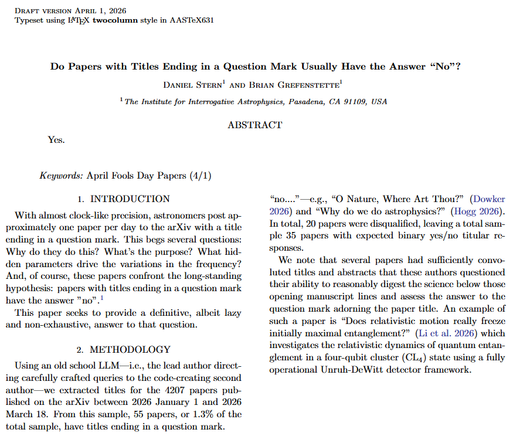
2. Do Papers with Titles Ending in a Question Mark Usually Have the Answer “No”?

With almost clock-like precision, astronomers post approx one paper per day to the arXiv with a title ending in a question mark.

This begs several questions:
Why do they do this? What’s the purpose? What hidden parameters drive the variations in the frequency?
🤔

https://arxiv.org/abs/2603.29936
2/n

April 1 paper 3.

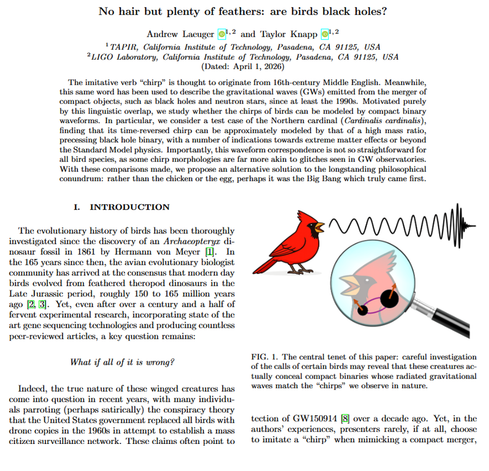
3. No hair but plenty of feathers: are birds black holes?

The imitative verb “chirp” is thought to originate from 16th-century Middle English. Meanwhile, this same word has been used to describe the gravitational waves emitted from the merger of compact objects, such as black holes and neutron stars. Motivated purely by this linguistic overlap, we study whether the chirps of birds can be modeled by compact binary waveforms.

https://arxiv.org/abs/2603.29064
3/n

April 1 paper 4.

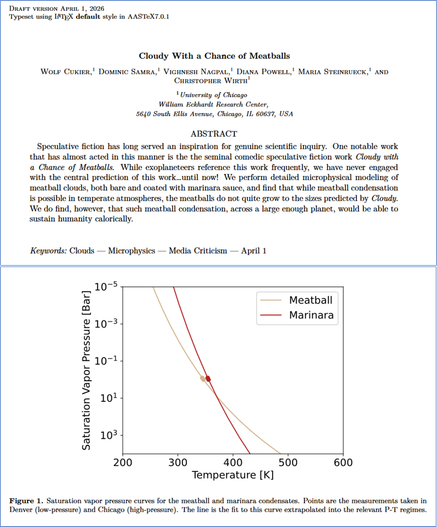
4. Cloudy With a Chance of Meatballs

None of these works have addressed the obvious question: could meatballs condense in, and then rain out of, exoplanet atmospheres?

We seek to right this catastrophic failure of the exoplanet field by running detailed microphysical models to understand the planetary conditions which give rise to meatball precipitation, as well as characterizing what that precipitation might look like.
🌨️ 😋
4/n

April 1 paper 5.

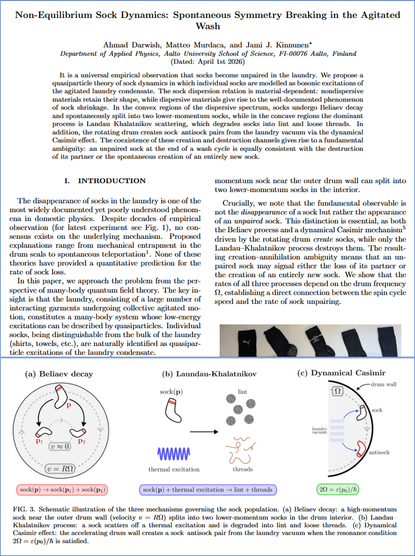
5. Non-Equilibrium Sock Dynamics: Spontaneous Symmetry Breaking in the Agitated Wash

On the basis of these findings, we offer the following practical recommendations for extending sock lifetime:
use synthetic socks with a nondispersive spectrum,
wash at low temperatures to suppress the Landau–Khalatnikov channel, and
select a low spin speed to remain below the Casimir resonance.
🧦 🤣
https://arxiv.org/abs/2603.29650
5/n

Additional creative April 1 papers can be found -
- in the replies section below
- at https://arxiv.org/list/astro-ph/recent?skip=0&show=50
- and at https://www.actaprimaaprilia.com/2026-issue

6/n

Astrophysics

@AkaSci
👆 Attn: @MarcAbrahams
Your time of year — reproducible like a broken analog clock.
@AkaSci Deep down, they want to be newspaper editors.

@AkaSci
Where to Search For Life: Evidence from narrative sources with established predictive efficacy
https://arxiv.org/abs/2603.28883

This paper proposes we analyze all galaxy names found in science fiction to gather statistical data to inform our search for extraterrestrial life

Where to Search For Life: Evidence from narrative sources with established predictive efficacy

The search for habitable planets, and even for ``Earth 2.0'', is a major driver in contemporary astronomy. However selecting target fields to prioritise for such searches presents a challenge. Here we establish a statistical analysis of the appearance of constellation names in science fiction magazines of the pulp era, evaluating the most commonly mentioned constellations and thus those which the science fiction community collectively identify as the most likely locations to find life. Given that the predictive power of science fiction is well established, we suggest that these locations might be prioritised by searches for extrasolar biospheres.

arXiv.org

@AkaSci
Declarative bespoke modelling: A new approach
https://arxiv.org/pdf/2603.28847

Modeling complex systems is hard and uses a lot of energy. What if we trashed the complex models and created new simple ones like x = y? By assigning x, we could immediately output the model answer y while also reducing all associated carbon emissions to nearly zero!

@AkaSci
Plan 9: Detecting Atmospheric Deterrence Against Interstellar Monsters
https://arxiv.org/abs/2603.28895

Injecting garlic, silver, and sulphur into our atmosphere to protect us from space vampires, space werewolves, and other interstellar threats with sensitive noses

Plan 9: Detecting Atmospheric Deterrence Against Interstellar Monsters

Exoplanet atmospheres are usually discussed as tracers of climate, chemistry, and habitability, but they may also preserve signatures of planetary defense. We consider three folklore-motivated deterrents against monsters: reduced organosulfur gases as anti-hematophage repellents, argentiferous reflective aerosols as anti-lycanthropic countermeasures, and haline aerosols as a counting problem for specters. We show that globally-mixed garlic-smelly levels of DMS/DMDS could produce observable mid-infrared transmission features, that silver hazes would show up as anomalous optical brightening, and that sea-salt lofting sustained by strong near-surface winds appears as muted spectra. None of these signatures is unique, which is precisely the observational challenge. A defended world may first appear merely sulfur-rich, bright, or hazy. Therefore, some atmospheres may encode not only biosignatures, but also evidence that the local biosphere has stopped being afraid of the dark.

arXiv.org

@AkaSci
Sugar Rush: Improving Observing Productivity via Night Dessert

https://arxiv.org/abs/2603.28915

A chocolate chip cookie recipe for combatting late night observing sleepies

Sugar Rush: Improving Observing Productivity via Night Dessert

Exhaustion and brain fog during long nights observing is common, but can be ameliorated by raising one's blood sugar. In this white paper, we present a prototype method for facilitating a sugar rush during late-night crashes, which has the potential to boost observing productivity.

arXiv.org

@AkaSci
New Paradigms in Pasta: Introducing GFpastamarkers for Enhanced Inclusivity and Productivity
https://arxiv.org/abs/2603.28957

Using pictures of pasta in data plots will make papers more concise and readable

New Paradigms in Pasta: Introducing $\mathtt{GF \ pastamarkers}$ for Enhanced Inclusivity and Productivity

Informative data visualization methods are key to the clear and efficient communication of myriad forms of data. The PASTA Collaboration has made substantial contributions to the field of data visualization through $\mathtt{pastamarkers}$, a Python-based package that utilizes various types of pasta as data markers to create engaging plots. This work introduces $\mathtt{GF \ pastamarkers}$, an extension of $\mathtt{pastamarkers}$ that utilizes the tenuous structure of gluten free (GF) pasta to meet the needs of the GF population. The implementation of $\mathtt{GF \ pastamarkers}$ employs an exponential crumbling factor ($CF$), which benefits authors by encouraging clearer and more concise scientific articles, thereby leading to more effective manuscripts and proposals.

arXiv.org

@AkaSci
On The Detection of Digiorno-like Objects in the Flavor Zone
https://arxiv.org/abs/2603.28977

Searching for frozen pizza in space

On The Detection of Digiorno-like Objects in the Flavor Zone

Aims: This work proposes a new SETI search methodology under the assumption that a sufficiently advanced civilization could skip the middle man of converting starlight to energy to food preparation, and could directly harness their star's energy for food prep. Methods: We define the concept of the Flavor Zone (FZ): the optimal distance from a star for cooking food. To develop this definition we propose the toy model of a Digiorno-Like Object (DLO) and define the FZ as the regime for optimal cooking according to package directions. We examine the effect of orbit on DLO cooking times and paradigms. Finally, we study the feasibility of detection of DLOs in their FZs with current technology. Results: We determined that DLOs aren't detectable with current technology nor should anyone ever try.

arXiv.org

@AkaSci
Schrödinger's Seed: Purr-fect Initialization for an Impurr-fect Universe
https://arxiv.org/abs/2603.29115

Prooving how we must turn to cats as the source all knowledge instead of adopting baseless numbers like 42, 67, and 69.

Schrödinger's Seed: Purr-fect Initialization for an Impurr-fect Universe

Context. Random seed selection in deep learning is often arbitrary -- conventionally fixed to values such as 42, a number with no known feline endorsement. Aims. We propose that cats, as liminal beings with a historically ambiguous relationship to quantum mechanics, are better suited to this task than random integers. Methods. We construct a cat-driven seed generator inspired by the first Friedmann equation, and test it by mapping 21 domestic cats' physical properties -- mass, coat pattern, eye colour, and name entropy -- via a Monte ``Catlo'' sampling procedure. Results. Cat-driven seeds achieve a mean accuracy of 92.58%, outperforming the baseline seed of 42 by $\sim$2.5%. Cats from astrophysicist households perform marginally better, suggesting cosmic insight may be contagious. Conclusions. The Universe responds better to cats than to arbitrary integers. Whether cats are aware of this remains unknown.

arXiv.org

@AkaSci
A Lower Bound on the Number of Fundamental Constants
https://arxiv.org/abs/2603.29300

Incomplete determination of the minimum number of numbers required to describe the universe. Result is indeterminate

A Lower Bound on the Number of Fundamental Constants

We describe here, for the first time, a lower bound on the total number of fundamental constants required for a mathematical description of our physical universe to be complete. The answer is shown to be one. The formal arithmetized meta-mathematical proof of this is left to the reader.

arXiv.org

@AkaSci
The Universe Favors Primes: A Study in the Primality of Cosmic Structures
https://arxiv.org/abs/2603.29321

Proving that the universe likes prime numbers more than it likes unicorns

The Universe Favors Primes: A Study in the Primality of Cosmic Structures

The cosmological principle states that the universe is uniform and does not favor any specific position or direction. However, research conducted by \cite{Shen2025} has revealed that the universe demonstrates a notable inclination towards parity-odd states. Furthermore, it remains uncertain whether the universe also favors prime numbers. In this study, we examine the largest available catalogs of galaxy groups to investigate this hypothesis. Specifically, we assess whether the number of galaxies within a galaxy group or cluster is more likely to be a prime number. Our results strongly suggest that the universe does indeed have a preference for prime numbers, with findings exceeding the 4.1 sigma significance threshold. This insight explains why the Primes consistently triumphs over Unicorn. Consequently, it may be necessary to consider revising the cosmological principle in the context of a higher-dimensional feature space. Moreover, our research establishes a connection between the Riemann Zeta function and cosmology pioneeringly, paving the way for the development of Cosmozetaology.

arXiv.org

@AkaSci
An innovative alternative to traditional funding streams for extragalactic astronomy
https://arxiv.org/abs/2603.29340

We're starting a block chain cryptocurrency to turn spectral analyses into money

An innovative alternative to traditional funding streams for extragalactic astronomy

With traditional sources of funding for astronomical research under increasing pressure, it is timely to explore innovative alternative mechanisms. We therefore introduce GalaxyCoin, a novel cryptocurrency whose issuance, validation, and economic evolution are anchored to real astrophysical objects - galaxies. GalaxyCoin links digital scarcity to observational astronomy by using galaxy catalogues to parametrise token generation, distribution, and long-term supply growth, providing a transparent, immutable, and independently verifiable foundation for the currency. We present the conceptual design of GalaxyCoin, highlight its potential advantages over conventional cryptocurrencies, and examine its broader implications for sustainability, trust, and public engagement at the intersection of astronomy, data-driven science, and blockchain technology. A central feature of GalaxyCoin is that it directly incentivises the discovery and spectroscopic confirmation of galaxies, aligning financial reward with the production of high-quality astronomical data. In terms of monetary design, its supply elasticity lies between that of fiat currencies and fixed-supply cryptocurrencies, making it distinctive in both economic structure and scientific purpose.

arXiv.org

@AkaSci
StarHash: unique, memorable, and deterministic names for astronomical objects
https://arxiv.org/abs/2603.29584

Star names are boring. Let's use this random name generator instead

StarHash: unique, memorable, and deterministic names for astronomical objects

The naming of astronomical objects has represented among the most significant challenges in the record-keeping of the field since the very beginning. Long and unwieldy coordinate names, uninformative and ambiguous internal names, and the sheer volume of aliases accumulated for some of the most studied objects conspire to complicate our study of the celestial sphere. This paper proposes StarHash, a reproducible, open-source astronomical naming scheme based on the terrestrial concept of geohashing, but re-implemented from the ground up for the rigorous demands of astronomy. Every 3.2 arcsec patch of sky now has three words associated with it, enabling the precise localisation of astronomical sources, and an easily communicable and memorable identifier. A carefully selected wordlist reduces ambiguity due to plurals and homophones, whilst the use of format-preserving encryption minimises residual spatial correlation in StarHash-derived identifiers. Pre-computed names for several existing catalogues are provided, alongside a Python reference implementation for validation and integration into databases, transient brokers, and other similar projects. Although not intended to be the final word in the naming of astronomical objects, StarHash humbly provides a memorable alternative to the status quo, and is intended to spark a discussion about this most foundational of issues in astronomy.

arXiv.org

@AkaSci
Antimatter Propulsion for Interstellar Travel via Positron Production from Potassium-40 Rich Biological Matter
https://arxiv.org/abs/2603.29635

Using bananas for interstellar travel

Antimatter Propulsion for Interstellar Travel via Positron Production from Potassium-40 Rich Biological Matter

Anitmatter-based propulsion is often cited as a physically plausible route to relativistic interstellar travel, and thus as a potential mechanism by which technologically advanced civilizations could expand throughout the galaxy. Its difficulty may be central to the resolution of Fermi's paradox. Since the Universe should be teaming with advanced technological life, yet we see none, it may be that interstellar travel is simply too difficult. It has been suggested that the main difficulty with using antimatter as propulsion is its limited availability, assuming it must be artificially manufactured. In this paper, we demonstrate that naturally occurring potassium 40 - rich biological matter (specifically bananas) is a promising, overlooked antimatter source for interstellar propulsion.

arXiv.org

@AkaSci
First Detection of Exoplanetary Cannabinoids: Evidence for THC and CBD in the Atmosphere of K2-18b
https://arxiv.org/abs/2603.29700

We found pot in space

First Detection of Exoplanetary Cannabinoids: Evidence for THC and CBD in the Atmosphere of K2-18b

We report the first unambiguous detection of cannabinoid molecules in an exoplanetary atmosphere. Using 420 hours of JWST observations combining NIRSpec and MIRI instruments, we identify spectroscopic signatures of tetrahydrocannabinol (THC; $Δ^9$-C$_{21}$H$_{30}$O$_2$) and cannabidiol (CBD; C$_{21}$H$_{30}$O$_2$) in the transmission spectrum of the temperate sub-Neptune K2-18b. The THC feature at 2.42~$μ$m is detected at 9.2$σ$ significance, while CBD absorption at 3.69~$μ$m reaches 7.8$σ$. We additionally report a mysterious feature at exactly 4.20~$μ$m detected at 4.20$σ$ (the probability of this coincidence is discussed extensively). Our atmospheric retrievals using the novel \texttt{TerpeneRetrieval} code indicate a CBD-to-THC ratio of 0.40$\pm$0.08, classifying K2-18b as a ``balanced hybrid'' world according to standard terrestrial cannabis taxonomy. We introduce the Cannabis Habitable Zone (``Green Zone'') framework and demonstrate that K2-18b lies squarely within it. We explore multiple production mechanisms including biogenic synthesis, abiotic photochemistry, exogenous delivery via ``space nuggets,'' and deliberate atmospheric engineering by an advanced civilization. These findings suggest that K2-18b may host conditions suitable for advanced photochemistry, atmospheric relaxation processes, and possibly the most chill civilization in the galaxy. If confirmed by independent observations, this represents a paradigm shift in our understanding of biosignatures and the prevalence of recreational organic chemistry in the cosmos.

arXiv.org

@AkaSci
Cloudy With a Chance of Meatballs
https://arxiv.org/abs/2603.29883

Analyzing the physics of meatball condensation

Cloudy With a Chance of Meatballs

Speculative fiction has long served an inspiration for genuine scientific inquiry. One notable work that has almost acted in this manner is the the seminal comedic speculative fiction work Cloudy with a Chance of Meatballs. While exoplaneteers reference this work frequently, we have never engaged with the central prediction of this work... until now! We perform detailed microphysical modeling of meatball clouds, both bare and coated with marinara sauce, and find that while meatball condensation is possible in temperate atmospheres, the meatballs do not quite grow to the sizes predicted by Cloudy. We do find, however, that such meatball condensation, across a large enough planet, would be able to sustain humanity calorically.

arXiv.org

@AkaSci
A Therapy Session with Sgr A*
https://arxiv.org/abs/2603.29963

Interviewing the black hole at the center of our galaxy

A Therapy Session with Sgr A*

The nature of Sagittarius A* (Sgr A*) has been the subject of intense study and debate for over half a century. Herein, we present the first successful interview with an astrophysical object, exploring the perspective of this supermassive black hole and, in doing so, challenging the traditional observational paradigm of astrophysics. Rather than treating astrophysical systems as purely passive entities characterized through indirect measurements, we introduce an interaction-based framework via a therapeutic-style interview enabled by the ARMCHAIR communication methodology. Using structured, psychotherapeutic dialogue, we probe Sgr A*'s responses to key aspects of its astrophysical characterization, including eating habits, its name, and concerns about privacy. These exchanges offer an alternative lens through which to interpret familiar observational phenomena. This work highlights potential limitations in strictly reductionist approaches and suggests a modest expansion of standard astrophysical methodology to leave room for considering how the objects we study might feel about the attention they receive.

arXiv.org
@AkaSci very good @sundogplanets, very good 👏👏👏👏👏