 surprisetalk
OpenAI closes funding round at an $852B valuation
https://openai.com/index/accelerating-the-next-phase-ai
https://www.cnbc.com/2026/03/31/openai-funding-round-ipo.html
OpenAI closes funding round at an $852B valuation
https://openai.com/index/accelerating-the-next-phase-ai
https://www.cnbc.com/2026/03/31/openai-funding-round-ipo.html
No, they didn't raise $122B as the HN title implies. A big chunk of that $122B is a "maybe" that depends on various things that need to happen in the future.
Oh, man... I can't wait to see where this is going. Might not be pretty after all.
That’s logically inconsistent. If the company was performing poorly enough that they couldn’t meet their funding milestones from a previous round, they’re not going to have an easy time raising the same money in a future round.
The milestones aren’t a hard-stop that forbids the previous funding round participants from providing the money if they still choose. It’s just an out.
Note that even that "money in the bank" of traditional venture firm is not really money in the bank. VC, PE, and hedge fund managers usually don't have all the cash for the fund sitting in the bank at all times. Rather, their agreement with the LPs that fund the fund is structured as a series of capital calls: it gives the fund the right to demand that their LPs deposit cash in their bank accounts within 10-30 days, which can then be used to fund the investments that the VC firm makes. The capital calls are backed by legal documents enforceable in court, with pretty stiff penalties for failing to meet a capital call.
Such a funding structure here isn't all that different: the funding agreement gives OpenAI the right to call on their backers to make certain cash deposits, contingent upon milestones being met. Deep down inside, "money in the bank" doesn't actually exist, it's just mutual agreements backed by force of law.
The funds are committed under the terms of the deal (share price, things like board seats, and other details). There are legal obligations to provide it.
This is a common structure for large investments. It would be really inefficient for all of these investors and companies to have to have the money sitting in cash to do a deal and then transfer it into the company's bank where it sits and earns interest for years until they can deploy it.
Even VC firms who raise funds work this way. The capital is "committed" but investors don't wire all of the money over right away so it can sit in the VC firm's bank accounts, waiting. The VCs do what's called a "capital call" through which they're legally bound to provide the money they committed when requested, under the terms of the deal.
One of the stipulations is that OpenAI achieves "AGI"... Need I say more?
Also a lot of this "money" is in cloud compute and credits not cash so...
Their ~$50 million total Alibaba investment turned into ~$70 billion. As of two years ago they were still liquidating out of it.
January 26, 2024 - "Japanese investment holding firm SoftBank Group Corp has largely cleared its ownership in e-commerce giant Alibaba Group Holding, concluding one of the most successful deals in China's internet industry and a holding that spanned about 23 years."
"SoftBank, which invested US$20 million into Alibaba when it was still a start-up in 2000, said in a corporate filing on Thursday that it was set to book a gain of 1.26 trillion yen (US$8.5 billion) - about 425 times the value of its initial outlay - for the Tokyo-based firm's 2024 financial year after divesting its [remaining] shares via subsidiary Skybridge."
https://finance.yahoo.com/news/japans-softbank-concludes-run...
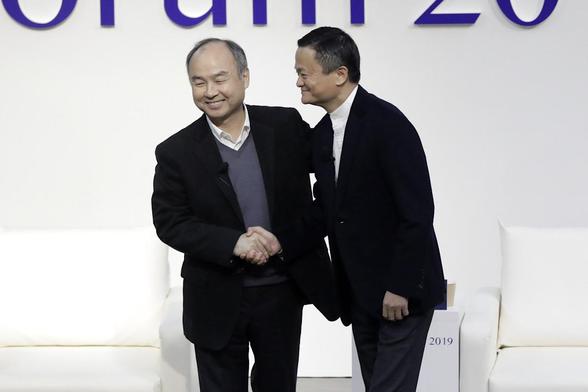
Japanese investment holding firm SoftBank Group Corp has largely cleared its ownership in e-commerce giant Alibaba Group Holding, concluding one of the most ...
I've wondered how many announced fundraising rounds were like this. It's in everyone's interest (VCs and entrepreneurs) if the message to the outside world is "this company is amazing so they've raised a boatload of cash". But VCs might not want to give it all up front, or unconditionally.
It makes it hard to say what the valuation of a company is. If the milestones are unlikely to be hit, then it's anyone's guess.
